
Title
Geometrical Landscapes: The Voyages of Discovery and the Transformation of Mathematical Practice (Writing Science),Used
Sold by Ergodebooks, an authorized reseller.
Returns accepted within 30 days | support@ergodebooks.com
Shipping Information
- Free Standard Shipping — United States only
- Processing Time: 3–5 business days
- Estimated Delivery: 6–10 business days after dispatch
- Double-boxed, fully insured & discreetly packaged
- Tracking number sent via email once dispatched
Returns & Refund
Returns accepted within 30 days of delivery.
Damaged or Defective Item
Free return shipping + replacement or full refund
Wrong Item Received
Free return shipping + replacement or full refund
Change of Mind
Return shipping at customer's expense · 25% restocking fee applies
Payment Option

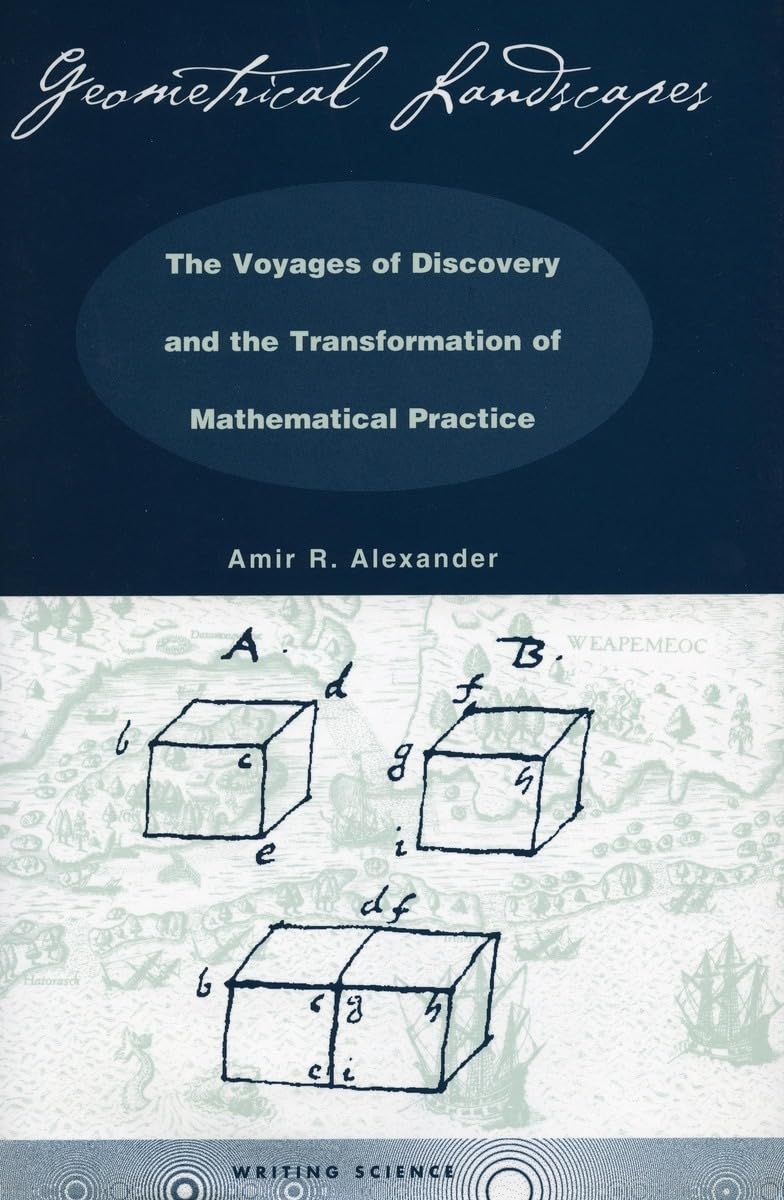
This challenging book argues that a new way of speaking of mathematics and describing it emerged at the end of the sixteenth century. Leading mathematicians like Hariot, Stevin, Galileo, and Cavalieri began referring to their field in terms drawn from the exploration accounts of Columbus and Magellan. As enterprising explorers in search of treasures of knowledge, these mathematicians described themselves as sailing the treacherous seas of mathematics, facing shipwreck on the shoals of paradox, and seeking shelter and refuge on the shores of geometrical demonstrations. Mathematics, formerly praised for its logic, clarity, and inescapable truths, was for them a hazardous voyage in inhospitable geometrical lands. Significantly, many of the same practitioners who promoted the vision of mathematics as heroic exploration also played central roles in developing the most important mathematical innovation of the periodthe infinitesimal methods. This was no coincidence: the heroic tales of exploration and discovery helped shape a new form of mathematical practice, complete with new questions, new acceptable answers, and new standards of evidence. It was this new vision of mathematics as a grand adventure that allowed for the development of the new techniques that led to the Newtonian calculus. In demonstrating this, the book moves from real voyages to imaginary ones, from the coasts of the Canadian Arctic to the tropical forests of Guyana, and from the inner structure of matter to the intricacies of the mathematical continuum. Throughout, a common rhetoric and imagery of exploration and discovery run like a thread through these diverse elements and bind them together.
⚠️ WARNING (California Proposition 65):
This product may contain chemicals known to the State of California to cause cancer, birth defects, or other reproductive harm.
For more information, please visit www.P65Warnings.ca.gov.