
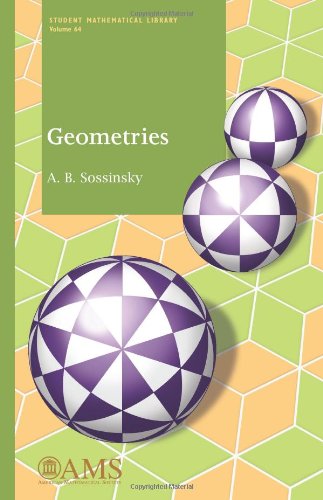
Title

Geometries (Student Mathematical Library) (Student Mathematical Library, 64),Used
Sold by Ergodebooks, an authorized reseller.
Returns accepted within 30 days | support@ergodebooks.com
Shipping Information
- Free Standard Shipping — United States only
- Processing Time: 3–5 business days
- Estimated Delivery: 6–10 business days after dispatch
- Double-boxed, fully insured & discreetly packaged
- Tracking number sent via email once dispatched
Returns & Refund
Returns accepted within 30 days of delivery.
Damaged or Defective Item
Free return shipping + replacement or full refund
Wrong Item Received
Free return shipping + replacement or full refund
Change of Mind
Return shipping at customer's expense · 25% restocking fee applies
Payment Option

The book is an innovative modern exposition of geometry, or rather, of geometries; it is the first textbook in which Felix Klein's Erlangen Program (the action of transformation groups) is systematically used as the basis for defining various geometries. The course of study presented is dedicated to the proposition that all geometries are created equalalthough some, of course, remain more equal than others. The author concentrates on several of the more distinguished and beautiful ones, which include what he terms "toy geometries", the geometries of Platonic bodies, discrete geometries, and classical continuous geometries. The text is based on firstyear semester course lectures delivered at the Independent University of Moscow in 2003 and 2006. It is by no means a formal algebraic or analytic treatment of geometric topics, but rather, a highly visual exposition containing upwards of 200 illustrations. The reader is expected to possess a familiarity with elementary Euclidean geometry, albeit those lacking this knowledge may refer to a compendium in Chapter 0. Per the author's predilection, the book contains very little regarding the axiomatic approach to geometry (save for a single chapter on the history of nonEuclidean geometry), but two Appendices provide a detailed treatment of Euclid's and Hilbert's axiomatics. Perhaps the most important aspect of this course is the problems, which appear at the end of each chapter and are supplemented with answers at the conclusion of the text. By analyzing and solving these problems, the reader will become capable of thinking and working geometrically, much more so than by simply learning the theory. Ultimately, the author makes the distinction between concrete mathematical objects called "geometries" and the singular "geometry", which he understands as a way of thinking about mathematics. Although the book does not address branches of mathematics and mathematical physics such as Riemannian and Khler manifolds or, say, differentiable manifolds and conformal field theories, the ideology of category language and transformation groups on which the book is based prepares the reader for the study of, and eventually, research in these important and rapidly developing areas of contemporary mathematics.
⚠️ WARNING (California Proposition 65):
This product may contain chemicals known to the State of California to cause cancer, birth defects, or other reproductive harm.
For more information, please visit www.P65Warnings.ca.gov.