
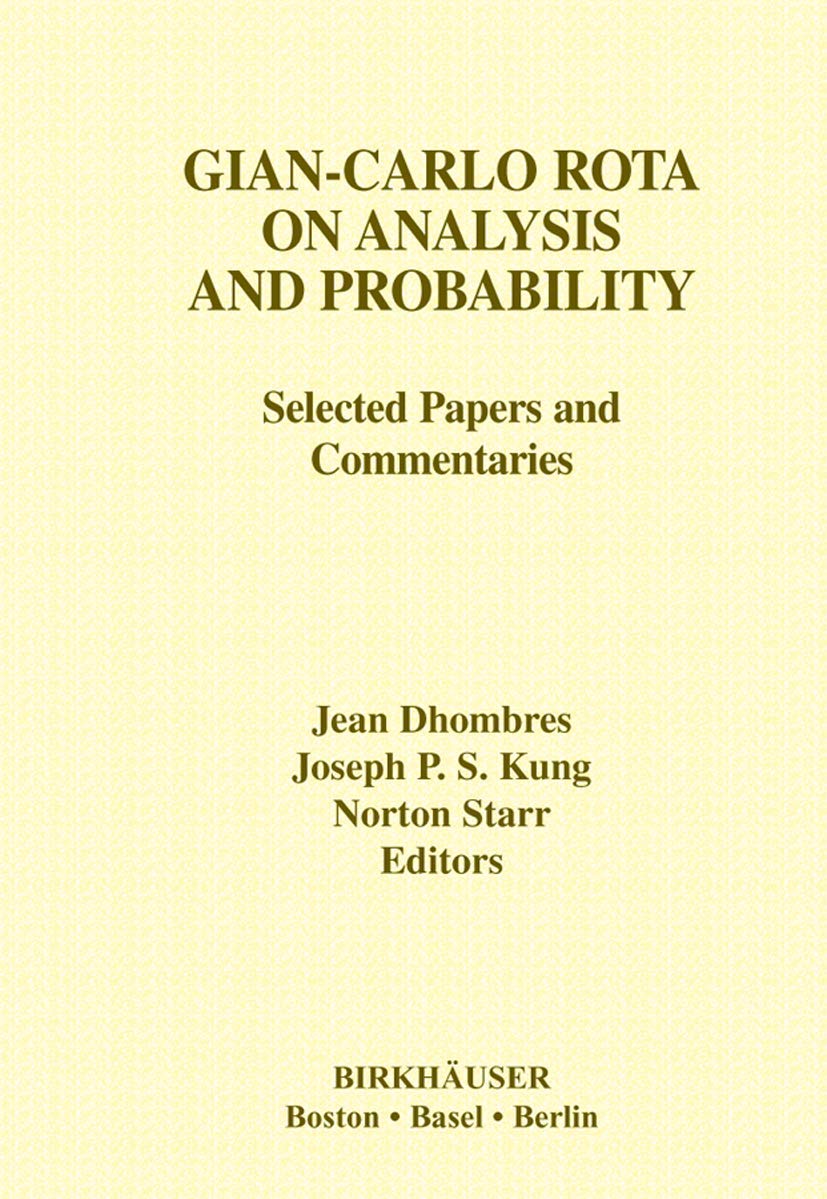
Title
Giancarlo Rota On Analysis And Probability,Used
Sold by Ergodebooks, an authorized reseller.
Returns accepted within 30 days | support@ergodebooks.com
Shipping Information
- Free Standard Shipping — United States only
- Processing Time: 3–5 business days
- Estimated Delivery: 6–10 business days after dispatch
- Double-boxed, fully insured & discreetly packaged
- Tracking number sent via email once dispatched
Returns & Refund
Returns accepted within 30 days of delivery.
Damaged or Defective Item
Free return shipping + replacement or full refund
Wrong Item Received
Free return shipping + replacement or full refund
Change of Mind
Return shipping at customer's expense · 25% restocking fee applies
Payment Option

GianCarlo Rota was born in Vigevano, Italy, in 1932. He died in Cambridge, Mas sachusetts, in 1999. He had several careers, most notably as a mathematician, but also as a philosopher and a consultant to the United States government. His mathe matical career was equally varied. His early mathematical studies were at Princeton (1950 to 1953) and Yale (1953 to 1956). In 1956, he completed his doctoral thesis under the direction of Jacob T. Schwartz. This thesis was published as the pa per 'Extension theory of differential operators I', the first paper reprinted in this volume. Rota's early work was in analysis, more specifically, in operator theory, differ ential equations, ergodic theory, and probability theory. In the 1960's, Rota was motivated by problems in fluctuation theory to study some operator identities of Glen Baxter (see [7]). Together with other problems in probability theory, this led Rota to study combinatorics. His series of papers, 'On the foundations of combi natorial theory', led to a fundamental reevaluation of the subject. Later, in the 1990's, Rota returned to some of the problems in analysis and probability theory which motivated his work in combinatorics. This was his intention all along, and his early death robbed mathematics of his unique perspective on linkages between the discrete and the continuous. Glimpses of his new research programs can be found in [2,3,6,9,10].
⚠️ WARNING (California Proposition 65):
This product may contain chemicals known to the State of California to cause cancer, birth defects, or other reproductive harm.
For more information, please visit www.P65Warnings.ca.gov.