
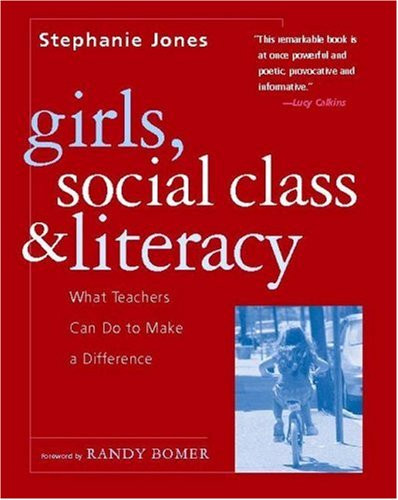
Title
Girls, Social Class, and Literacy: What Teachers Can Do to Make a Difference,Used
Sold by Ergodebooks, an authorized reseller.
Returns accepted within 30 days | support@ergodebooks.com
Shipping Information
- Free Standard Shipping — United States only
- Processing Time: 3–5 business days
- Estimated Delivery: 6–10 business days after dispatch
- Double-boxed, fully insured & discreetly packaged
- Tracking number sent via email once dispatched
Returns & Refund
Returns accepted within 30 days of delivery.
Damaged or Defective Item
Free return shipping + replacement or full refund
Wrong Item Received
Free return shipping + replacement or full refund
Change of Mind
Return shipping at customer's expense · 25% restocking fee applies
Payment Option

Using stories from her own life as a girl in a workingpoor family and illuminating narratives from students living in a highpoverty neighborhood, Stephanie introduces readers to critical literacy and equips them with the tools to begin tearing apart stereotypes and creating new understandings about students, families, ourselves, and one another. This remarkable book is at once powerful and poetic, provocative and informative.Lucy Calkins Be prepared to have your heart examined, perhaps bruised, and ultimately strengthened for the social action that is the reason Stephanie teaches and writesand the reason every educator must read this book.Jo Beth Allen, author of Sociocultural Playgrounds: Teacher Research in the Writing Classroom A mustread for teacher study groups preparing to tackle the impact of poverty on elementary education.Barbara Comber, Centre for Studies in Literacy, Policy and Learning Cultures University of South AustraliaGirls, Social Class, and Literacy is a compelling and provocative look at the debilitating effects of classism on young girls, as well as a pragmatic and powerful examination of the transformative effects of sensitive, smart teaching on children whose lives and education are too often a reflection of their economic status. Stephanie Jones shares the insights of a fiveyear study that followed eight workingpoor girls, offering you unusually sharp insight into what its like to be underprivileged in America. With critical literacy as her tool, Jones then helps you peel back your ideas of the poorand of your own studentsto see them, and your role in their lives, more clearly. Just as important, using reading and writing workshop as an instructional framework, she describes how to validate and honor all students realities while cultivating crucial critical literacy skills. Youll find out why giving children the option to find and talk openly about disconnections with childrens literature (as well as connections) and to write on topics of their choosing (even difficult ones) can have a large, positive impact on students as they speak and write about their reality without shame or fear of judgment.As the gap between rich and poor widens in America, more and more children from workingpoor families enter schools. You can make a difference in their lives by rethinking how you look at social class and extending to all children the same opportunities to share their experiences through reading, speaking, and writing. Read Girls, Social Class, and Literacy and ensure that in your classroom the education every student receives is not proportionate to their financial worth, but rather to their human worth.
⚠️ WARNING (California Proposition 65):
This product may contain chemicals known to the State of California to cause cancer, birth defects, or other reproductive harm.
For more information, please visit www.P65Warnings.ca.gov.
- Q: What is the main focus of 'Girls, Social Class, and Literacy'? A: The book examines the effects of classism on young girls and highlights the transformative power of sensitive and informed teaching practices for students from working-poor families.
- Q: Who is the author of this book? A: The author is Stephanie Jones, who shares insights from her five-year study of eight working-poor girls.
- Q: What age group is this book suitable for? A: This book is particularly relevant for educators, teacher study groups, and those interested in the impact of poverty on elementary education.
- Q: How many pages does this book contain? A: The book contains 192 pages.
- Q: What type of binding does this book have? A: The book is available in paperback binding.
- Q: When was 'Girls, Social Class, and Literacy' published? A: The book was published on August 25, 2006.
- Q: Does this book include practical teaching strategies? A: Yes, it provides practical insights and critical literacy strategies to help educators better understand and support their students' diverse backgrounds.
- Q: What key themes are addressed in the book? A: Key themes include classism, critical literacy, and the importance of validating students' experiences through inclusive teaching practices.
- Q: Is this book well-received by educators? A: Yes, it has been praised by educators and experts for its compelling insights and practical applications in the classroom.
- Q: Can this book help in understanding the challenges faced by students from low-income families? A: Absolutely, it offers a deep dive into the realities of underprivileged students and how educators can make a positive impact on their education.