
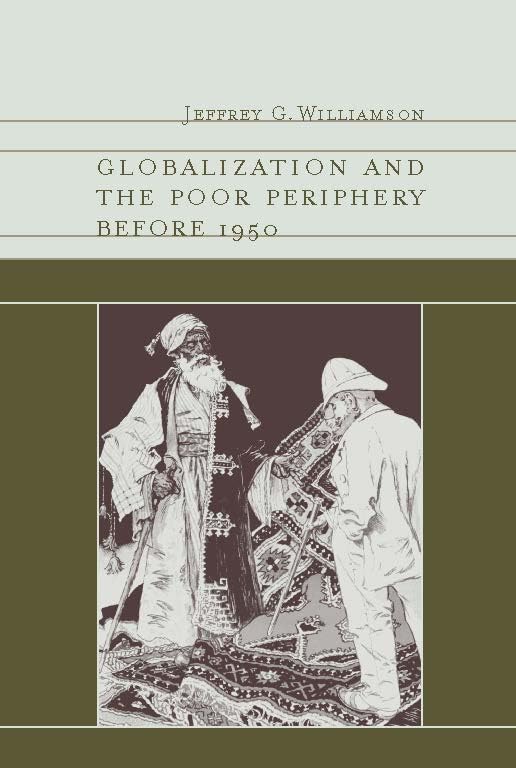
Title
Globalization And the Poor Periphery Before 1950 (THE OHLIN LECTURES),Used
Sold by Ergodebooks, an authorized reseller.
Returns accepted within 30 days | support@ergodebooks.com
Shipping Information
- Free Standard Shipping — United States only
- Processing Time: 1–3 business days
- Estimated Delivery: 3–5 business days after dispatch
- Double-boxed, fully insured & discreetly packaged
- Tracking number sent via email once dispatched
- Orders over $250 require signature upon delivery. Taxes calculated at checkout.
Returns & Refund
Returns accepted within 30 days of delivery.
Damaged or Defective Item
Free return shipping + replacement or full refund
Wrong Item Received
Free return shipping + replacement or full refund
Change of Mind
Return shipping at customer's expense · 25% restocking fee applies
Payment Option

In Globalization and the Poor Periphery before 1950 Jeffrey Williamson examines globalization through the lens of both the economist and the historian, analyzing its economic impact on industrially lagging poor countries in the nineteenth and early twentieth centuries. Williamson argues that industrialization in the core countries of northwest Europe and their overseas settlements, combined with a worldwide revolution in transportation, created an antiglobal backlash in the periphery, the poorer countries of eastern and southern Europe, the Middle East, Africa, Asia, and Latin America.During the "first global century," from about 1820 to 1913, and the antiglobal autarkic interwar period from 1914 to 1940, new methods of transportation integrated world commodity markets and caused a boom in trade between the core and the periphery. Rapid productivity growth, which lowered the price of manufactured goods, led to a soaring demand in the core countries for raw materials supplied by the periphery. When the boom turned into bust, after almost a century and a half, the gap in living standards between the core and the periphery was even wider than it had been at the beginning of the cycle. The periphery, argues Williamson, obeyed the laws of motion of the international economy. Synthesizing and summarizing fifteen years of Williamson's pioneering work on globalization, the book documents these laws of motion in the periphery, assesses their distribution and growth consequences, and examines the response of trade policy in these regions.
⚠️ WARNING (California Proposition 65):
This product may contain chemicals known to the State of California to cause cancer, birth defects, or other reproductive harm.
For more information, please visit www.P65Warnings.ca.gov.