If you have any questions, you are always welcome to contact us. We'll get back to you as soon as possible, withing 24 hours on weekdays.
Customer service
All questions about your order, return and delivery must be sent to our customer service team by e-mail at yourstore@yourdomain.com
Sale & Press
If you are interested in selling our products, need more information about our brand or wish to make a collaboration, please contact us at press@yourdomain.com
Help
If you have any questions, you are always welcome to contact us. We'll get back to you as soon as possible, withing 24 hours on weekdays.
Customer service
All questions about your order, return and delivery must be sent to our customer service team by e-mail at yourstore@yourdomain.com
Sale & Press
If you are interested in selling our products, need more information about our brand or wish to make a collaboration, please contact us at press@yourdomain.com
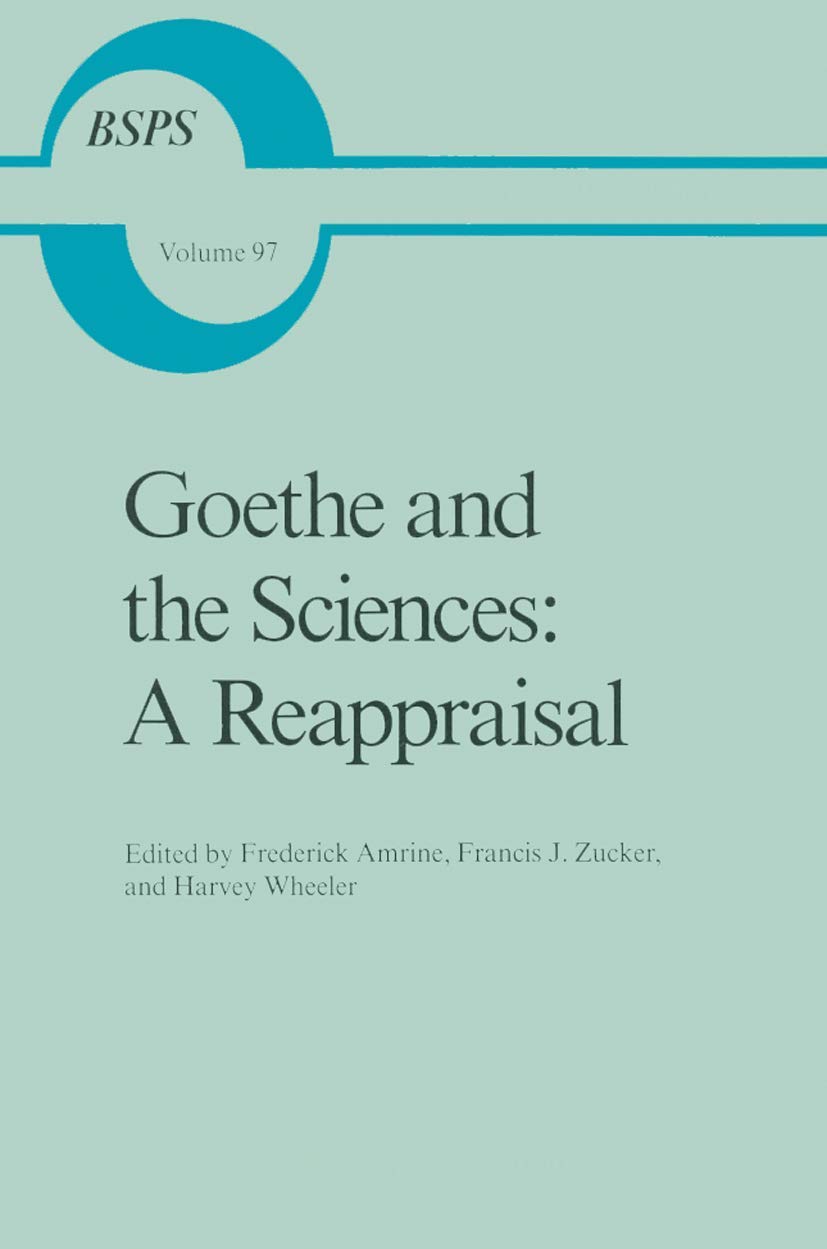
of him in like measure within myself, that is my highest wish. This noble individual was not conscious of the fact that at that very moment the divine within him and the divine of the universe were most intimately united. So, for Goethe, the resonance with a natural rationality seems part of the genius of modern science. Einstein's 'cosmic religion', which reflects Spinoza, also echoes Goethe's remark (Ibid. , Item 575 from 1829): Man must cling to the belief that the incomprehensible is comprehensible. Else he would give up investigating. But how far will Goethe share the devotion of these cosmic rationalists to the beautiful harmonies of mathematics, so distant from any pure and 'direct observation'? Kepler, Spinoza, Einstein need not, and would not, rest with discovery of a pattern within, behind, as a source of, the phenomenal world, and they would not let even the most profound of descriptive generalities satisfy scientific curiosity. For his part, Goethe sought fundamental archetypes, as in his intuition of a Urpjlanze, basic to all plants, infinitely plastic. When such would be found, Goethe would be content, for (as he said to Eckermann, Feb. 18, 1829): . . . to seek something behind (the Urphaenomenon) is futile. Here is the limit. But as a rule men are not satisfied to behold an Urphaenomenon. They think there must be something beyond. They are like children who, having looked into a mirror, turn it around to see what is on the other side.
⚠️ WARNING (California Proposition 65):
This product may contain chemicals known to the State of California to cause cancer,
birth defects, or other reproductive harm.
For MAP (Minimum Advertised Price) violations and Intellectual Property (IP) or Trademark concerns, please contact:
support@ergodebooks.com
⚠️ California Proposition 65 Warning: Some products sold on this website may expose you to chemicals known to the State of California to cause cancer, birth defects, or other reproductive harm. For more information, visit www.P65Warnings.ca.gov.