
Title
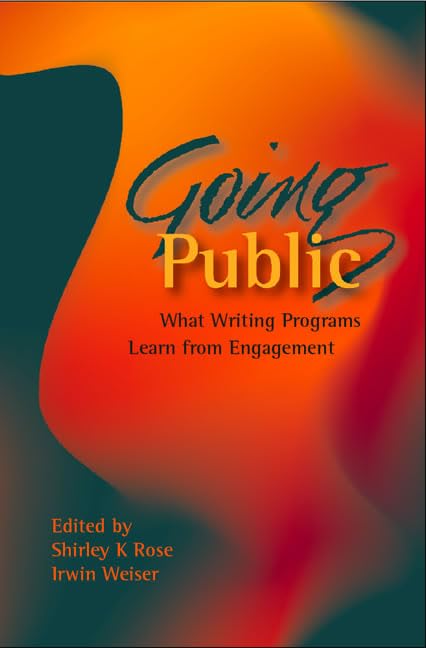
Going Public: What Writing Programs Learn From Engagement,New
Sold by Ergodebooks, an authorized reseller.
Returns accepted within 30 days | support@ergodebooks.com
Shipping Information
- Free Standard Shipping — United States only
- Processing Time: 3–5 business days
- Estimated Delivery: 6–10 business days after dispatch
- Double-boxed, fully insured & discreetly packaged
- Tracking number sent via email once dispatched
Returns & Refund
Returns accepted within 30 days of delivery.
Damaged or Defective Item
Free return shipping + replacement or full refund
Wrong Item Received
Free return shipping + replacement or full refund
Change of Mind
Return shipping at customer's expense · 25% restocking fee applies
Payment Option

An important new resource for WPA preparation courses in rhetoric and composition PhD programs. In Going Public, Rose and Weiser moderate a discussion of the role of the writing program visavis the engagement movement, the service learning movement, and current interest in public discourse/civic rhetoric among scholars of rhetoric and composition. This is a thoughtful collection on the ways that engagementfocused programs may be changing conceptions of WPA identity.As institutions begin to include more explicit engagement with citizen and stakeholder communities as an element of their mission, writing program administrators find themselves with an opportunity to articulate the ways in which writing program goals and purposes significantly contribute to achieving these new institutional goals. Writing programs are typically situated at points where students make the transition from community to college (e.g., firstyear composition) or from college to community (e.g. professional writing), and are already dedicated to developing literacies that are critically needed in communities.In Going Public, Rose and Weiser locate their discussion in the context of three current conversations in higher education: 1) the engagement movement, particularly as this movement serves to address and respond to calls for greater accountability to broader publics; 2) recent interest in public discourse/civic rhetoric among scholars of rhetorical history and contemporary rhetorical theory; 3) the service learning movement in higher education, especially the ways in which college and university writing programs have contributed to this movement.While there have been a number of publications describing servicelearning and community leadership programs, most of these focus on curricular elements and address administrative issues, if at all, primarily from a curricular perspective. The emphasis of the current book is on the ways that engagementfocused programs change conceptions of WPA identity. Going Public, then, is not only a significant contribution to the scholarly literature, but also supplies an important new resource for WPA preparation courses in rhetoric and composition PhD programs.
⚠️ WARNING (California Proposition 65):
This product may contain chemicals known to the State of California to cause cancer, birth defects, or other reproductive harm.
For more information, please visit www.P65Warnings.ca.gov.