
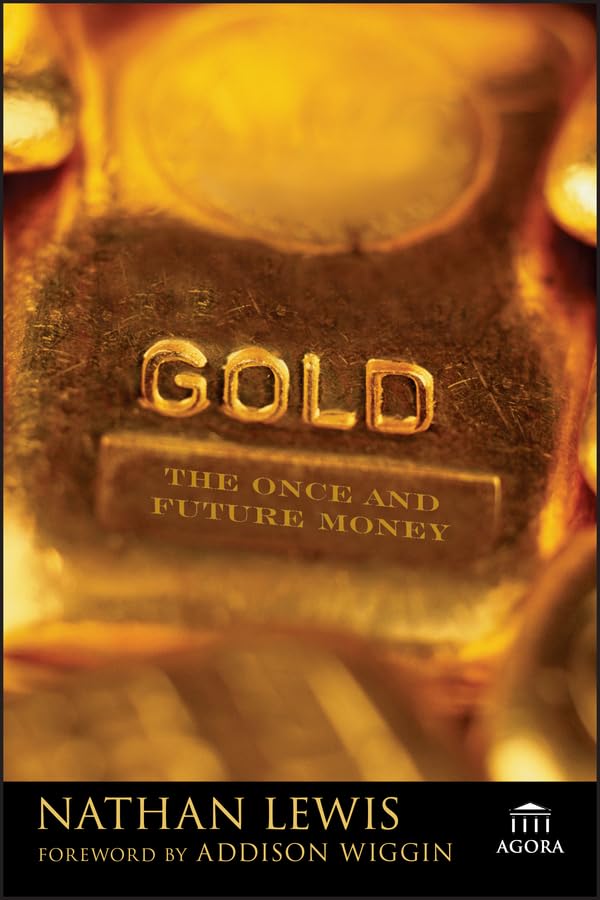
Title
Gold: The Once and Future Money,New
Sold by Ergodebooks, an authorized reseller.
Returns accepted within 30 days | support@ergodebooks.com
Shipping Information
- Free Standard Shipping — United States only
- Processing Time: 3–5 business days
- Estimated Delivery: 6–10 business days after dispatch
- Double-boxed, fully insured & discreetly packaged
- Tracking number sent via email once dispatched
Returns & Refund
Returns accepted within 30 days of delivery.
Damaged or Defective Item
Free return shipping + replacement or full refund
Wrong Item Received
Free return shipping + replacement or full refund
Change of Mind
Return shipping at customer's expense · 25% restocking fee applies
Payment Option

For most of the last three millennia, the worlds commercial centers have used one or another variant of a gold standard. It should be one of the best understood of human institutions, but its not. Its one of the worst understood, by both its advocates and detractors. Though it has been spurned by governments many times, this has never been due to a fault of gold to serve its duty, but because governments had other plans for their currencies beyond maintaining their stability. And so, says Nathan Lewis, there is no reason to believe that the great monetary successes of the past four centuries, and indeed the past four millennia, could not be recreated in the next four centuries. In Gold, he makes a forceful, welldocumented case for a worldwide return to the gold standard.Governments and central bankers around the world today unanimously agree on the desirability of stable money, ever more so after some monetary disaster has reduced yet another economy to smoking ruins. Lewis shows how gold provides the stability needed to foster greater prosperity and productivity throughout the world. He offers an insightful look at money in all its forms, from the seventh century B.C. to the present day, explaining in straightforward laymans terms the effects of inflation, deflation, and floating currencies along with their effect on prices, wages, taxes, and debt. He explains how the circulation of money is regulated by central banks and, in the process, demystifies the concepts of supply, demand, and the value of currency. And he illustrates how higher taxes diminish productivity, trade, and the stability of money. Lewis also provides an entertaining history of U.S. money and offers a sobering look at recent currency crises around the world, including the Asian monetary crisis of the late 1990s and the devastating currency devaluations in Russia, China, Mexico, and Yugoslavia.Lewiss ultimate conclusion is simple but powerful: gold has been adopted as money because it works. The gold standard produced decades and even centuries of stable money and economic abundance. If history is a guide, it will be done again.Nathan Lewis was formerly the chief international economist of a firm that provided investment research for institutions. He now works for an asset management company based in New York. Lewis has written for the Financial Times, Asian Wall Street Journal, Japan Times, Pravda, and other publications. He has appeared on financial television in the United States, Japan, and the Middle East.
⚠️ WARNING (California Proposition 65):
This product may contain chemicals known to the State of California to cause cancer, birth defects, or other reproductive harm.
For more information, please visit www.P65Warnings.ca.gov.
- Q: What is the main subject of 'Gold: The Once and Future Money'? A: 'Gold: The Once and Future Money' discusses the historical and economic significance of the gold standard, arguing for its potential return as a means to achieve monetary stability.
- Q: Who is the author of this book? A: The author of 'Gold: The Once and Future Money' is Nathan Lewis, a former chief international economist with extensive experience in investment research.
- Q: What is the publication date of this book? A: 'Gold: The Once and Future Money' was published on January 1, 2007.
- Q: What is the book's binding type? A: The book is available in hardcover binding.
- Q: How many pages does the book have? A: 'Gold: The Once and Future Money' consists of 447 pages.
- Q: What are some key features of this book? A: Key features include being new, in mint condition, dispatched on the same day for orders received before noon, guaranteed packaging, and a no-quibbles return policy.
- Q: What category does this book fall under? A: 'Gold: The Once and Future Money' is categorized under Money & Monetary Policy.
- Q: Can this book help me understand inflation and deflation? A: Yes, the book explains inflation, deflation, and their effects on currency and economy in straightforward terms, making it accessible for readers.
- Q: What historical events does the author discuss in relation to currency crises? A: The author provides insights into various currency crises, including the Asian monetary crisis of the late 1990s and devaluations occurring in Russia, China, Mexico, and Yugoslavia.
- Q: Is there a specific edition of this book? A: Yes, 'Gold: The Once and Future Money' is available in its first edition.