If you have any questions, you are always welcome to contact us. We'll get back to you as soon as possible, withing 24 hours on weekdays.
Customer service
All questions about your order, return and delivery must be sent to our customer service team by e-mail at yourstore@yourdomain.com
Sale & Press
If you are interested in selling our products, need more information about our brand or wish to make a collaboration, please contact us at press@yourdomain.com
Help
If you have any questions, you are always welcome to contact us. We'll get back to you as soon as possible, withing 24 hours on weekdays.
Customer service
All questions about your order, return and delivery must be sent to our customer service team by e-mail at yourstore@yourdomain.com
Sale & Press
If you are interested in selling our products, need more information about our brand or wish to make a collaboration, please contact us at press@yourdomain.com
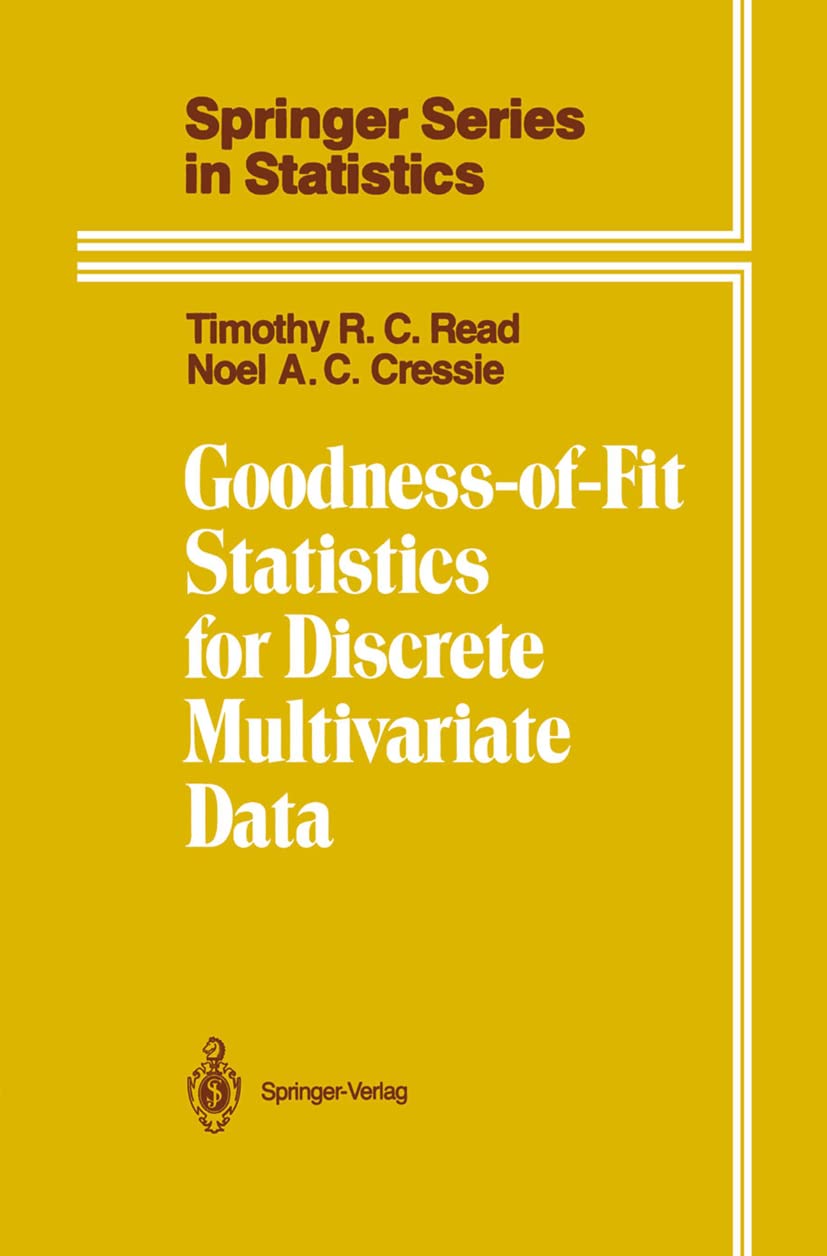
The statistical analysis of discrete multivariate data has received a great deal of attention in the statistics literature over the past two decades. The develop ment ofappropriate models is the common theme of books such as Cox (1970), Haberman (1974, 1978, 1979), Bishop et al. (1975), Gokhale and Kullback (1978), Upton (1978), Fienberg (1980), Plackett (1981), Agresti (1984), Goodman (1984), and Freeman (1987). The objective of our book differs from those listed above. Rather than concentrating on model building, our intention is to describe and assess the goodnessoffit statistics used in the model verification part of the inference process. Those books that emphasize model development tend to assume that the model can be tested with one of the traditional goodnessoffit tests 2 2 (e.g., Pearson's X or the loglikelihood ratio G ) using a chisquared critical value. However, it is well known that this can give a poor approximation in many circumstances. This book provides the reader with a unified analysis of the traditional goodnessoffit tests, describing their behavior and relative merits as well as introducing some new test statistics. The powerdivergence family of statistics (Cressie and Read, 1984) is used to link the traditional test statistics through a single realvalued parameter, and provides a way to consolidate and extend the current fragmented literature. As a byproduct of our analysis, a new 2 2 statistic emerges "between" Pearson's X and the loglikelihood ratio G that has some valuable properties.
⚠️ WARNING (California Proposition 65):
This product may contain chemicals known to the State of California to cause cancer,
birth defects, or other reproductive harm.
For MAP (Minimum Advertised Price) violations and Intellectual Property (IP) or Trademark concerns, please contact:
support@ergodebooks.com
⚠️ California Proposition 65 Warning: Some products sold on this website may expose you to chemicals known to the State of California to cause cancer, birth defects, or other reproductive harm. For more information, visit www.P65Warnings.ca.gov.