
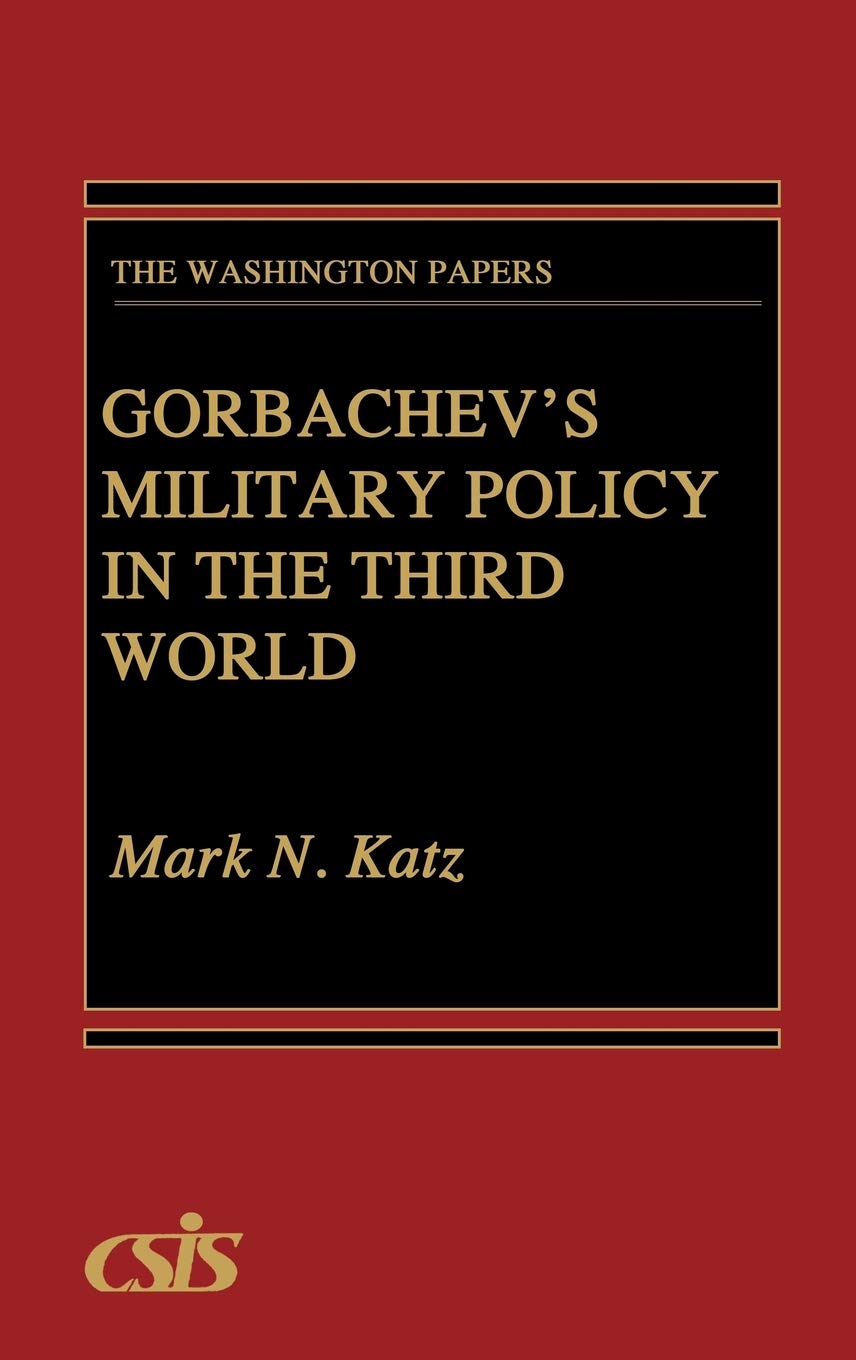
Title
Gorbachev'S Military Policy In The Third World (The Washington Papers)
Sold by Ergodebooks, an authorized reseller.
Returns accepted within 30 days | support@ergodebooks.com
Shipping Information
- Free Standard Shipping — United States only
- Processing Time: 3–5 business days
- Estimated Delivery: 6–10 business days after dispatch
- Double-boxed, fully insured & discreetly packaged
- Tracking number sent via email once dispatched
Returns & Refund
Returns accepted within 30 days of delivery.
Damaged or Defective Item
Free return shipping + replacement or full refund
Wrong Item Received
Free return shipping + replacement or full refund
Change of Mind
Return shipping at customer's expense · 25% restocking fee applies
Payment Option

Mark Katz's highly readable and useful overview of Soviet military interest in the Third World will be an important resource for anyone doing research in this field.Francis Fukuyama, Deputy Director for EastWest Relations, Policy Planning Staff, U.S. Department of StateIn his timely and thoughtful assessment of Gorbachev's evolving military policy, Mark Katz cautions against concluding that Moscow has lost interest in retaining and acquiring positions of influence in areas such as Angola, the Arab world, Ethiopia, and Central America. By detailing for us the new thinking' in Moscow, and the new policies that it has spawned in the USSR's Third World Policy, he has made a valuable contribution to the ongoing debate about the challenge that Gorbachev poses to the United States. Alvin Z. Rubinstein, Professor of Political Science, University of PennsylvaniaThis book examines the changes that have occurred in Soviet military policy toward the Third World under Gorbachev. Mark Katz studies Gorbachev's active pursuit of detente with the West in terms of his ambitious economic reform efforts. Katz maintains that since Gorbachev regards detente as so essential for the achievement of perestroika, he has adopted a less aggressive military policy in the Third World. This book examines the Soviet military statements since Gorbachev came to power, which indicate that the Soviet military, for the most part, does not oppose Gorbachev's retrenchment from the Third World. The Soviet military even seems to approve the decision to withdraw from Afghanistan.The author points out that while Gorbachev has deemphasized the expansion of Moscow's base network in the Third World, he has vigorously sought to reduce U.S. military access to it. Gorbachev has attempted to do this through a steppedup diplomatic campaign to convince moderate Third World states that the Soviet Union is not their enemy and hence there is no need to ally with Washington against Moscow. Katz also analyzes the Soviet support of regional security proposals for Asia and the Pacific, the Persian Gulf, the Middle East, parts of Africa, Central America, and elsewhere. Katz maintains that if these security proposals are accepted, U.S. military access to them would definitely be reduced and that the Soviets' deemphasis on obtaining new bases could mean that moderate Third World governments may become more amenable to accepting these regional security proposals.
⚠️ WARNING (California Proposition 65):
This product may contain chemicals known to the State of California to cause cancer, birth defects, or other reproductive harm.
For more information, please visit www.P65Warnings.ca.gov.