
Title
Gossip and the Everyday Production of Politics,Used
Sold by Ergodebooks, an authorized reseller.
Returns accepted within 30 days | support@ergodebooks.com
Shipping Information
- Free Standard Shipping — United States only
- Processing Time: 3–5 business days
- Estimated Delivery: 6–10 business days after dispatch
- Double-boxed, fully insured & discreetly packaged
- Tracking number sent via email once dispatched
Returns & Refund
Returns accepted within 30 days of delivery.
Damaged or Defective Item
Free return shipping + replacement or full refund
Wrong Item Received
Free return shipping + replacement or full refund
Change of Mind
Return shipping at customer's expense · 25% restocking fee applies
Payment Option

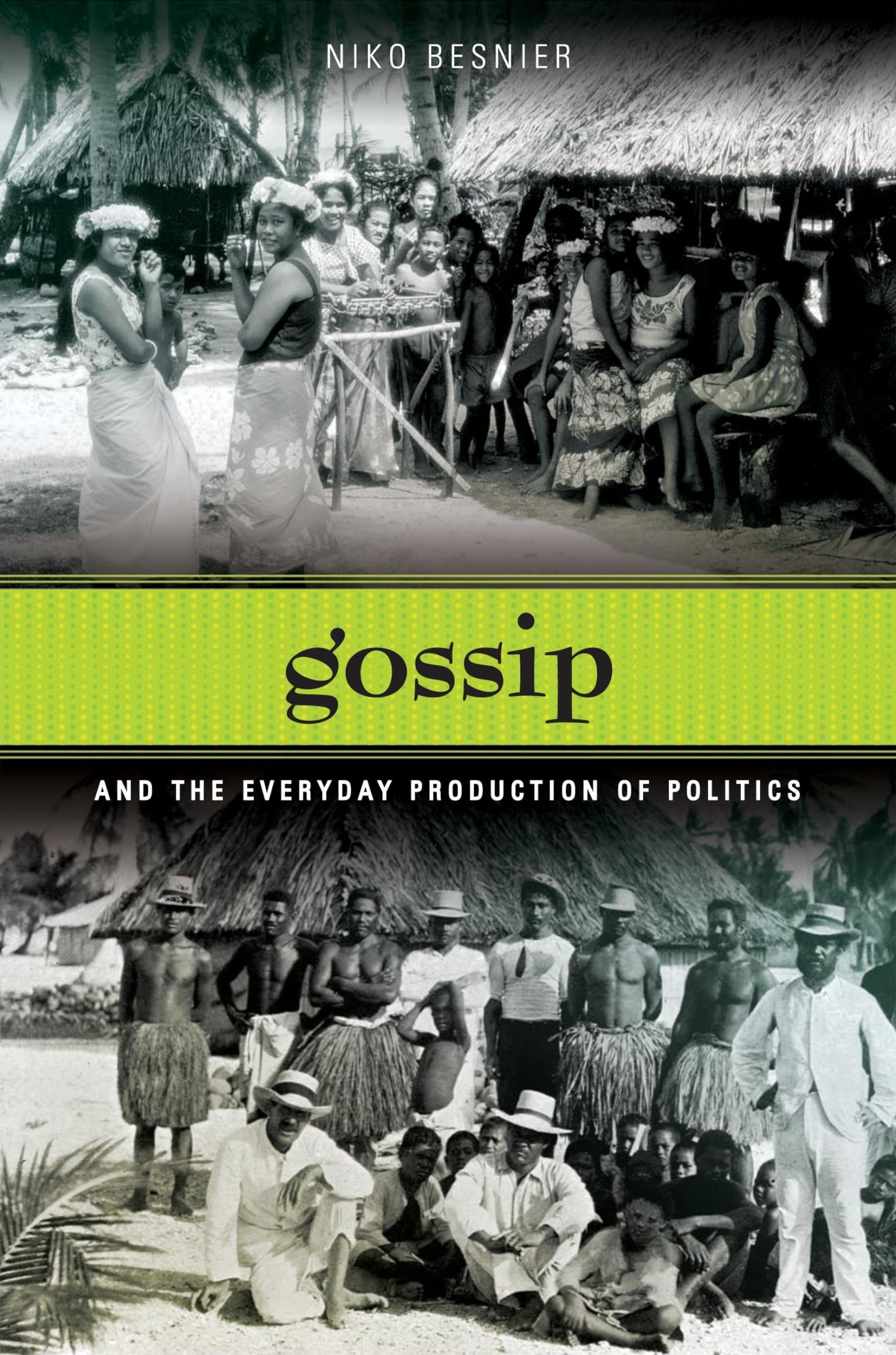
Although gossip is disapproved of across the worlds societies, it is a prominent feature of sociality, whose role in the construction of society and culture cannot be overestimated. In particular, gossip is central to the enactment of politics: through it people transform difference into inequality and enact or challenge power structures. Based on the authors intimate ethnographic knowledge of Nukulaelae Atoll, Tuvalu, this work uses an analysis of gossip as political action to develop a holistic understanding of a number of disparate themes, including conflict, power, agency, morality, emotion, locality, belief, and gender. It brings together two methodological traditionsthe microscopic analysis of unelicited interaction and the macroscopic interpretation of social practicethat are rarely wedded successfully.Drawing on a broad range of theoretical resources, Niko Besnier approaches gossip from several angles. A detailed analysis of how Nukulaelaes people structure their gossip interactions demonstrates that this structure reflects and contributes to the atolls political ideology, which wavers between a staunch egalitarianism and a need for hierarchy. His discussion then turns to narratives of specific events in which gossip played an important role in either enacting egalitarianism or reinforcing inequality. Embedding gossip in a broad range of communicative practices enables Besnier to develop a nuanced analysis of how gossip operates, demonstrating how it allows some to gain power while others suffer because of it. Throughout, he is particularly attentive to the ways in which anthropologists themselves are the subject and object of gossip, making his work a notable contribution to reflexive social science.Written in an engaging and accessible style, Gossip and the Everyday Production of Politics will appeal to students and scholars of political, legal, linguistic, and psychological anthropology; social science methodology; communication, conflict, gender, and globalization studies; and Pacific Islands studies.
⚠️ WARNING (California Proposition 65):
This product may contain chemicals known to the State of California to cause cancer, birth defects, or other reproductive harm.
For more information, please visit www.P65Warnings.ca.gov.
- Q: How many pages does this book have? A: This book has two hundred fifty-eight pages. It provides an in-depth exploration of gossip's role in political contexts.
- Q: What is the binding type of this book? A: The binding type is paperback. This makes it lightweight and easy to handle for reading.
- Q: Who is the author of this book? A: The author is Niko Besnier. He draws on ethnographic knowledge to analyze gossip within political frameworks.
- Q: What are the dimensions of the book? A: The book measures six point two inches in length, zero point eight inches in width, and eight point nine inches in height. These dimensions make it a compact read.
- Q: What topics does this book cover? A: This book covers gossip, power dynamics, and social structures. It delves into themes like agency, morality, and gender.
- Q: What is the main focus of the book? A: The main focus is on the analysis of gossip as a political action. It examines how gossip influences power and societal structures.
- Q: Is this book suitable for beginners in anthropology? A: Yes, it is suitable for beginners. The engaging writing style makes complex themes accessible to new readers.
- Q: What kind of research methods are used in this book? A: The book employs both microscopic and macroscopic research methods. It combines detailed interaction analysis with broader social practice interpretations.
- Q: What is the target audience for this book? A: The target audience includes students and scholars of anthropology, social science, and Pacific Islands studies. It appeals to those interested in political and cultural dynamics.
- Q: How should I care for this book? A: To care for this book, keep it in a dry place and avoid exposure to direct sunlight. This will help preserve its condition.
- Q: Can this book be used as a reference for academic work? A: Yes, this book can be used as a reference. Its thorough analysis and extensive bibliography make it a valuable academic resource.
- Q: What should I do if I receive a damaged copy? A: If you receive a damaged copy, contact the seller for a replacement or refund. Most sellers have customer service to assist with such issues.
- Q: Is there a warranty on this book? A: No, there is typically no warranty on books. However, return policies may apply depending on the seller.
- Q: What if I have questions about the book after purchase? A: If you have questions after purchase, consider reaching out to academic forums or online communities. You can also check reviews for additional insights.
- Q: Is this book appropriate for all readers? A: Yes, it is appropriate for all readers interested in anthropology and political studies. However, it discusses complex social dynamics.