
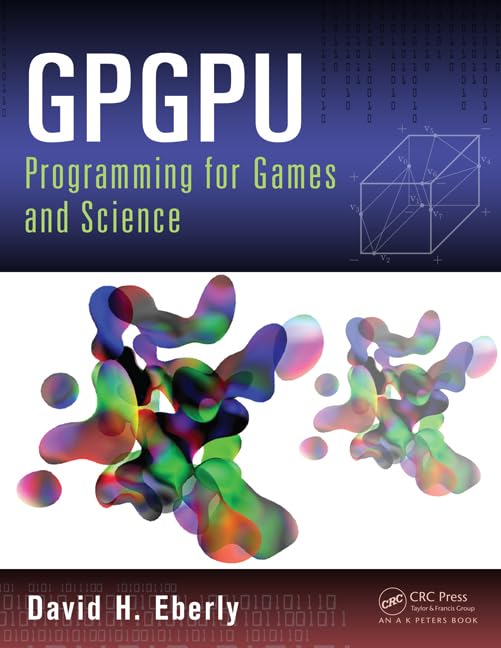
Title
GPGPU Programming for Games and Science,Used
Sold by Ergodebooks, an authorized reseller.
Returns accepted within 30 days | support@ergodebooks.com
Shipping Information
- Free Standard Shipping — United States only
- Processing Time: 3–5 business days
- Estimated Delivery: 6–10 business days after dispatch
- Double-boxed, fully insured & discreetly packaged
- Tracking number sent via email once dispatched
Returns & Refund
Returns accepted within 30 days of delivery.
Damaged or Defective Item
Free return shipping + replacement or full refund
Wrong Item Received
Free return shipping + replacement or full refund
Change of Mind
Return shipping at customer's expense · 25% restocking fee applies
Payment Option

An InDepth, Practical Guide to GPGPU Programming Using Direct3D 11GPGPU Programming for Games and Science demonstrates how to achieve the following requirements to tackle practical problems in computer science and software engineering:Robustness Accuracy Speed Quality source code that is easily maintained, reusable, and readableThe book primarily addresses programming on a graphics processing unit (GPU) while covering some material also relevant to programming on a central processing unit (CPU). It discusses many concepts of general purpose GPU (GPGPU) programming and presents practical examples in game programming and scientific programming.The author first describes numerical issues that arise when computing with floatingpoint arithmetic, including making tradeoffs among robustness, accuracy, and speed. He then shows how single instruction multiple data (SIMD) extensions work on CPUs since GPUs also use SIMD.The core of the book focuses on the GPU from the perspective of Direct3D 11 (D3D11) and the High Level Shading Language (HLSL). This chapter covers drawing 3D objects; vertex, geometry, pixel, and compute shaders; input and output resources for shaders; copying data between CPU and GPU; configuring two or more GPUs to act as one; and IEEE floatingpoint support on a GPU.The book goes on to explore practical matters of programming a GPU, including code sharing among applications and performing basic tasks on the GPU. Focusing on mathematics, it next discusses vector and matrix algebra, rotations and quaternions, and coordinate systems. The final chapter gives several sample GPGPU applications on relatively advanced topics.Web ResourceAvailable on a supporting website, the authors fully featured Geometric Tools Engine for computing and graphics saves you from having to write a large amount of infrastructure code necessary for even the simplest of applications involving shader programming. The engine provides robust and accurate source code with SIMD when appropriate and GPU versions of algorithms when possible.
⚠️ WARNING (California Proposition 65):
This product may contain chemicals known to the State of California to cause cancer, birth defects, or other reproductive harm.
For more information, please visit www.P65Warnings.ca.gov.