
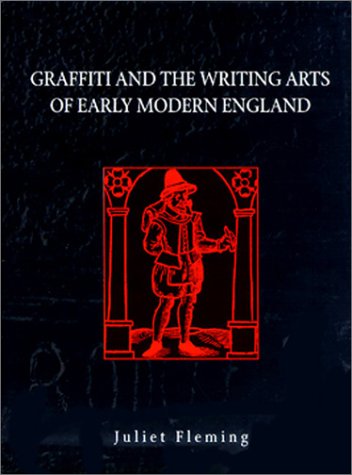
Title
Graffiti and the Writing Arts of Early Modern England (Material Texts),Used
Sold by Ergodebooks, an authorized reseller.
Returns accepted within 30 days | support@ergodebooks.com
Shipping Information
- Free Standard Shipping — United States only
- Processing Time: 3–5 business days
- Estimated Delivery: 6–10 business days after dispatch
- Double-boxed, fully insured & discreetly packaged
- Tracking number sent via email once dispatched
Returns & Refund
Returns accepted within 30 days of delivery.
Damaged or Defective Item
Free return shipping + replacement or full refund
Wrong Item Received
Free return shipping + replacement or full refund
Change of Mind
Return shipping at customer's expense · 25% restocking fee applies
Payment Option

Product DescriptionSelected by Choice magazine as an Outstanding Academic TitleGraffiti and the Writing Arts of Early Modern England is an excavation of a series of previously unknown or disregarded writing practices. Our modern assumptions regarding written expression have limited our examination of the history of writing and literacy to that which has been preserved in print or manuscript. In a work of tremendous originality and intellectual daring, Fleming brings detailed historical scholarship into dialogue with the challenge of contemporary theory to explore a lost realm where writing practices moved off the boundaries of the page to fill windows, body surfaces, ceramics, ceilings, and walls.Developing and drawing on an archive that has until now been closed to literary scholars, Fleming argues that the whitewashed wall was the primary writing apparatus of the early modern English, recovers the tattoo practices of sixteenthcentury Europeans, and demonstrates how to read the poetic burden of early modern crockery. Her book is a work of cultural history that provides a startling new perspective on early modern writing, one that swerves from the preoccupations of generations of scholars in order to transform the fundamental terms of literary inquiry.Review'Tattoos, graffiti, pots, poesy rings, and inscriptions on clothes and on implements were all significant and meaningful forms of writing in early modern England. In this beautifully packaged and engaging book Juliet Fleming argues that these modes of writing . . . were central to consciousness and to the idea of writing. . . . Her book succeedsas a challenge to our understating of the practices of writing and the notion of literaturebecause of its originality, its restless interrogation of words well beyond the realms of the canonical, its brilliantly imaginative approach to cultural history, and because of its wellproportioned, elegant, and dense prose.'Albion'Through stunningly imaginative acts of archaeological and archival retrieval, Juliet Fleming has given us the keenest account we have of what distinguishes early modern writing from our own.'Margreta de Grazia, University of PennsylvaniaAbout the AuthorJuliet Fleming is Lecturer in the Faculty of English at Cambridge University and a Fellow of Trinity Hall, Cambridge University.
⚠️ WARNING (California Proposition 65):
This product may contain chemicals known to the State of California to cause cancer, birth defects, or other reproductive harm.
For more information, please visit www.P65Warnings.ca.gov.