If you have any questions, you are always welcome to contact us. We'll get back to you as soon as possible, withing 24 hours on weekdays.
Customer service
All questions about your order, return and delivery must be sent to our customer service team by e-mail at yourstore@yourdomain.com
Sale & Press
If you are interested in selling our products, need more information about our brand or wish to make a collaboration, please contact us at press@yourdomain.com
Help
If you have any questions, you are always welcome to contact us. We'll get back to you as soon as possible, withing 24 hours on weekdays.
Customer service
All questions about your order, return and delivery must be sent to our customer service team by e-mail at yourstore@yourdomain.com
Sale & Press
If you are interested in selling our products, need more information about our brand or wish to make a collaboration, please contact us at press@yourdomain.com
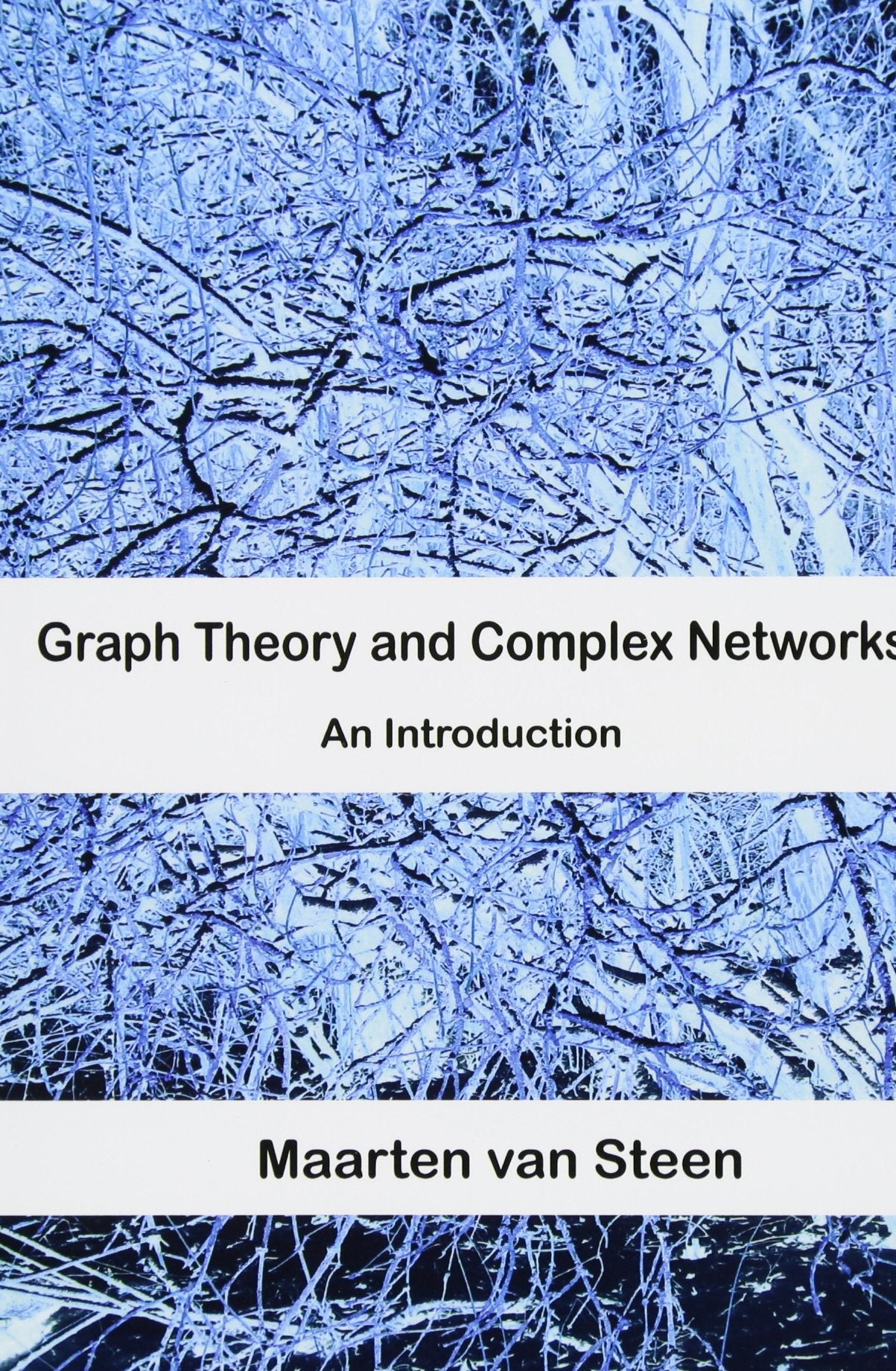
This book aims to explain the basics of graph theory that are needed at an introductory level for students in computer or information sciences. To motivate students and to show that even these basic notions can be extremely useful, the book also aims to provide an introduction to the modern field of network science.Mathematics is often unnecessarily difficult for students, at times even intimidating. For this reason, explicit attention is paid in the first chapters to mathematical notations and proof techniques, emphasizing that the notations form the biggest obstacle, not the mathematical concepts themselves. This approach allows to gradually prepare students for using tools that are necessary to put graph theory to work: complex networks.In the second part of the book the student learns about random networks, small worlds, the structure of the Internet and the Web, peertopeer systems, and social networks. Again, everything is discussed at an elementary level, but such that in the end students indeed have the feeling that they:1.Have learned how to read and understand the basic mathematics related to graph theory.2.Understand how basic graph theory can be applied to optimization problems such as routing in communication networks.3.Know a bit more about this sometimes mystical field of small worlds and random networks.There is an accompanying web site www.distributedsystems.net/gtcn from where supplementary material can be obtained, including exercises, Mathematica notebooks, data for analyzing graphs, and generators for various complex networks.
⚠️ WARNING (California Proposition 65):
This product may contain chemicals known to the State of California to cause cancer,
birth defects, or other reproductive harm.
For MAP (Minimum Advertised Price) violations and Intellectual Property (IP) or Trademark concerns, please contact:
support@ergodebooks.com
⚠️ California Proposition 65 Warning: Some products sold on this website may expose you to chemicals known to the State of California to cause cancer, birth defects, or other reproductive harm. For more information, visit www.P65Warnings.ca.gov.