If you have any questions, you are always welcome to contact us. We'll get back to you as soon as possible, withing 24 hours on weekdays.
Customer service
All questions about your order, return and delivery must be sent to our customer service team by e-mail at yourstore@yourdomain.com
Sale & Press
If you are interested in selling our products, need more information about our brand or wish to make a collaboration, please contact us at press@yourdomain.com
Help
If you have any questions, you are always welcome to contact us. We'll get back to you as soon as possible, withing 24 hours on weekdays.
Customer service
All questions about your order, return and delivery must be sent to our customer service team by e-mail at yourstore@yourdomain.com
Sale & Press
If you are interested in selling our products, need more information about our brand or wish to make a collaboration, please contact us at press@yourdomain.com
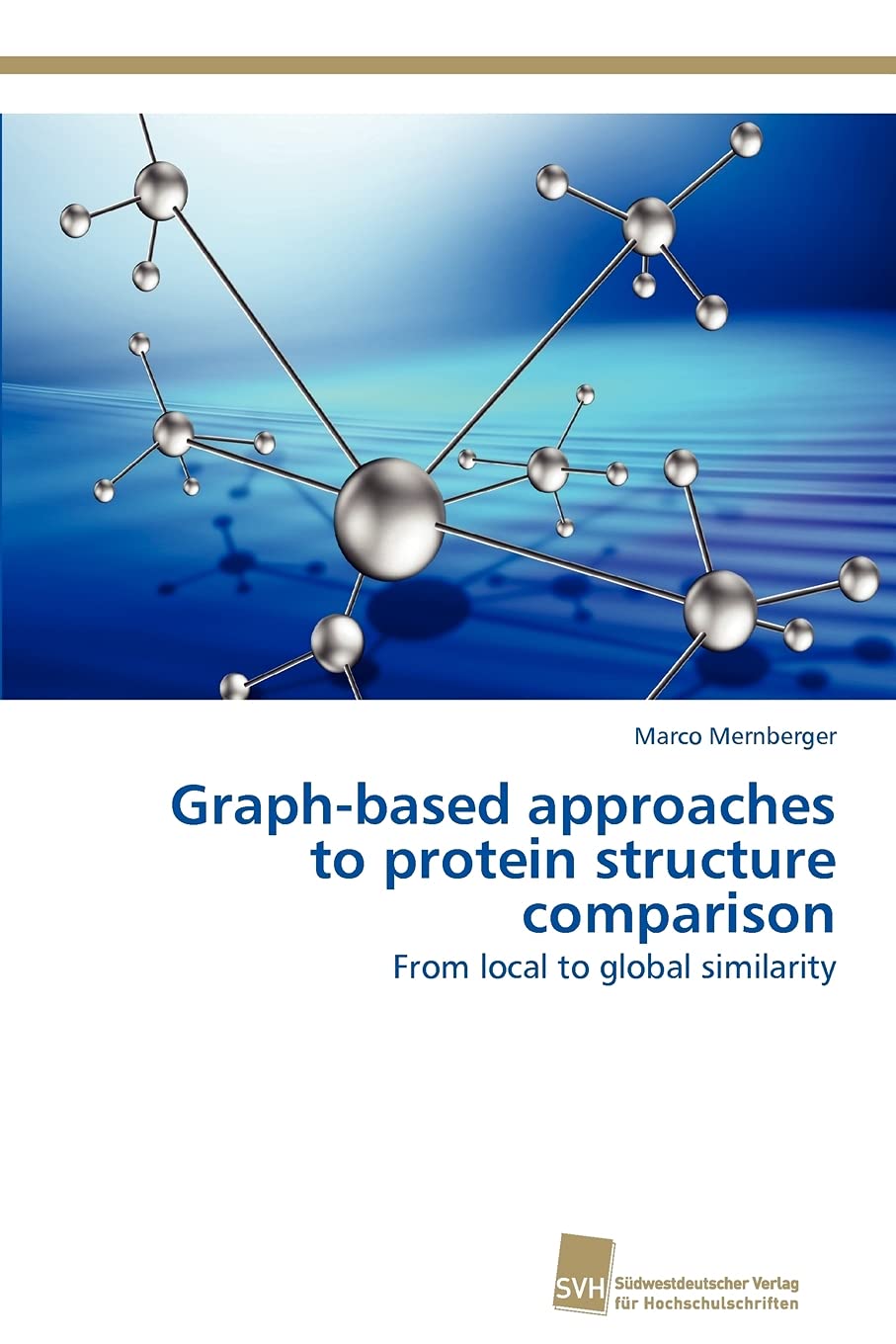
The comparison of protein structures is a central task in structural bioinformatics. Drawing upon structural information enables the inference of function for unknown proteins, even without apparent homology on the sequence level. Regarding enzyme function, the conformation of the catalytic site or the binding pocket accomodating bound substrates or ligands is especially interesting due to structural constraints imposed by the catalyzed reaction or the bound molecule. Hence, these sites are likely to be similar in proteins interacting with similar molecules. This is especially appealing in pharmaceutics as it allows for the prediction of cross reactivities prior to expensive clinical trials. In this book, Marco Mernberger gives an introduction to protein structure comparison with a special regard to protein binding pockets and developes different graphbased approaches based on global, local and semiglobal strategies. As it is not apparent which principle is more suitable for the detection of cross reactivities, a comparative study is conducted, highlighting the advantages and drawbacks of local, global and semiglobal methods.
⚠️ WARNING (California Proposition 65):
This product may contain chemicals known to the State of California to cause cancer,
birth defects, or other reproductive harm.
For MAP (Minimum Advertised Price) violations and Intellectual Property (IP) or Trademark concerns, please contact:
support@ergodebooks.com
⚠️ California Proposition 65 Warning: Some products sold on this website may expose you to chemicals known to the State of California to cause cancer, birth defects, or other reproductive harm. For more information, visit www.P65Warnings.ca.gov.