
Title
Graphical Simulation of Deformable Models,Used
Sold by Ergodebooks, an authorized reseller.
Returns accepted within 30 days | support@ergodebooks.com
Shipping Information
- Free Standard Shipping — United States only
- Processing Time: 3–5 business days
- Estimated Delivery: 6–10 business days after dispatch
- Double-boxed, fully insured & discreetly packaged
- Tracking number sent via email once dispatched
Returns & Refund
Returns accepted within 30 days of delivery.
Damaged or Defective Item
Free return shipping + replacement or full refund
Wrong Item Received
Free return shipping + replacement or full refund
Change of Mind
Return shipping at customer's expense · 25% restocking fee applies
Payment Option

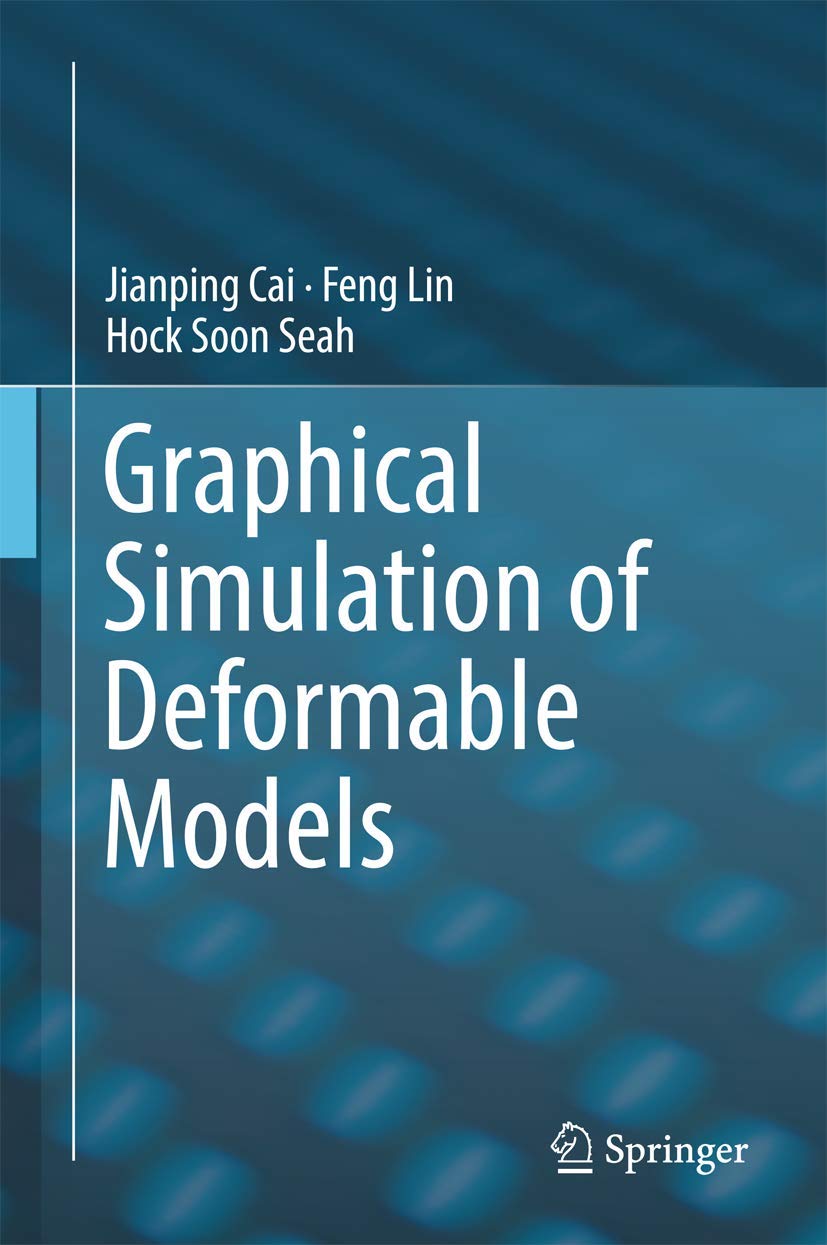
This book covers dynamic simulation of deformable objects, which is one of the most challenging tasks in computer graphics and visualization. It focuses on the simulation of deformable models with anisotropic materials, one of the less common approaches in the existing research. Both physicallybased and geometricallybased approaches are examined.The authors start with transversely isotropic materials for the simulation of deformable objects with fibrous structures. Next, they introduce a fiberfield incorporated corotational finite element model (CLFEM) that works directly with a constitutive model of transversely isotropic material. A smooth fiberfield is used to establish the local frames for each element.To introduce deformation simulation for orthotropic materials, an orthotropic deformation controlling framefield is conceptualized and a frame construction tool is developed for users to define the desired material properties. The orthotropic framefield is coupled with the CLFEM model to complete an orthotropic deformable model.Finally, the authors present an integrated realtime system for animation of skeletal characters with anisotropic tissues. To solve the problems of volume distortion and high computational costs, a strainbased PBD framework for skeletal animation is explained; natural secondary motion of soft tissues is another benefit.The book is written for those researchers who would like to develop their own algorithms. The key mathematical and computational concepts are presented together with illustrations and working examples. It can also be used as a reference book for graduate students and senior undergraduates in the areas of computer graphics, computer animation, and virtual reality. Academics, researchers, and professionals will find this to be an exceptional resource.
⚠️ WARNING (California Proposition 65):
This product may contain chemicals known to the State of California to cause cancer, birth defects, or other reproductive harm.
For more information, please visit www.P65Warnings.ca.gov.