If you have any questions, you are always welcome to contact us. We'll get back to you as soon as possible, withing 24 hours on weekdays.
Customer service
All questions about your order, return and delivery must be sent to our customer service team by e-mail at yourstore@yourdomain.com
Sale & Press
If you are interested in selling our products, need more information about our brand or wish to make a collaboration, please contact us at press@yourdomain.com
Help
If you have any questions, you are always welcome to contact us. We'll get back to you as soon as possible, withing 24 hours on weekdays.
Customer service
All questions about your order, return and delivery must be sent to our customer service team by e-mail at yourstore@yourdomain.com
Sale & Press
If you are interested in selling our products, need more information about our brand or wish to make a collaboration, please contact us at press@yourdomain.com
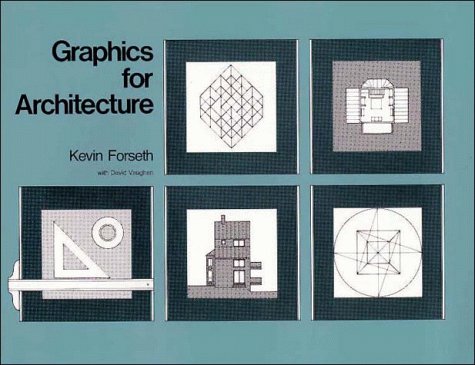
Graphics for Architecture Kevin Forseth with David Vaughan A thorough understanding of design drawing enhances the designer's ability to reason out difficult graphic constructions and to select or create appropriate means for depicting buildings and environments. This fully illustrated guide presents the most effective methods for mechanically constructing architectural plans, elevations, sections, paralines, perspectives, and shadows. All methods are described in basic principles of perspective geometry. Throughout the volume many pictorial drawings illuminate the connection between stepbystep procedures for constructing design drawings and the abstract concepts underlying orthographic, oblique, and perspective projections. For formulating graphics workbook problems around paraline construction the guide includes a notation system for describing an unlimited range of paralineoblique drawings. A shortcut method for casting shadows in plan and elevation is useful for modeling shadows in architectural site plans and for obtaining fast design results. In addition there are eight different stepbystep procedures for setting up and constructing one and twopoint perspective. Commonmethod perspectives are presented in the context of a draftingboard surface, and perspectives without plan are discussed as interiors, exteriors, and sections. Combining carefully organized learning sequences with the quick reference qualities of a handbook, this volume is an excellent reference source for the architectural office or studio as well as an easytofollow manual for students.
⚠️ WARNING (California Proposition 65):
This product may contain chemicals known to the State of California to cause cancer,
birth defects, or other reproductive harm.
For MAP (Minimum Advertised Price) violations and Intellectual Property (IP) or Trademark concerns, please contact:
support@ergodebooks.com
⚠️ California Proposition 65 Warning: Some products sold on this website may expose you to chemicals known to the State of California to cause cancer, birth defects, or other reproductive harm. For more information, visit www.P65Warnings.ca.gov.