If you have any questions, you are always welcome to contact us. We'll get back to you as soon as possible, withing 24 hours on weekdays.
Customer service
All questions about your order, return and delivery must be sent to our customer service team by e-mail at yourstore@yourdomain.com
Sale & Press
If you are interested in selling our products, need more information about our brand or wish to make a collaboration, please contact us at press@yourdomain.com
Help
If you have any questions, you are always welcome to contact us. We'll get back to you as soon as possible, withing 24 hours on weekdays.
Customer service
All questions about your order, return and delivery must be sent to our customer service team by e-mail at yourstore@yourdomain.com
Sale & Press
If you are interested in selling our products, need more information about our brand or wish to make a collaboration, please contact us at press@yourdomain.com
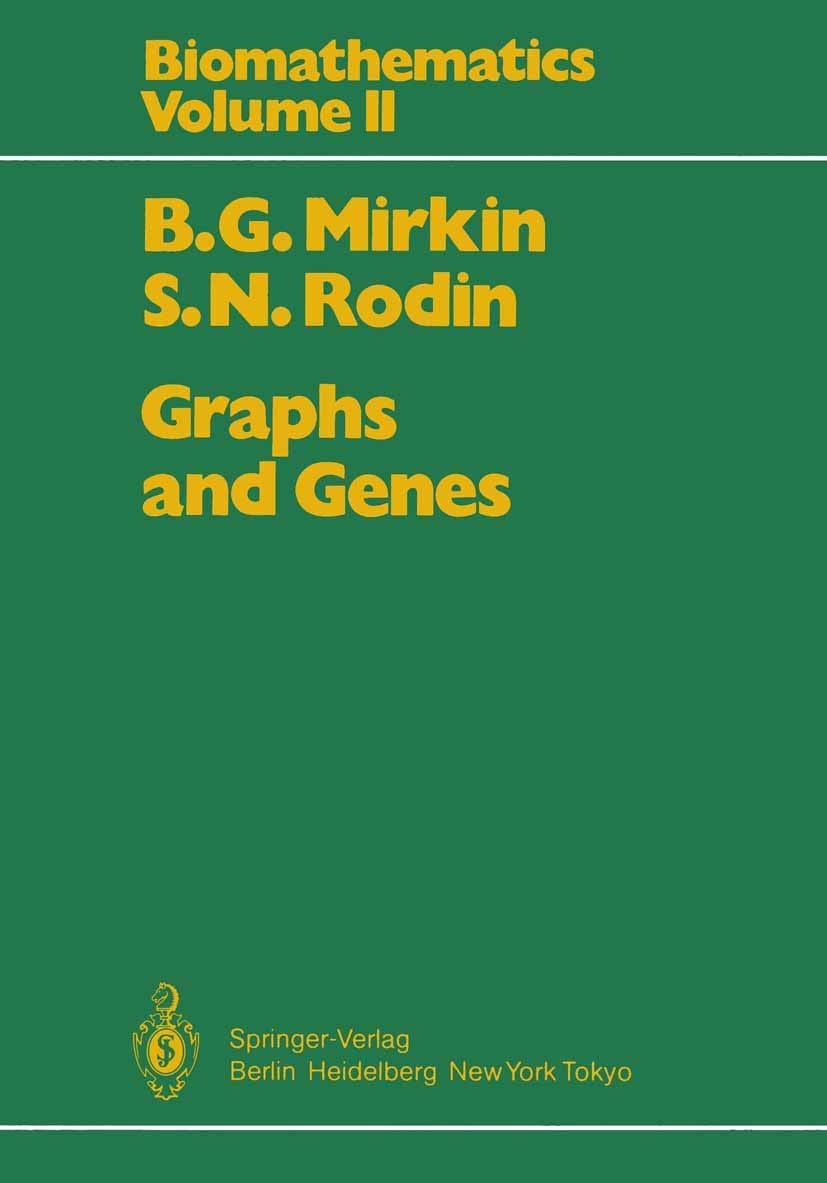
This book is written by a mathematician and a theoretical biologist who have arrived at a good mutual understanding and a well workedout common notation. The reader need hardly be convinced of the necessity of such a mutual understanding, not only for the two investigators, but also for the sciences they represent. Like Moliere's hero, geneticists are gradually beginning to understand that, unknowingly, they have been speaking in the language of cybernetics. Mathematicians are unexpec tedly discovering that many past and present problems and methods of genetics can be naturally formulated in the language of graph theory. In this way a powerful abstract mathematical theory suddenly finds a productive application. Moreover, in its turn, such an application be gins to "feed" the mathematical theory by presenting it with a number of new problems. The reader may judge for himself the fruitfulness of such mutual interaction. At the same time several important circumstances need to be men tioned. The formalization and rigorous formulation given here embraces not only the older problems, known by geneticists for many decades (the construction of genetic maps, the analysis of complementation, etc. ), but also comparatively new problems: the construction of partial com plementation maps, phylogenetic trees of proteins, etc.
⚠️ WARNING (California Proposition 65):
This product may contain chemicals known to the State of California to cause cancer,
birth defects, or other reproductive harm.
For MAP (Minimum Advertised Price) violations and Intellectual Property (IP) or Trademark concerns, please contact:
support@ergodebooks.com
⚠️ California Proposition 65 Warning: Some products sold on this website may expose you to chemicals known to the State of California to cause cancer, birth defects, or other reproductive harm. For more information, visit www.P65Warnings.ca.gov.