
Title
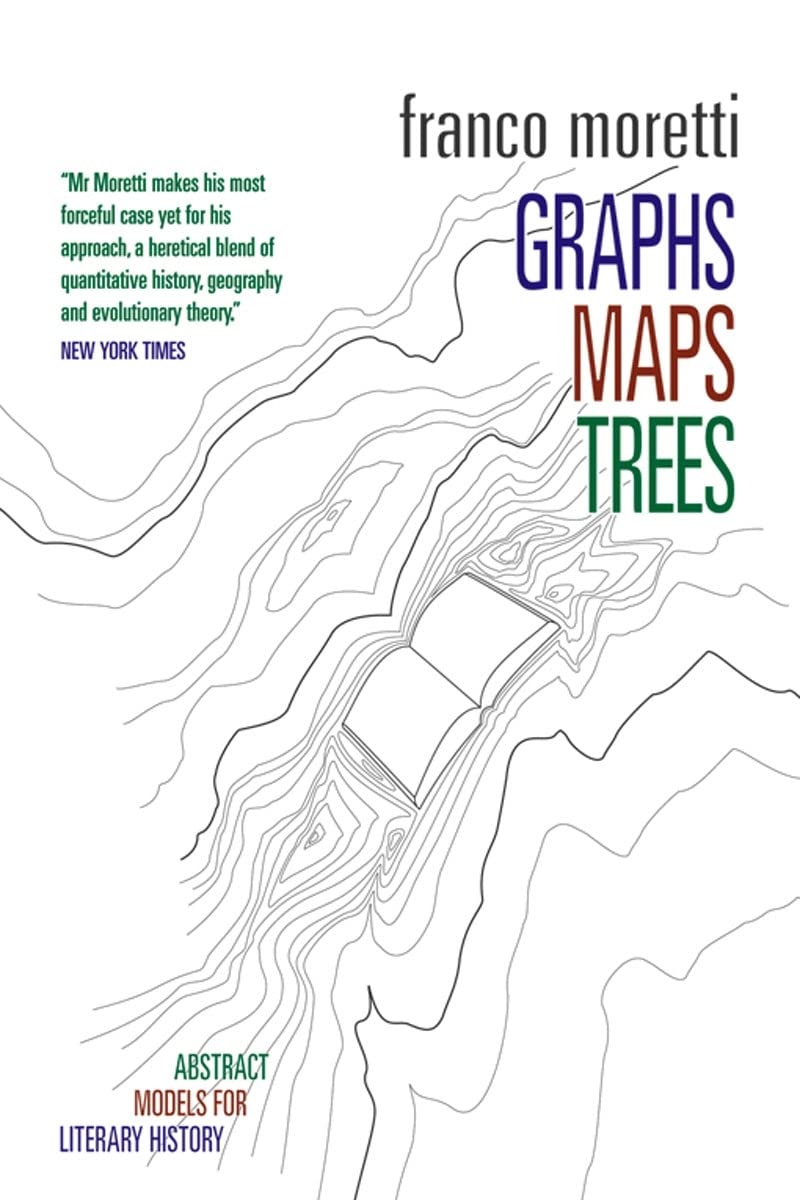
Graphs, Maps, Trees: Abstract Models For Literary History
Sold by Ergodebooks, an authorized reseller.
Returns accepted within 30 days | support@ergodebooks.com
Shipping Information
- Free Standard Shipping — United States only
- Processing Time: 3–5 business days
- Estimated Delivery: 6–10 business days after dispatch
- Double-boxed, fully insured & discreetly packaged
- Tracking number sent via email once dispatched
Returns & Refund
Returns accepted within 30 days of delivery.
Damaged or Defective Item
Free return shipping + replacement or full refund
Wrong Item Received
Free return shipping + replacement or full refund
Change of Mind
Return shipping at customer's expense · 25% restocking fee applies
Payment Option

In This Groundbreaking Book, Franco Moretti Argues That Literature Scholars Should Stop Reading Books And Start Counting, Graphing, And Mapping Them Instead. In Place Of The Traditionally Selective Literary Canon Of A Few Hundred Texts, Moretti Offers Charts, Maps And Time Lines, Developing The Idea Of Distant Reading Into A Fullblown Experiment In Literary Historiography, In Which The Canon Disappears Into The Larger Literary System. Charting Entire Genresthe Epistolary, The Gothic, And The Historical Novelas Well As The Literary Output Of Countries Such As Japan, Italy, Spain, And Nigeria, He Shows How Literary History Looks Significantly Different From What Is Commonly Supposed And How The Concept Of Aesthetic Form Can Be Radically Redefined.
⚠️ WARNING (California Proposition 65):
This product may contain chemicals known to the State of California to cause cancer, birth defects, or other reproductive harm.
For more information, please visit www.P65Warnings.ca.gov.
- Q: What is the page count of this book? A: This book has one hundred twenty-eight pages. It provides a comprehensive exploration of literary history through quantitative analysis.
- Q: What are the dimensions of 'Graphs, Maps, Trees'? A: The dimensions are five point five two inches in length, zero point four three inches in width, and eight point two seven inches in height. These measurements make it a compact paperback.
- Q: What type of binding does this book have? A: This book is bound in paperback. This makes it lightweight and easy to handle for readers.
- Q: Who is the author of 'Graphs, Maps, Trees'? A: The author is Franco Moretti. He is known for his innovative approach to literary studies.
- Q: What genre does this book belong to? A: It belongs to the Criticism and Theory genre. This categorization indicates its focus on literary analysis and theoretical frameworks.
- Q: What is the main idea of 'Graphs, Maps, Trees'? A: The main idea is that literature scholars should focus on quantitative analysis instead of traditional reading. Moretti introduces the concept of 'distant reading' to reshape literary historiography.
- Q: Is this book suitable for beginners in literary theory? A: Yes, it is suitable for beginners. Moretti's approach is accessible and challenges conventional literary analysis.
- Q: How can I apply the concepts from this book? A: You can apply these concepts by analyzing literary texts through quantitative methods. This includes creating charts and maps to explore literary trends.
- Q: Is there a specific audience for this book? A: Yes, it targets literary scholars and students. However, it is also engaging for general readers interested in literature.
- Q: What are some key themes discussed in the book? A: Key themes include the redefinition of literary canon and the exploration of entire genres. Moretti emphasizes the importance of a broader literary system.
- Q: How do I keep this book in good condition? A: To keep it in good condition, store it upright in a cool, dry place. Avoid exposing it to direct sunlight to prevent fading.
- Q: Can this book be used in academic settings? A: Yes, it is often used in academic settings. Its innovative approach to literary analysis makes it a valuable resource for coursework.
- Q: What if the book arrives damaged? A: If the book arrives damaged, contact the seller for a return or exchange. Most sellers have policies in place for damaged items.
- Q: Is there a warranty for this book? A: No, books typically do not come with a warranty. However, check the seller's return policy for any guarantees.
- Q: How does this book compare to other literary theory texts? A: This book is unique in its quantitative approach. Unlike many traditional texts, it emphasizes data analysis over close reading.
- Q: Is this book appropriate for young readers? A: Yes, it is appropriate for young readers interested in literature. However, it may be more engaging for high school students and above.