
Title
Graphs on Surfaces (Johns Hopkins Studies in the Mathematical Sciences, 10),Used
Sold by Ergodebooks, an authorized reseller.
Returns accepted within 30 days | support@ergodebooks.com
Shipping Information
- Free Standard Shipping — United States only
- Processing Time: 3–5 business days
- Estimated Delivery: 6–10 business days after dispatch
- Double-boxed, fully insured & discreetly packaged
- Tracking number sent via email once dispatched
Returns & Refund
Returns accepted within 30 days of delivery.
Damaged or Defective Item
Free return shipping + replacement or full refund
Wrong Item Received
Free return shipping + replacement or full refund
Change of Mind
Return shipping at customer's expense · 25% restocking fee applies
Payment Option

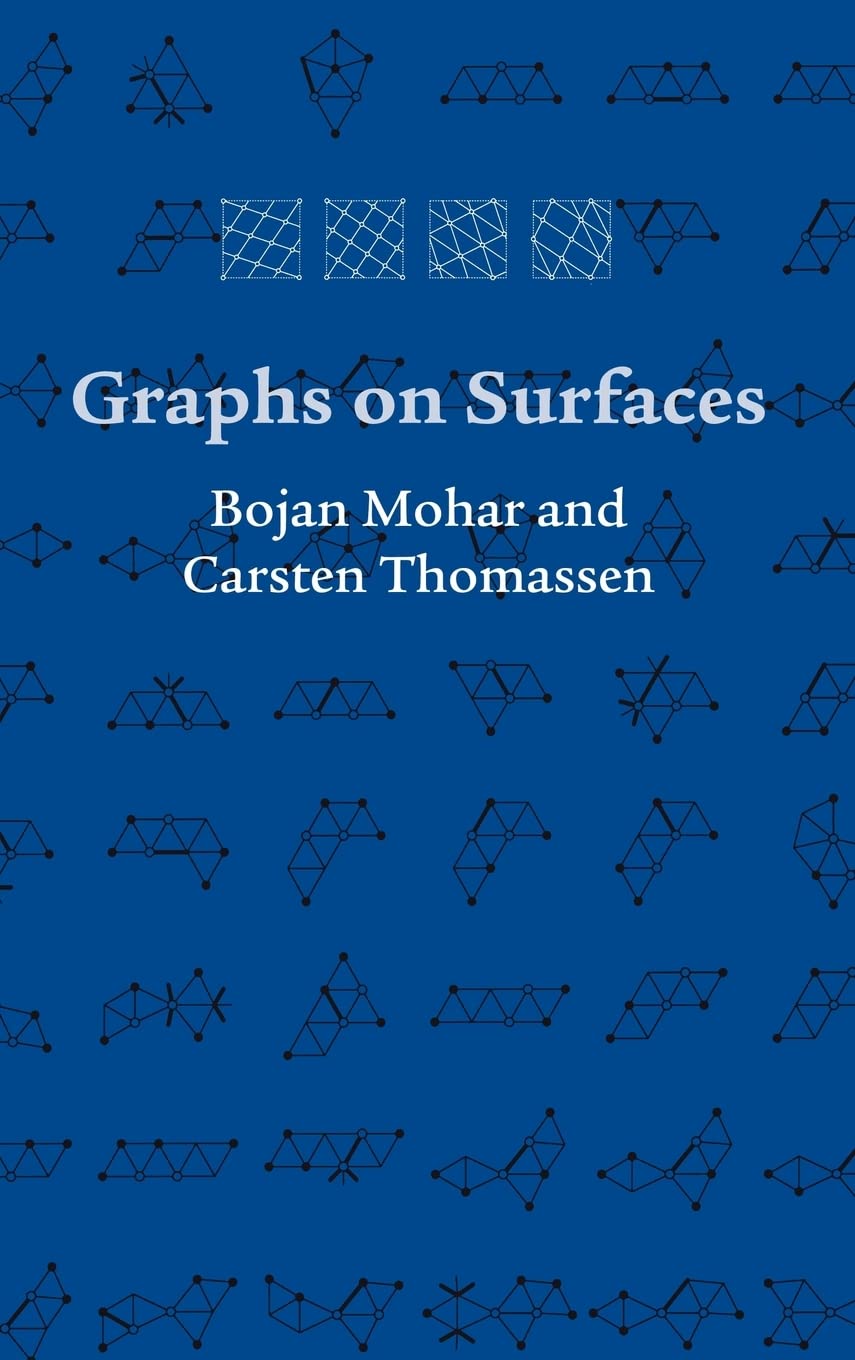
Graph theory is one of the fastest growing branches of mathematics. Until recently, it was regarded as a branch of combinatorics and was best known by the famous fourcolor theorem stating that any map can be colored using only four colors such that no two bordering countries have the same color. Now graph theory is an area of its own with many deep results and beautiful open problems. Graph theory has numerous applications in almost every field of science and has attracted new interest because of its relevance to such technological problems as computer and telephone networking and, of course, the internet. In this new book in the Johns Hopkins Studies in the Mathematical Science series, Bojan Mohar and Carsten Thomassen look at a relatively new area of graph theory: that associated with curved surfaces.Graphs on surfaces form a natural link between discrete and continuous mathematics. The book provides a rigorous and concise introduction to graphs on surfaces and surveys some of the recent developments in this area. Among the basic results discussed are Kuratowski's theorem and other planarity criteria, the Jordan Curve Theorem and some of its extensions, the classification of surfaces, and the HeffterEdmondsRingel rotation principle, which makes it possible to treat graphs on surfaces in a purely combinatorial way. The genus of a graph, contractability of cycles, edgewidth, and facewidth are treated purely combinatorially, and several results related to these concepts are included. The extension by Robertson and Seymour of Kuratowski's theorem to higher surfaces is discussed in detail, and a shorter proof is presented. The book concludes with a survey of recent developments on coloring graphs on surfaces.
⚠️ WARNING (California Proposition 65):
This product may contain chemicals known to the State of California to cause cancer, birth defects, or other reproductive harm.
For more information, please visit www.P65Warnings.ca.gov.