If you have any questions, you are always welcome to contact us. We'll get back to you as soon as possible, withing 24 hours on weekdays.
Customer service
All questions about your order, return and delivery must be sent to our customer service team by e-mail at yourstore@yourdomain.com
Sale & Press
If you are interested in selling our products, need more information about our brand or wish to make a collaboration, please contact us at press@yourdomain.com
Help
If you have any questions, you are always welcome to contact us. We'll get back to you as soon as possible, withing 24 hours on weekdays.
Customer service
All questions about your order, return and delivery must be sent to our customer service team by e-mail at yourstore@yourdomain.com
Sale & Press
If you are interested in selling our products, need more information about our brand or wish to make a collaboration, please contact us at press@yourdomain.com
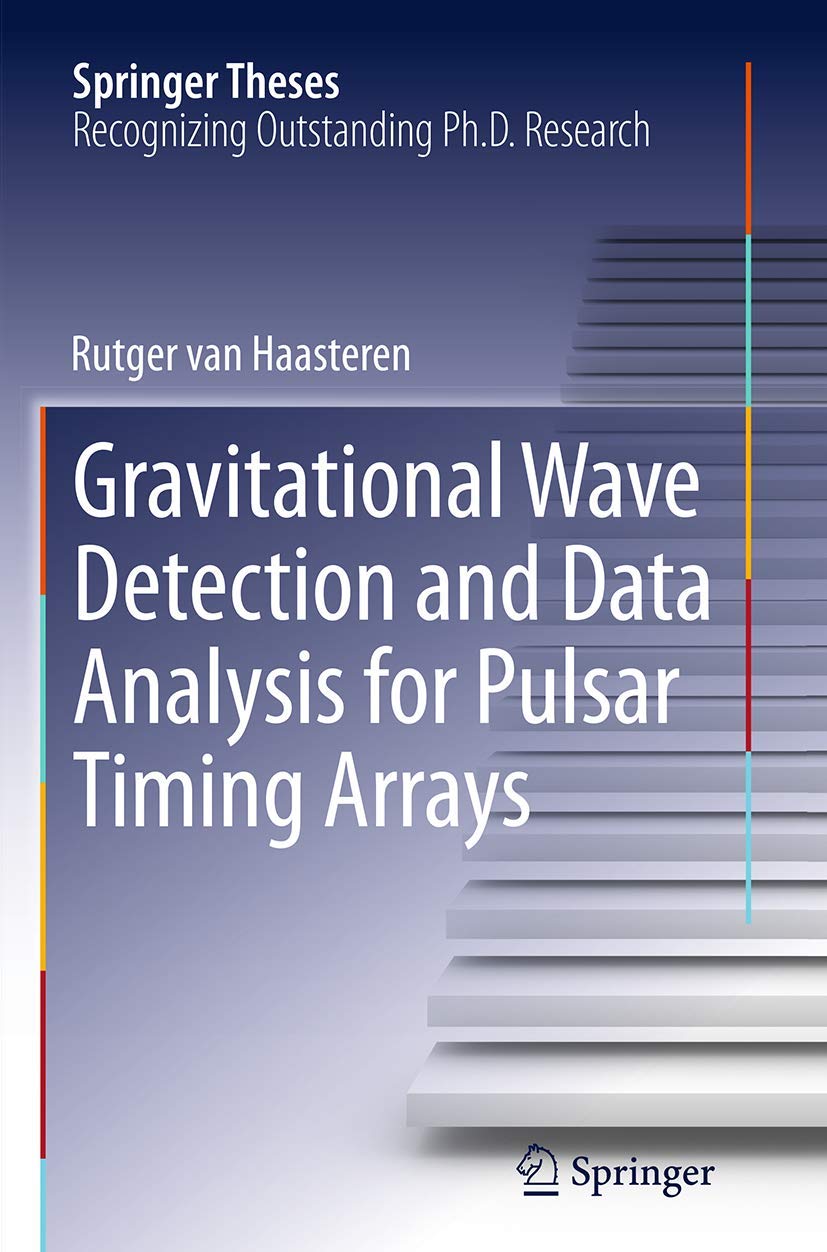
Pulsar timing is a promising method for detecting gravitational waves in the nanoHertz band.In his prize winning Ph.D. thesis Rutger van Haasteren deals with how one takes thousands of seemingly random timing residuals which are measured by pulsar observers, and extracts information about the presence and character of the gravitational waves in the nanoHertz band that are washing over our Galaxy. The author presents a sophisticated mathematical algorithm that deals with this issue. His algorithm is probably the most welldeveloped of those that are currently in use in the Pulsar Timing Array community.In chapter 3, the gravitationalwave memory effect is described. This is one of the first descriptions of this interesting effect in relation with pulsar timing, which may become observable in future Pulsar Timing Array projects.The last part of the work is dedicated to an effort to combine the European pulsar timing data sets in order to search for gravitational waves. This study has placed the most stringent limit to date on the intensity of gravitational waves that are produced by pairs of supermassive black holes dancing around each other in distant galaxies, as well as those that may be produced by vibrating cosmic strings.Rutger van Haasteren has won the 2011 GWIC Thesis Prize of the Gravitational Wave International Community for his innovative work in various directions of the search for gravitational waves by pulsar timing. The work is presented in this Ph.D. thesis.
⚠️ WARNING (California Proposition 65):
This product may contain chemicals known to the State of California to cause cancer,
birth defects, or other reproductive harm.
For MAP (Minimum Advertised Price) violations and Intellectual Property (IP) or Trademark concerns, please contact:
support@ergodebooks.com
⚠️ California Proposition 65 Warning: Some products sold on this website may expose you to chemicals known to the State of California to cause cancer, birth defects, or other reproductive harm. For more information, visit www.P65Warnings.ca.gov.