

Title
Greek and Roman Calendars: Constructions of Time in the Classical World,Used
Sold by Ergodebooks, an authorized reseller.
Returns accepted within 30 days | support@ergodebooks.com
Shipping Information
- Free Standard Shipping — United States only
- Processing Time: 3–5 business days
- Estimated Delivery: 6–10 business days after dispatch
- Double-boxed, fully insured & discreetly packaged
- Tracking number sent via email once dispatched
Returns & Refund
Returns accepted within 30 days of delivery.
Damaged or Defective Item
Free return shipping + replacement or full refund
Wrong Item Received
Free return shipping + replacement or full refund
Change of Mind
Return shipping at customer's expense · 25% restocking fee applies
Payment Option

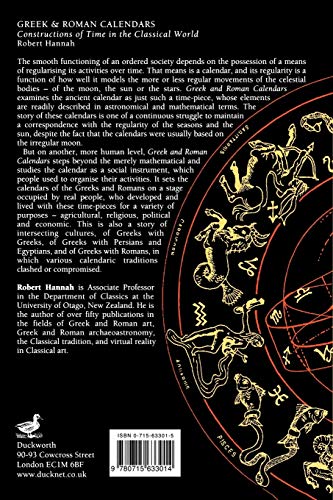
The smooth functioning of an ordered society depends on the possession of a means of regularising its activities over time. That means is a calendar, and its regularity is a function of how well it models the more or less regular movements of the celestial bodies of the moon, the sun or the stars. Greek and Roman Calendars examines the ancient calendar as just such a timepiece, whose elements are readily described in astronomical and mathematical terms. The story of these calendars is one of a continuous struggle to maintain a correspondence with the regularity of the seasons and the sun, despite the fact that the calendars were usually based on the irregular moon. But on another, more human level, Greek and Roman Calendars steps beyond the merely mathematical and studies the calendar as a social instrument, which people used to organise their activities. It sets the calendars of the Greeks and Romans on a stage occupied by real people, who developed and lived with these timepieces for a variety of purposes agricultural, religious, political and economic.This is also a story of intersecting cultures, of Greeks with Greeks, of Greeks with Persians and Egyptians, and of Greeks with Romans, in which various calendaric traditions clashed or compromised.
⚠️ WARNING (California Proposition 65):
This product may contain chemicals known to the State of California to cause cancer, birth defects, or other reproductive harm.
For more information, please visit www.P65Warnings.ca.gov.
- Q: How many pages are in this book? A: This book contains one hundred ninety-two pages. It offers a detailed exploration of Greek and Roman calendars.
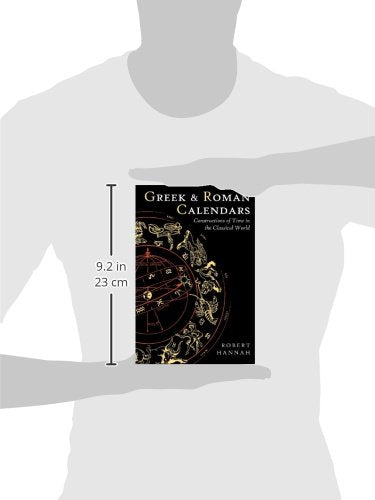
- Q: What are the dimensions of this book? A: The book measures six point fourteen inches in length, zero point thirty-nine inches in width, and nine point twenty-one inches in height. These dimensions make it a portable read.
- Q: What is the binding type of this book? A: This book is published in paperback binding. This makes it lightweight and easy to handle.
- Q: Who is the author of this book? A: The author of this book is Robert Hannah. He provides insights into ancient time-keeping methods.
- Q: What is the main topic of this book? A: The book examines the construction of time through Greek and Roman calendars. It discusses how these calendars were used in society.
- Q: Is this book suitable for beginners? A: Yes, this book is suitable for readers with a general interest in history. It provides accessible information about ancient calendars.
- Q: What themes are explored in this book? A: The book explores themes of agriculture, religion, politics, and economics as they relate to timekeeping. It highlights the social use of calendars.
- Q: Can I read this book for academic purposes? A: Yes, this book is suitable for academic study. It provides a comprehensive analysis of time in the classical world.
- Q: How should I store this book? A: Store this book in a dry place, away from direct sunlight. This will help to maintain its condition over time.
- Q: How should I clean this book? A: To clean this book, gently wipe the cover with a soft, dry cloth. Avoid using water or cleaning solutions.
- Q: What if my book arrives damaged? A: If your book arrives damaged, contact the seller for a replacement or return. Most sellers have a return policy for such issues.
- Q: What is the return policy for this book? A: The return policy varies by seller, but typically you can return the book within a specified time frame if it's in original condition.
- Q: Is this book suitable for children? A: Yes, this book is generally suitable for older children interested in history. However, parental guidance is recommended.
- Q: Does this book include illustrations? A: No, this book does not include illustrations. It focuses on textual analysis of calendars and time in the classical world.
- Q: Is there a digital version of this book? A: Yes, a digital version may be available. Check the publisher's website or online bookstores for availability.
- Q: Is this book an essential read for history buffs? A: Yes, this book is considered a valuable resource for history enthusiasts. It provides unique insights into ancient cultures.