
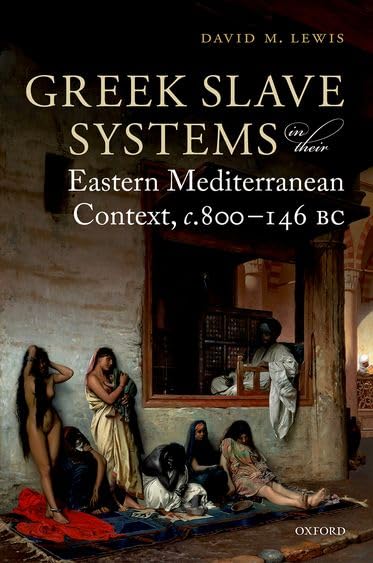
Title
Greek Slave Systems in their Eastern Mediterranean Context, c.800146 BC,New
Sold by Ergodebooks, an authorized reseller.
Returns accepted within 30 days | support@ergodebooks.com
Shipping Information
- Free Standard Shipping — United States only
- Processing Time: 3–5 business days
- Estimated Delivery: 6–10 business days after dispatch
- Double-boxed, fully insured & discreetly packaged
- Tracking number sent via email once dispatched
Returns & Refund
Returns accepted within 30 days of delivery.
Damaged or Defective Item
Free return shipping + replacement or full refund
Wrong Item Received
Free return shipping + replacement or full refund
Change of Mind
Return shipping at customer's expense · 25% restocking fee applies
Payment Option

The orthodox view of slavery in the ancient Mediterranean holds that Greece and Rome were its only 'genuine slave societies', that is, societies in which slave labour contributed significantly to the economy and underpinned the wealth of elites. Other societies, traditionally labelled 'societies with slaves', are thought to have made little use of slave labour and therefore have been largely ignored in recent scholarship. This volume presents a radically different view of the ancient Eastern Mediterranean world, showing that elite exploitation of slave labour in Greece and the Near East shared some fundamental similarities, although the degree of elite dependence on slaves varied from region to region. Whilst slavery was indeed particularly highly developed in Greece and Rome, it was also economically entrenched in Carthage, and played a not insignificant role in the affairs of elites in Israel, Assyria, Babylonia, and Persia. The differing degrees to which Eastern Mediterranean elites exploited slave labour represents the outcome of a complex interplay between cultural, economic, political, geographical, and demographic factors.Proceeding on a regional basis, this book tracks the ways in which local conditions shaped a wide variety of Greek and Near Eastern slave systems, and how the legal architecture of slavery in individual regions was altered and adapted to accommodate these needs. The result is a nuanced exploration of the economic underpinnings of Greek elite culture that sets its reliance on slavery within a broader historical context and sheds light on the complex circumstances from which it emerged.
⚠️ WARNING (California Proposition 65):
This product may contain chemicals known to the State of California to cause cancer, birth defects, or other reproductive harm.
For more information, please visit www.P65Warnings.ca.gov.