
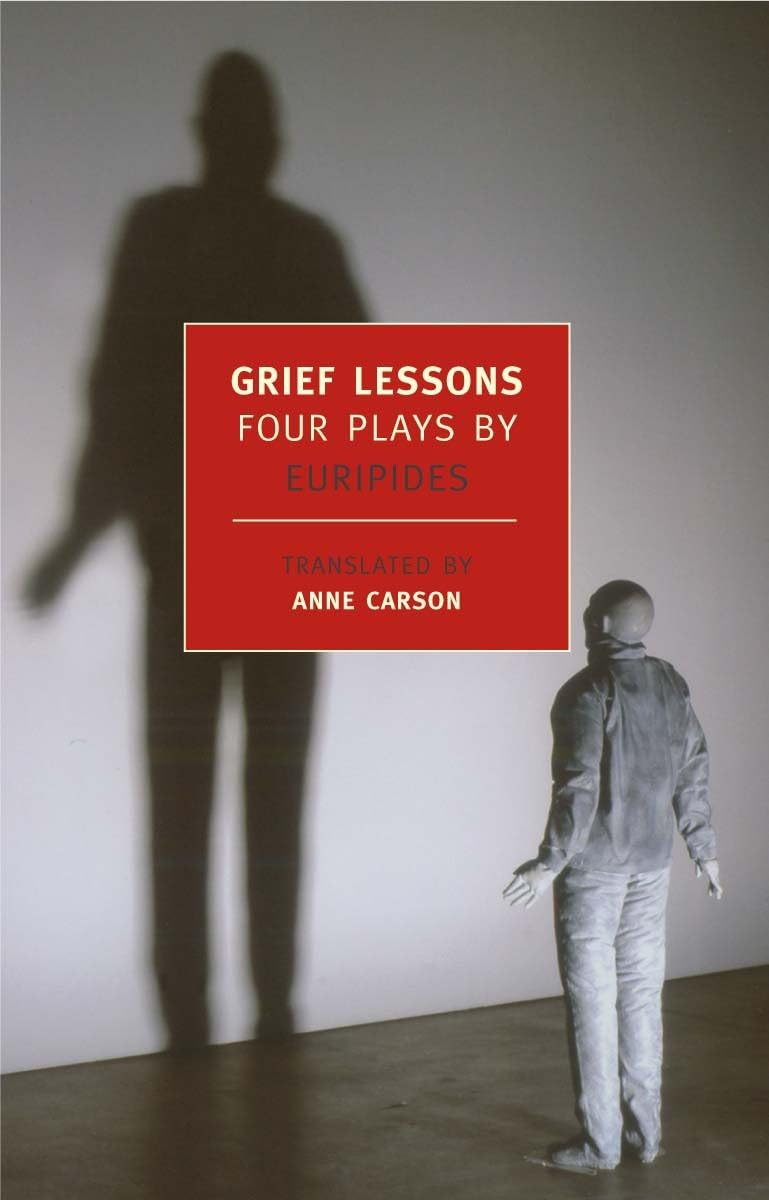
Title
Grief Lessons: Four Plays by Euripides (New York Review Books Classics),Used
Sold by Ergodebooks, an authorized reseller.
Returns accepted within 30 days | support@ergodebooks.com
Shipping Information
- Free Standard Shipping — United States only
- Processing Time: 3–5 business days
- Estimated Delivery: 6–10 business days after dispatch
- Double-boxed, fully insured & discreetly packaged
- Tracking number sent via email once dispatched
Returns & Refund
Returns accepted within 30 days of delivery.
Damaged or Defective Item
Free return shipping + replacement or full refund
Wrong Item Received
Free return shipping + replacement or full refund
Change of Mind
Return shipping at customer's expense · 25% restocking fee applies
Payment Option

Now in paperback.Euripides, the last of the three great tragedians of ancient Athens, reached the height of his renown during the disastrous Peloponnesian War, when democratic Athens was brought down by its own outsized ambitions. Euripides, the classicist Bernard Knox has written, was born never to live in peace with himself and to prevent the rest of mankind from doing so. His plays were shockers: he unmasked heroes, revealing them as foolish and savage, and he wrote about the powerlesswomen and children, slaves and barbariansfor whom tragedy was not so much exceptional as unending. Euripides plays rarely won first prize in the great democratic competitions of ancient Athens, but their combustible mixture of realism and extremism fascinated audiences throughout the Greek world. In the last days of the Peloponnesian War, Athenian prisoners held captive in faroff Sicily were said to have won their freedom by reciting snatches of Euripides latest tragedies.Four of those tragedies are presented here in new translations by the contemporary poet and classicist Anne Carson. They are Herakles, in which the hero swaggers home to destroy his own family; Hekabe, set after the Trojan War, in which Hektors widow takes vengeance on her Greek captors; Hippolytos, about love and the horror of love; and the strange tragiccomedy fable Alkestis, which tells of a husband who arranges for his wife to die in his place. The volume also contains brief introductions by Carson to each of the plays along with two remarkable framing essays: Tragedy: A Curious Art Form and Why I Wrote Two Plays About Phaidra.
⚠️ WARNING (California Proposition 65):
This product may contain chemicals known to the State of California to cause cancer, birth defects, or other reproductive harm.
For more information, please visit www.P65Warnings.ca.gov.
- Q: What are the main themes explored in 'Grief Lessons: Four Plays by Euripides'? A: The main themes in 'Grief Lessons' include the complexities of human emotions, the consequences of war, the struggle for power, and the tragedy of loss. Euripides delves into the lives of women, children, and those marginalized in society, showcasing their suffering and resilience.
- Q: Who translated the plays in this edition? A: The plays in this edition are translated by Anne Carson, a contemporary poet and classicist known for her innovative interpretations of classical texts.
- Q: What plays are included in this collection? A: This collection includes four tragedies: 'Herakles', 'Hekabe', 'Hippolytos', and 'Alkestis', each presented with new translations and introductions by Anne Carson.
- Q: What is the condition of the book? A: The book is brand new and comes in paperback binding, ensuring that it is in excellent condition for readers.
- Q: How many pages does 'Grief Lessons' have? A: The book contains a total of 312 pages, providing a comprehensive look at the selected plays.
- Q: When was 'Grief Lessons: Four Plays by Euripides' published? A: This edition of 'Grief Lessons' was published on September 16, 2008.
- Q: What kind of introduction does the book provide for each play? A: Each play features a brief introduction by Anne Carson, offering insights into the themes and context of the tragedies.
- Q: Is this book suitable for someone new to Greek tragedies? A: Yes, this book is suitable for readers new to Greek tragedies, as Anne Carson's translations and introductions provide accessible entry points into Euripides' works.
- Q: What makes Euripides' plays different from other Greek tragedians? A: Euripides' plays often focus on the psychological depth of characters and the fragility of human nature, presenting heroes as flawed individuals and highlighting the struggles of the powerless.
- Q: Are there any additional essays included in this volume? A: Yes, the volume includes two notable framing essays: 'Tragedy: A Curious Art Form' and 'Why I Wrote Two Plays About Phaidra', offering further context and exploration of Euripides' work.