If you have any questions, you are always welcome to contact us. We'll get back to you as soon as possible, withing 24 hours on weekdays.
Customer service
All questions about your order, return and delivery must be sent to our customer service team by e-mail at yourstore@yourdomain.com
Sale & Press
If you are interested in selling our products, need more information about our brand or wish to make a collaboration, please contact us at press@yourdomain.com
Help
If you have any questions, you are always welcome to contact us. We'll get back to you as soon as possible, withing 24 hours on weekdays.
Customer service
All questions about your order, return and delivery must be sent to our customer service team by e-mail at yourstore@yourdomain.com
Sale & Press
If you are interested in selling our products, need more information about our brand or wish to make a collaboration, please contact us at press@yourdomain.com
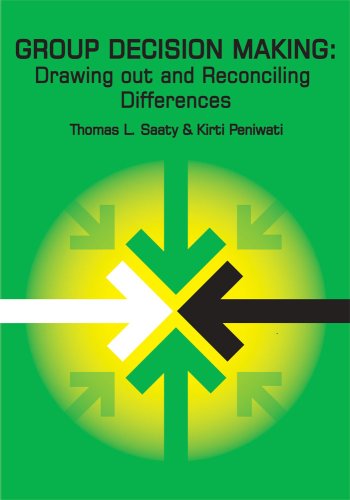
When a group makes a decision, that decision carries a lot more weight than when just one person does it. Think of the founding fathers of the American constitution and how much power and influence their ideas have had in the entire world for more than two hundred years. Also think of gravity, a universal force brought about by an enormous number of minute particles that band together to make a universal law. Together, they create a massive force, a law of nature; alone they can barely be noticed. That is how our minds work by deciding together to create a power that transcends our individuality. Group decision making is a gift and an opportunity to create greater influence through the working together of many minds. This book shows how to use the Analytic Hierarchy Process for hierarchical decision making and the Analytic Network Process for decision making in networks with dependence and feedback in group decision making. Part I discusses the group and the decision and shows the importance of using a structured process, particularly for those high value decisions involving many powerful parties with different interests. It discusses how to facilitate a group decision, combine individual judgments and smooth differences to arrive at a decision that everyone can live with and get behind. Part II discusses the group in planning and how to draw out differences. Part III is about conflict resolution and Part IV is about how to address significant issues that come up in group decision making and shows that it is possible to construct an overall group preference.
⚠️ WARNING (California Proposition 65):
This product may contain chemicals known to the State of California to cause cancer,
birth defects, or other reproductive harm.
For MAP (Minimum Advertised Price) violations and Intellectual Property (IP) or Trademark concerns, please contact:
support@ergodebooks.com
⚠️ California Proposition 65 Warning: Some products sold on this website may expose you to chemicals known to the State of California to cause cancer, birth defects, or other reproductive harm. For more information, visit www.P65Warnings.ca.gov.