If you have any questions, you are always welcome to contact us. We'll get back to you as soon as possible, withing 24 hours on weekdays.
Customer service
All questions about your order, return and delivery must be sent to our customer service team by e-mail at yourstore@yourdomain.com
Sale & Press
If you are interested in selling our products, need more information about our brand or wish to make a collaboration, please contact us at press@yourdomain.com
Help
If you have any questions, you are always welcome to contact us. We'll get back to you as soon as possible, withing 24 hours on weekdays.
Customer service
All questions about your order, return and delivery must be sent to our customer service team by e-mail at yourstore@yourdomain.com
Sale & Press
If you are interested in selling our products, need more information about our brand or wish to make a collaboration, please contact us at press@yourdomain.com
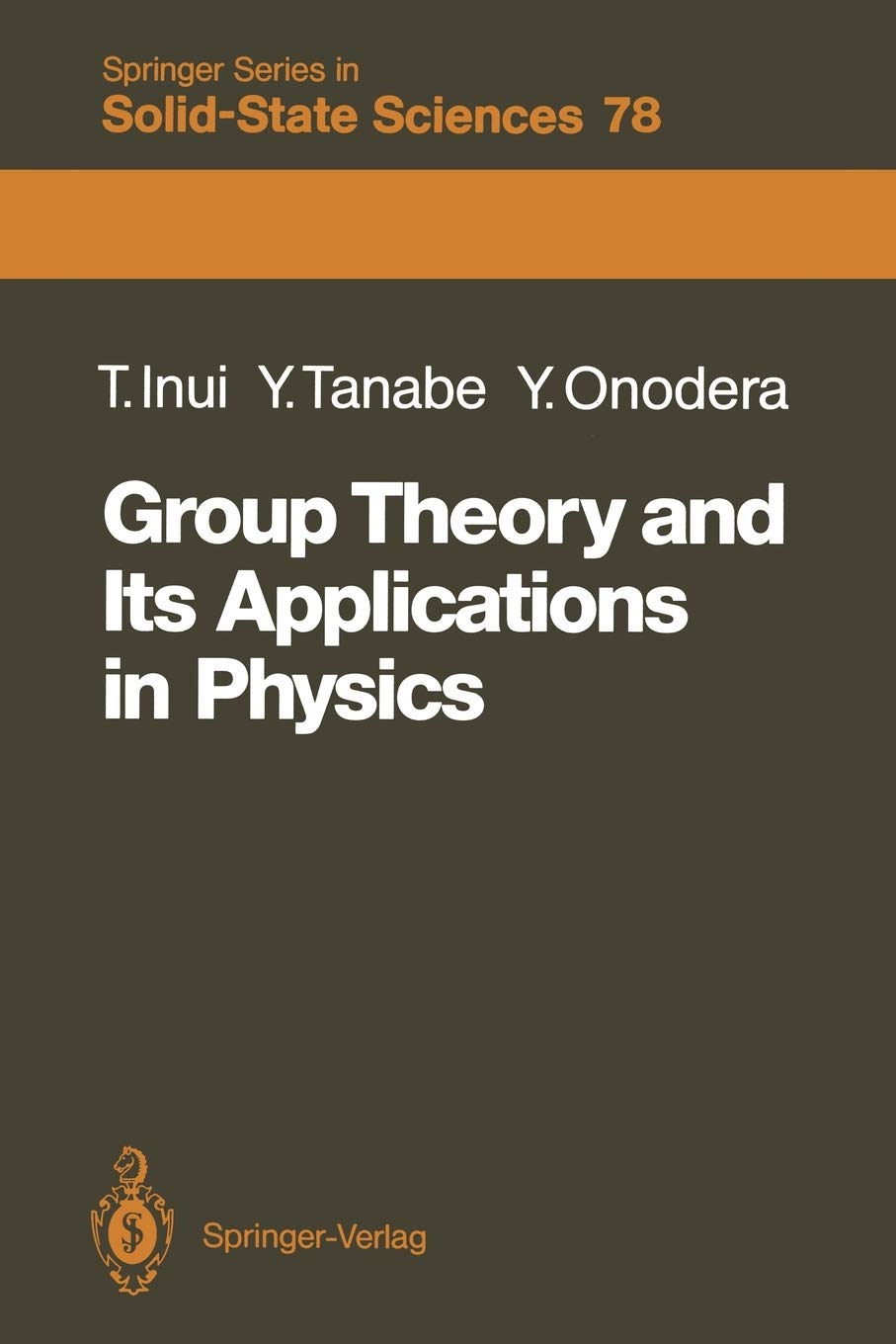
This book has been written to introduce readers to group theory and its ap plications in atomic physics, molecular physics, and solidstate physics. The first Japanese edition was published in 1976. The present English edi tion has been translated by the authors from the revised and enlarged edition of 1980. In translation, slight modifications have been made in. Chaps. 8 and 14 to update and condense the contents, together with some minor additions and improvements throughout the volume. The authors cordially thank Professor J. L. Birman and Professor M. Car dona, who encouraged them to prepare the English translation. Tokyo, January 1990 T. Inui . Y. Tanabe Y. Onodera Preface to the Japanese Edition As the title shows, this book has been prepared as a textbook to introduce readers to the applications of group theory in several fields of physics. Group theory is, in a nutshell, the mathematics of symmetry. It has three main areas of application in modern physics. The first originates from early studies of crystal morphology and constitutes a framework for classical crystal physics. The analysis of the symmetry of tensors representing macroscopic physical properties (such as elastic constants) belongs to this category. The sec ond area was enunciated by E. Wigner (1926) as a powerful means of handling quantummechanical problems and was first applied in this sense to the analysis of atomic spectra. Soon, H.
⚠️ WARNING (California Proposition 65):
This product may contain chemicals known to the State of California to cause cancer,
birth defects, or other reproductive harm.
For MAP (Minimum Advertised Price) violations and Intellectual Property (IP) or Trademark concerns, please contact:
support@ergodebooks.com
⚠️ California Proposition 65 Warning: Some products sold on this website may expose you to chemicals known to the State of California to cause cancer, birth defects, or other reproductive harm. For more information, visit www.P65Warnings.ca.gov.