
Title
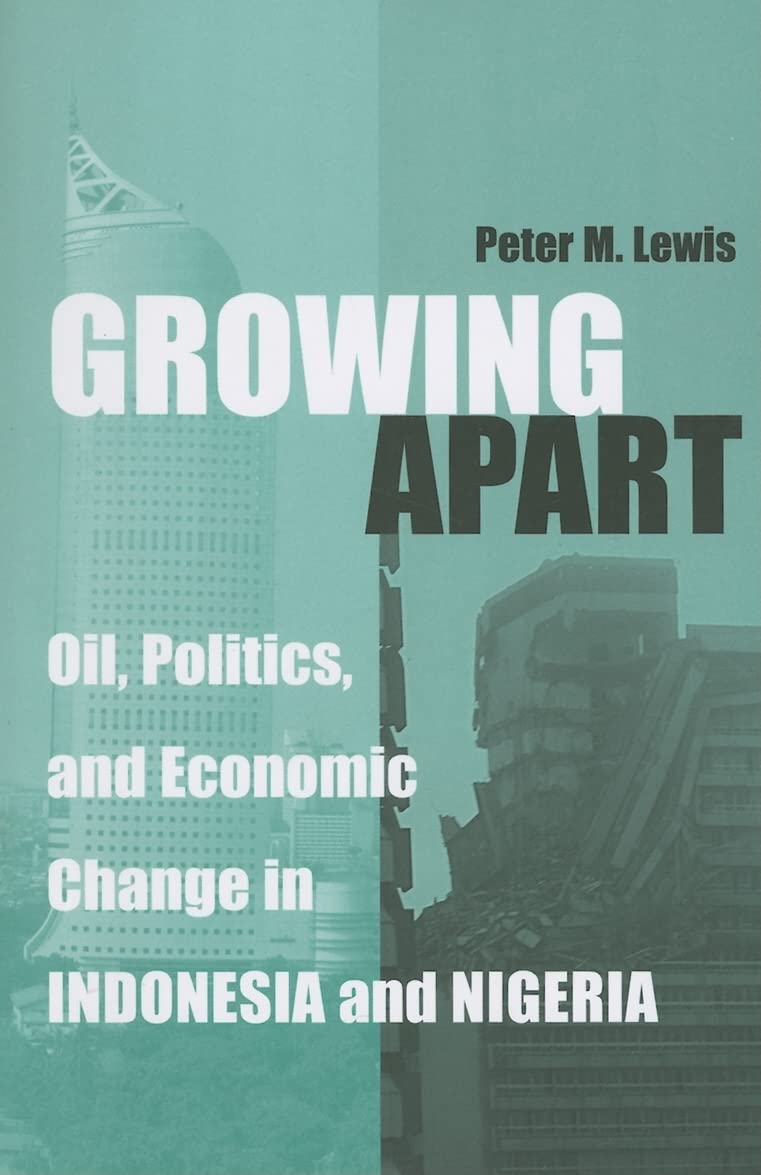
Growing Apart: Oil, Politics, and Economic Change in Indonesia and Nigeria (Interests, Identities, And Institutions In Comparati,Used
Sold by Ergodebooks, an authorized reseller.
Returns accepted within 30 days | support@ergodebooks.com
Shipping Information
- Free Standard Shipping — United States only
- Processing Time: 3–5 business days
- Estimated Delivery: 6–10 business days after dispatch
- Double-boxed, fully insured & discreetly packaged
- Tracking number sent via email once dispatched
Returns & Refund
Returns accepted within 30 days of delivery.
Damaged or Defective Item
Free return shipping + replacement or full refund
Wrong Item Received
Free return shipping + replacement or full refund
Change of Mind
Return shipping at customer's expense · 25% restocking fee applies
Payment Option

Growing Apart is an important and distinguished contribution to the literature on the political economy of development. Indonesia and Nigeria have long presented one of the most natural opportunities for comparative study. Peter Lewis, one of America's best scholars of Nigeria, has produced the definitive treatment of their divergent development paths. In the process, he tells us much theoretically about when, why, and how political institutions shape economic growth.'Larry Diamond, Senior Fellow, Hoover Institution'Growing Apart is a careful and sophisticated analysis of the political factors that have shaped the economic fortunes of Indonesia and Nigeria. Both scholars and policymakers will benefit from this book's valuable insights.'Michael L. Ross, Associate Professor of Political Science, Chair of International Development Studies, UCLA'Lewis presents an extraordinarily welldocumented comparative case study of two countries with a great deal in common, and yet with remarkably different postcolonial histories. His approach is a welcome departure from currently fashionable attempts to explain development using large, multicountry databases packed with often dubious measures of various aspects of 'governance.''Ross H. McLeod, Editor, Bulletin of Indonesian Economic Studies'This is a highly readable and important book. Peter Lewis provides us with both a compelling institutionalist analysis of economic development performance and a very insightful comparative account of the political economies of two highly complex developing countries, Nigeria and Indonesia. His wellinformed account generates interesting findings by focusing on the ability of leaders in both countries to make credible commitments to the private sector and assemble progrowth coalitions. This kind of crossregional political economy is often advocated in the profession but actually quite rare because it is so hard to do well. Lewis's book will set the standard for a long time.'Nicolas van de Walle, John S. Knight Professor of International Studies, Cornell UniversityPeter M. Lewis is Associate Professor and Director of the African Studies Program, Johns Hopkins University, School of Advanced International Studies.
⚠️ WARNING (California Proposition 65):
This product may contain chemicals known to the State of California to cause cancer, birth defects, or other reproductive harm.
For more information, please visit www.P65Warnings.ca.gov.
- Q: What is the main focus of the book 'Growing Apart'? A: 'Growing Apart' primarily examines the political economy of development in Indonesia and Nigeria, analyzing how political institutions influence economic growth in these two countries.
- Q: Who is the author of 'Growing Apart'? A: The author of 'Growing Apart' is Peter M. Lewis, who is an Associate Professor and Director of the African Studies Program at Johns Hopkins University.
- Q: How many pages does 'Growing Apart' contain? A: 'Growing Apart' has a total of 360 pages.
- Q: What is the publication date of 'Growing Apart'? A: 'Growing Apart' was published on April 17, 2007.
- Q: What type of binding does the book have? A: 'Growing Apart' is available in a paperback binding.
- Q: Is there any specific edition of 'Growing Apart'? A: Yes, 'Growing Apart' is published as a First Edition.
- Q: What are the key themes explored in 'Growing Apart'? A: Key themes in 'Growing Apart' include the impact of political factors on economic fortunes and the comparative analysis of the divergent development paths of Indonesia and Nigeria.
- Q: What credentials does Peter Lewis have that contribute to the credibility of 'Growing Apart'? A: Peter Lewis is a well-respected scholar in the field of political science, specifically focused on Nigeria, and his work is recognized for its depth and thorough documentation.
- Q: Can 'Growing Apart' benefit policymakers? A: Yes, the insights presented in 'Growing Apart' are valuable for both scholars and policymakers interested in understanding the relationship between political institutions and economic development.
- Q: What makes 'Growing Apart' a significant contribution to comparative politics? A: 'Growing Apart' is considered a significant contribution due to its rigorous analysis of two countries with similar backgrounds yet different postcolonial experiences, offering a nuanced understanding of political economy.