
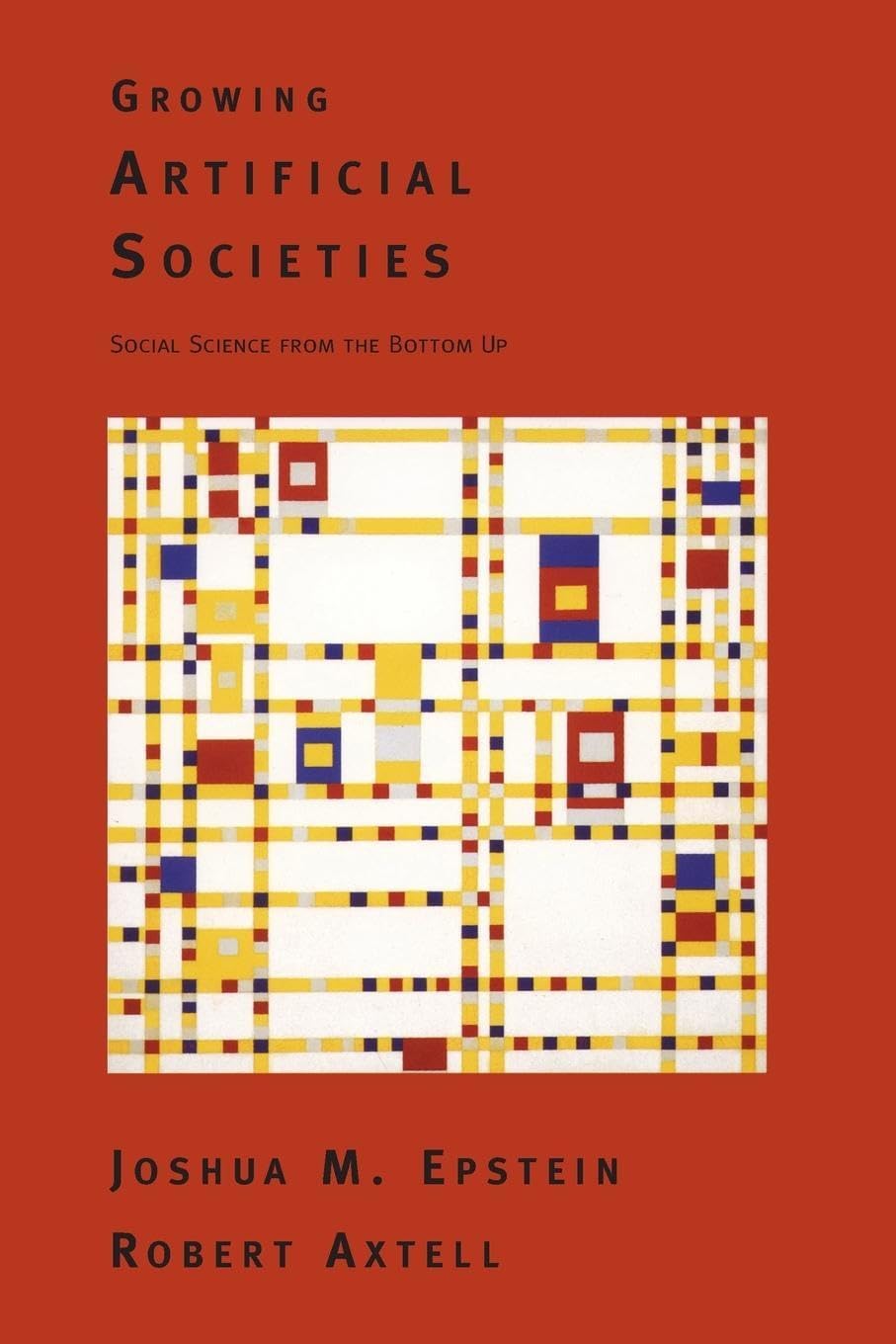
Title
Growing Artificial Societies: Social Science From The Bottom Up (Complex Adaptive Systems)
Sold by Ergodebooks, an authorized reseller.
Returns accepted within 30 days | support@ergodebooks.com
Shipping Information
- Free Standard Shipping — United States only
- Processing Time: 3–5 business days
- Estimated Delivery: 6–10 business days after dispatch
- Double-boxed, fully insured & discreetly packaged
- Tracking number sent via email once dispatched
Returns & Refund
Returns accepted within 30 days of delivery.
Damaged or Defective Item
Free return shipping + replacement or full refund
Wrong Item Received
Free return shipping + replacement or full refund
Change of Mind
Return shipping at customer's expense · 25% restocking fee applies
Payment Option

A Brookings Institution Press And Mit Press Publicationhow Do Social Structures And Group Behaviors Arise From The Interaction Of Individuals? In This Groundbreaking Study, Joshua M. Epstein And Robert L. Axtell Approach This Ageold Question With Cuttingedge Computer Simulation Techniques. Such Fundamental Collective Behaviors As Group Formation, Cultural Transmission, Combat, And Trade Are Seen To Emerge From The Interaction Of Individual Agents Following Simple Local Rules.In Their Computer Model, Epstein And Axtell Begin The Development Of A Bottom Up Social Science. Their Program, Named Sugarscape, Simulates The Behavior Of Artificial People (Agents) Located On A Landscape Of A Generalized Resource (Sugar). Agents Are Born Onto The Sugarscape With A Vision, A Metabolism, A Speed, And Other Genetic Attributes. Their Movement Is Governed By A Simple Local Rule: Look Around As Far As You Can; Find The Spot With The Most Sugar; Go There And Eat The Sugar. Every Time An Agent Moves, It Burns Sugar At An Amount Equal To Its Metabolic Rate. Agents Die If And When They Burn Up All Their Sugar. A Remarkable Range Of Social Phenomena Emerge. For Example, When Seasons Are Introduced, Migration And Hibernation Can Be Observed. Agents Are Accumulating Sugar At All Times, So There Is Always A Distribution Of Wealth.Next, Epstein And Axtell Attempt To Grow A Protohistory Of Civilization. It Starts With Agents Scattered About A Twinpeaked Landscape; Over Time, There Is Selforganization Into Spatially Segregated And Culturally Distinct Tribes Centered On The Peaks Of The Sugarscape. Population Growth Forces Each Tribe To Disperse Into The Sugar Lowlands Between The Mountains. There, The Two Tribes Interact, Engaging In Combat And Competing For Cultural Dominance, To Produce Complex Social Histories With Violent Expansionist Phases, Peaceful Periods, And So On. The Protohistory Combines A Number Of Ingredients, Each Of Which Generates Insights Of Its Own. One Of These Ingredients Is Sexual Reproduction. In Some Runs, The Population Becomes Thin, Birth Rates Fall, And The Population Can Crash. Alternatively, The Agents May Overpopulate Their Environment, Driving It Into Ecological Collapse.When Epstein And Axtell Introduce A Second Resource (Spice) To The Sugarscape And Allow The Agents To Trade, An Economic Market Emerges. The Introduction Of Pollution Resulting From Resourcemining Permits The Study Of Economic Markets In The Presence Of Environmental Factors.This Study Is Part Of The 2050 Project, A Joint Venture Of The Santa Fe Institute, The World Resources Institute, And The Brookings Institution. The Project Is An International Effort To Identify Conditions For A Sustainable Global System In The Middle Of The Next Century And To Design Policy Actions To Help Achieve Such A System.
⚠️ WARNING (California Proposition 65):
This product may contain chemicals known to the State of California to cause cancer, birth defects, or other reproductive harm.
For more information, please visit www.P65Warnings.ca.gov.
- Q: What is the page count of 'Growing Artificial Societies'? A: This book contains two hundred twenty-six pages. It offers an in-depth exploration of social structures and group behaviors through computer simulations.
- Q: What are the dimensions of the book? A: The book measures eight point nine eight inches in length, six point one three inches in width, and nine point zero two inches in height.
- Q: What type of binding does this book have? A: This book is published in paperback binding. This makes it lightweight and easy to handle for readers.
- Q: What themes does this book cover? A: It covers themes such as social structures, group behaviors, and economic markets. The authors use simulations to illustrate these complex topics.
- Q: What is the author's background? A: The book is authored by Joshua M. Epstein and Robert L. Axtell. They are well-known researchers in the fields of social science and complex adaptive systems.
- Q: How do I use 'Growing Artificial Societies' for research? A: You can use this book as a foundational text for understanding social dynamics. It is particularly useful for students and researchers in behavioral psychology and social sciences.
- Q: Is this book suitable for beginners in social science? A: Yes, this book is suitable for beginners. It introduces key concepts in social science through engaging simulations that are easy to understand.
- Q: What type of reader would benefit from this book? A: Students, educators, and professionals in behavioral psychology and social sciences will benefit greatly from this book. It provides insights into complex social phenomena.
- Q: How should I store this book to keep it in good condition? A: Store this book in a cool, dry place away from direct sunlight. Keeping it on a bookshelf will help maintain its shape and prevent damage.
- Q: How do I clean the book if it gets dirty? A: To clean the book, use a dry cloth to gently wipe the cover. Avoid using water or cleaning solutions to prevent damage to the pages.
- Q: Can I return the book if I am not satisfied? A: Yes, you can return the book within a specified return period if you are not satisfied. Check the seller's return policy for specific details.
- Q: What if the book arrives damaged? A: If the book arrives damaged, contact the seller for a replacement or refund. Most sellers have policies in place to address such issues.
- Q: Is there a warranty for this book? A: No, books typically do not come with a warranty. However, you can check the return policy for protection against defective copies.
- Q: How does this book compare to other texts in social science? A: This book stands out due to its unique approach using computer simulations. It offers insights not commonly found in traditional social science texts.
- Q: Is this book appropriate for academic study? A: Yes, it is appropriate for academic study. It provides valuable information and methodologies that are applicable in research and classroom settings.