
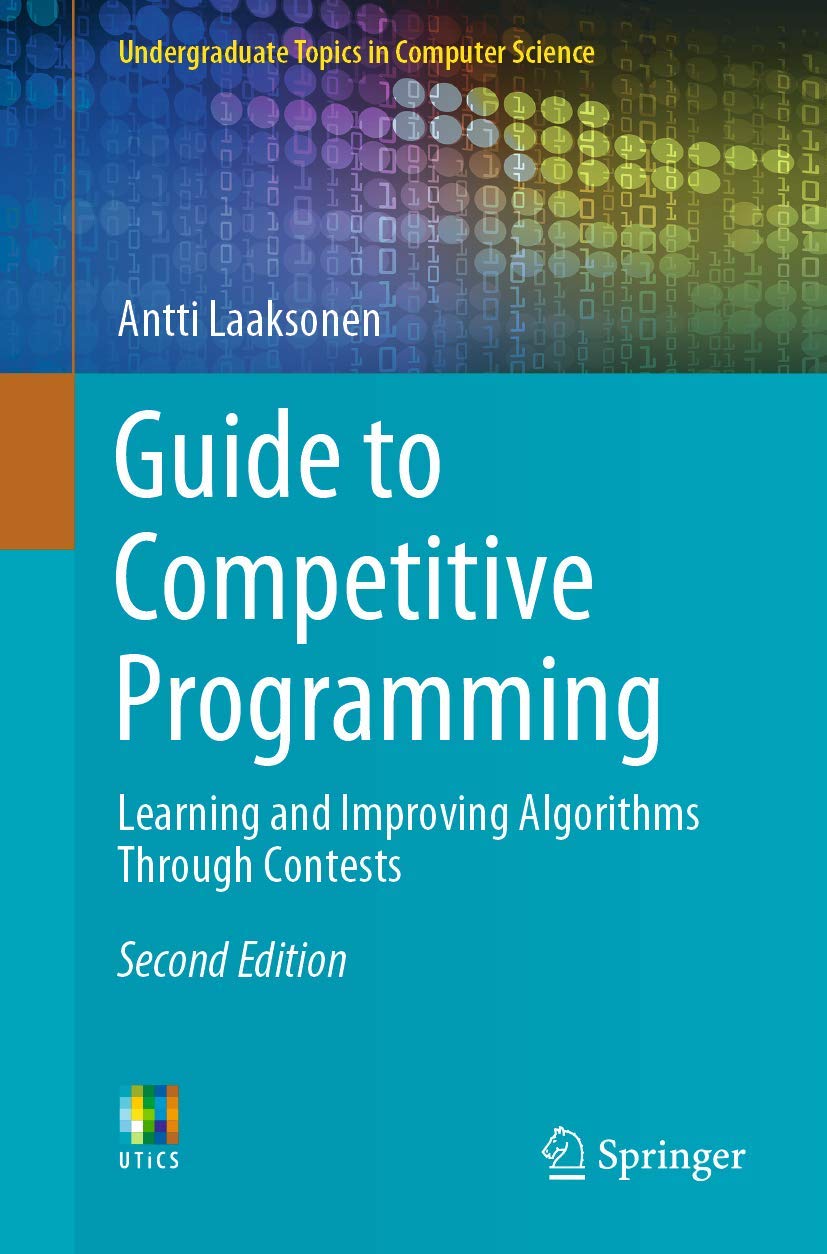
Title
Guide To Competitive Programming: Learning And Improving Algorithms Through Contests (Undergraduate Topics In Computer Science)
Sold by Ergodebooks, an authorized reseller.
Returns accepted within 30 days | support@ergodebooks.com
Shipping Information
- Free Standard Shipping — United States only
- Processing Time: 3–5 business days
- Estimated Delivery: 6–10 business days after dispatch
- Double-boxed, fully insured & discreetly packaged
- Tracking number sent via email once dispatched
Returns & Refund
Returns accepted within 30 days of delivery.
Damaged or Defective Item
Free return shipping + replacement or full refund
Wrong Item Received
Free return shipping + replacement or full refund
Change of Mind
Return shipping at customer's expense · 25% restocking fee applies
Payment Option

Building On What Already Is The Most Comprehensive Introduction To Competitive Programming, This Enhanced New Textbook Features New Material On Advanced Topics, Such As Calculating Fourier Transforms, Finding Minimum Cost Flows In Graphs, And Using Automata In String Problems. Critically, The Text Accessibly Describes And Shows How Competitive Programming Is A Proven Method Of Implementing And Testing Algorithms, As Well As Developing Computational Thinking And Improving Both Programming And Debugging Skills.Topics And Features: Introduces Dynamic Programming And Other Fundamental Algorithm Design Techniques, And Investigates A Wide Selection Of Graph Algorithms; Compatible With The Ioi Syllabus, Yet Also Covering More Advanced Topics, Such As Maximum Flows, Nim Theory, And Suffix Structures; Surveys Specialized Algorithms For Trees, And Discusses The Mathematical Topics That Are Relevant In Competitive Programming; Reviews The Features Of The C++ Programminglanguage, And Describes How To Create Efficient Algorithms That Can Quickly Process Large Data Sets; Discusses Sorting Algorithms And Binary Search, And Examines A Selection Of Data Structures Of The C++ Standard Library; Covers Such Advanced Algorithm Design Topics As Bitparallelism And Amortized Analysis, And Presents A Focus On Efficiently Processing Array Range Queries; Describes A Selection Of More Advanced Topics, Including Squareroot Algorithms And Dynamic Programming Optimization.Fully Updated, Expanded And Easy To Follow, This Core Textbook/Guide Is An Ideal Reference For All Students Needing To Learn Algorithms And To Practice For Programming Contests. Knowledge Of Programming Basics Is Assumed, But Previous Background In Algorithm Design Or Programming Contests Is Not Necessary. With Its Breadth Of Topics, Examples And References, The Book Is Eminently Suitable For Both Beginners And More Experienced Readers Alike.
⚠️ WARNING (California Proposition 65):
This product may contain chemicals known to the State of California to cause cancer, birth defects, or other reproductive harm.
For more information, please visit www.P65Warnings.ca.gov.
- Q: What is the size of the book? A: The book measures six point one inches in length, zero point seventy-five inches in width, and nine point twenty-five inches in height.
- Q: How many pages does this book have? A: This book contains three hundred twenty-eight pages, providing a comprehensive guide to competitive programming.
- Q: What type of binding does the book use? A: The book is available in paperback binding, making it easy to handle and read.
- Q: Is this book suitable for beginners? A: Yes, this book is suitable for beginners as it assumes a basic knowledge of programming without requiring prior experience in algorithm design.
- Q: What topics does the book cover? A: The book covers a wide range of topics including dynamic programming, graph algorithms, and advanced algorithm design techniques.
- Q: Can I use this book to prepare for programming contests? A: Yes, this book is designed to help readers prepare for programming contests by providing practical algorithms and problem-solving techniques.
- Q: How should I store this book? A: Store the book in a cool, dry place to prevent any damage and ensure its longevity.
- Q: Is there any special care needed for this book? A: No special care is needed; simply avoid exposure to moisture and direct sunlight to keep it in good condition.
- Q: What if the book arrives damaged? A: If the book arrives damaged, you should contact the seller for return or replacement options.
- Q: Can I find advanced topics in this book? A: Yes, the book includes advanced topics such as maximum flows, Nim theory, and dynamic programming optimization.
- Q: Is this book compatible with any specific syllabus? A: Yes, the book is compatible with the International Olympiad in Informatics (IOI) syllabus.
- Q: What programming language is primarily discussed in the book? A: The book primarily discusses algorithms using the C++ programming language.
- Q: Does this book include practical examples? A: Yes, the book contains numerous examples to illustrate the concepts and techniques discussed.
- Q: Is there a focus on computational thinking in the book? A: Yes, the book emphasizes computational thinking as a key aspect of learning algorithms.
- Q: What is the author's name? A: The author of the book is Antti Laaksonen.