
Title
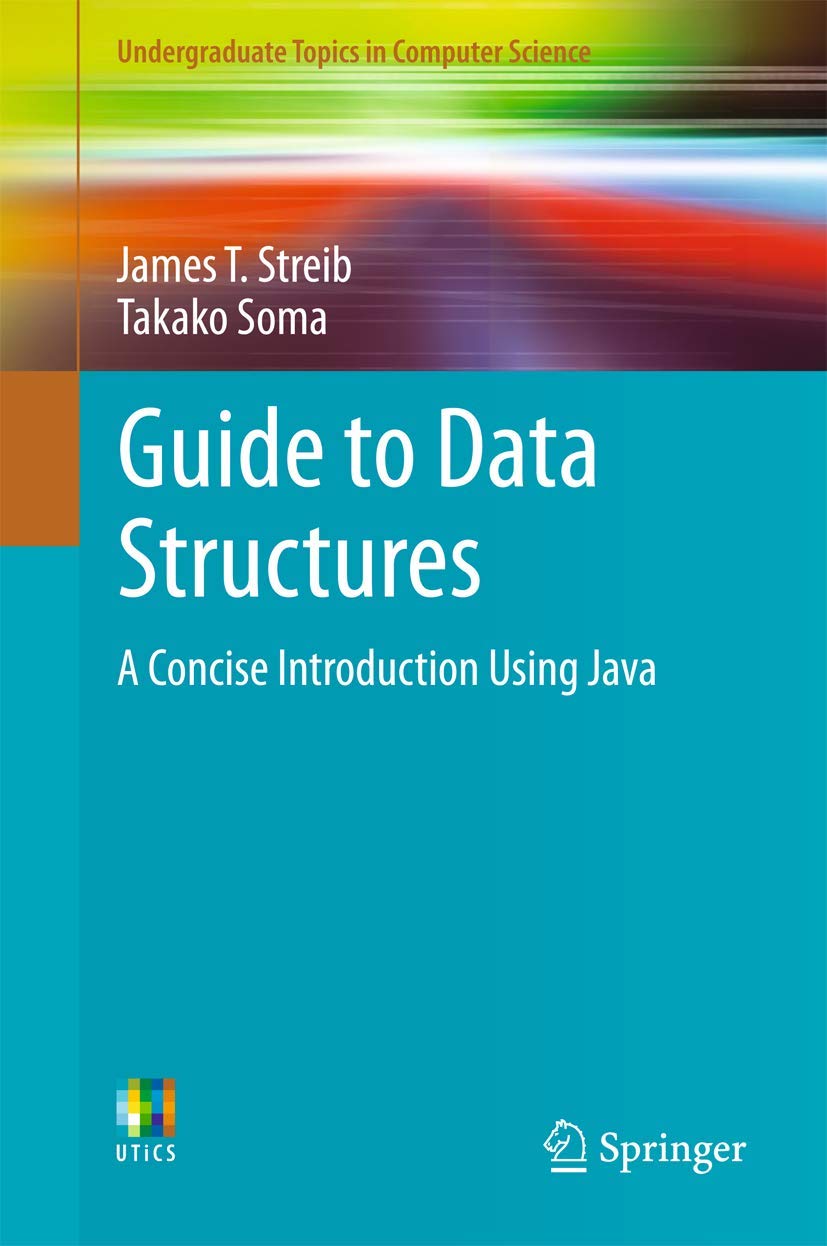
Guide to Data Structures: A Concise Introduction Using Java (Undergraduate Topics in Computer Science),Used
Sold by Ergodebooks, an authorized reseller.
Returns accepted within 30 days | support@ergodebooks.com
Shipping Information
- Free Standard Shipping — United States only
- Processing Time: 3–5 business days
- Estimated Delivery: 6–10 business days after dispatch
- Double-boxed, fully insured & discreetly packaged
- Tracking number sent via email once dispatched
Returns & Refund
Returns accepted within 30 days of delivery.
Damaged or Defective Item
Free return shipping + replacement or full refund
Wrong Item Received
Free return shipping + replacement or full refund
Change of Mind
Return shipping at customer's expense · 25% restocking fee applies
Payment Option

This accessible and engaging textbook/guide provides a concise introduction to data structures and associated algorithms. Emphasis is placed on the fundamentals of data structures, enabling the reader to quickly learn the key concepts, and providing a strong foundation for later studies of more complex topics. The coverage includes discussions on stacks, queues, lists, (using both arrays and links), sorting, and elementary binary trees, heaps, and hashing. This content is also a natural continuation from the material provided in the separate Springer title Guide to Java by the same authors.Topics and features: reviews the preliminary concepts, and introduces stacks and queues using arrays, along with a discussion of arraybased lists; examines linked lists, the implementation of stacks and queues using references, binary trees, a range of varied sorting techniques, heaps, and hashing; presents both primitive and generic data types in each chapter, and makes use of contour diagrams to illustrate objectoriented concepts; includes chapter summaries, and asks the reader questions to help them interact with the material; contains numerous examples and illustrations, and one or more complete program in every chapter; provides exercises at the end of each chapter, as well as solutions to selected exercises, and a glossary of important terms.This clearlywritten work is an ideal classroom text for a second semester course in programming using the Java programming language, in preparation for a subsequent advanced course in data structures and algorithms. The book is also eminently suitable as a selfstudy guide in either academe or industry.
⚠️ WARNING (California Proposition 65):
This product may contain chemicals known to the State of California to cause cancer, birth defects, or other reproductive harm.
For more information, please visit www.P65Warnings.ca.gov.
- Q: What are the dimensions of the book? A: The book measures six point one inches in length, nine point two five inches in height, and zero point nine one inches in width.
- Q: How many pages does the book have? A: The book contains three hundred eighty-nine pages, providing an extensive exploration of data structures.
- Q: What type of binding does this book have? A: This book is available in paperback binding, making it lightweight and portable for readers.
- Q: What is the reading level of this book? A: This book is suitable for undergraduate students, particularly those in their second semester of programming.
- Q: Is this book suitable for self-study? A: Yes, this book is an excellent self-study guide for both academic and industry professionals looking to understand data structures.
- Q: What programming language is used in this book? A: The book uses Java as the primary programming language to explain data structures and algorithms.
- Q: How do I engage with the material in this book? A: Each chapter includes summaries, questions for interaction, and exercises to help reinforce learning and comprehension.
- Q: Is this book appropriate for beginners? A: Yes, this book is designed to introduce fundamental concepts, making it suitable for beginners in programming.
- Q: What topics are covered in this book? A: Topics include stacks, queues, lists, sorting techniques, binary trees, heaps, and hashing, providing a comprehensive overview of data structures.
- Q: Are solutions provided for the exercises? A: Yes, the book includes solutions to selected exercises at the end of each chapter to aid learning.
- Q: What should I do if my book arrives damaged? A: If your book arrives damaged, contact the seller or manufacturer promptly to initiate a return or exchange.
- Q: Does the book come with any digital resources? A: No, the book does not include any digital resources; it is purely a physical paperback edition.
- Q: Are there illustrations in the book? A: Yes, the book contains numerous examples and illustrations to support the learning of data structures and algorithms.
- Q: Can I use this book for a course in algorithms? A: Yes, this book serves as a foundation for more advanced studies in algorithms following the introduction to data structures.
- Q: Does this book include a glossary of terms? A: Yes, the book provides a glossary of important terms to assist readers in understanding key concepts.