
Title
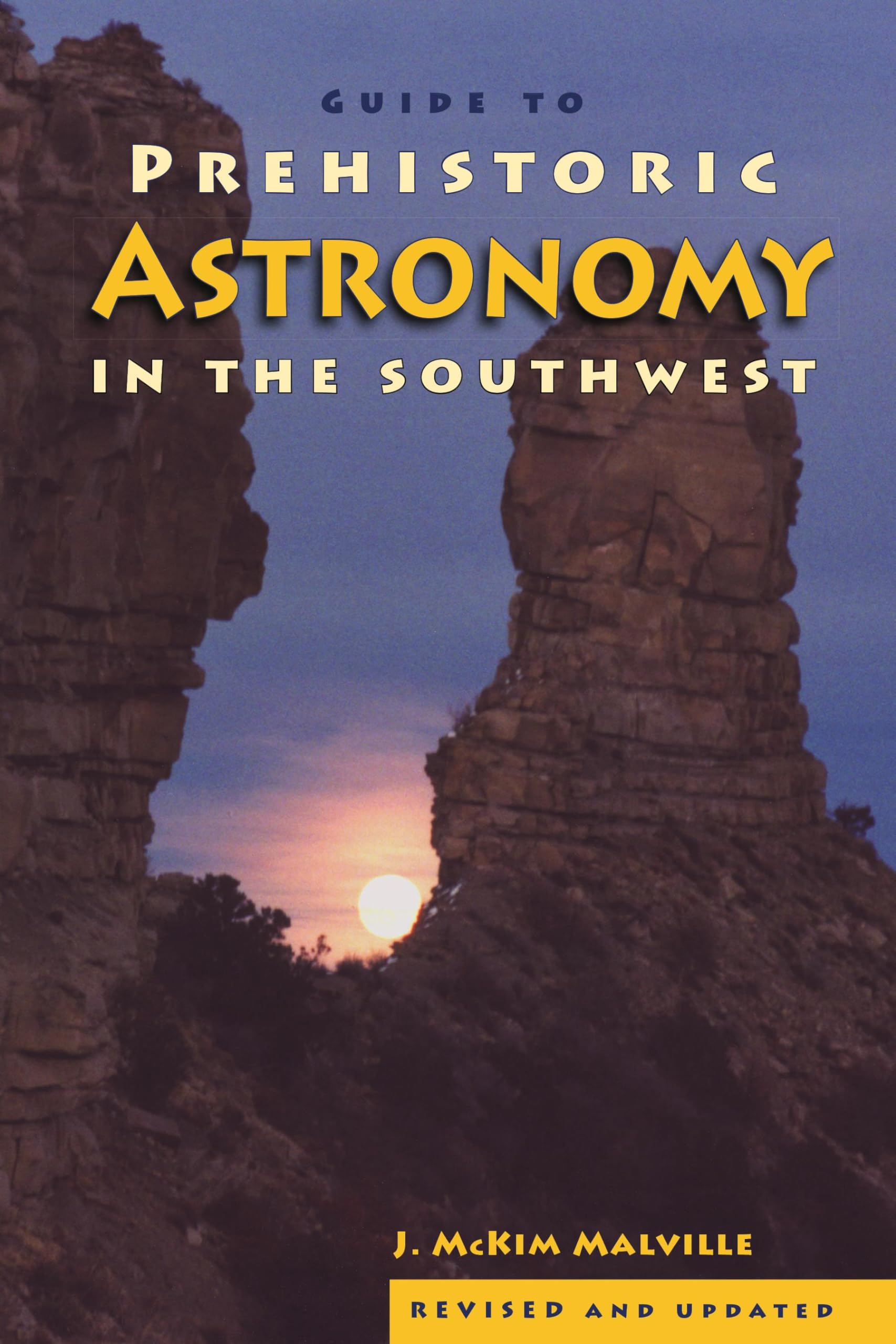
Guide to Prehistoric Astronomy in the Southwest,New
Sold by Ergodebooks, an authorized reseller.
Returns accepted within 30 days | support@ergodebooks.com
Shipping Information
- Free Standard Shipping — United States only
- Processing Time: 3–5 business days
- Estimated Delivery: 6–10 business days after dispatch
- Double-boxed, fully insured & discreetly packaged
- Tracking number sent via email once dispatched
Returns & Refund
Returns accepted within 30 days of delivery.
Damaged or Defective Item
Free return shipping + replacement or full refund
Wrong Item Received
Free return shipping + replacement or full refund
Change of Mind
Return shipping at customer's expense · 25% restocking fee applies
Payment Option

Since the last edition of 'Guide to Prehistoric Astronomy in the Southwest' in 1993, there has been a steady growth in the knowledge of astronomy practiced by the Ancestral Pueblo. Predictions that had been made in the last edition have been verified in the many annual returns of the solstice sun and, after 18.6 years, the return of the major standstill moon. New work in archaeology has been published on Chimney Rock, Chaco Canyon, Mesa Verde, Yellow Jacket, and Hovenweep, which reveals even more clearly how culture and astronomy were integrated.Astronomy can now be understood as an essential aspect of the whole culture of the Ancestral Pueblo. The approach of this book is a synthesis of astronomy, people, and culture. After an introduction to basic astronomy and archaeology, the book identifies specific places where one can view evidence for astronomical practices, as well as observing essentially the same sunrises that were observed by the Ancestral Pueblo a thousand years ago. Astronomy did not arrive in the area fully born, and the book shows how astronomy evolved with the practical and ceremonial needs of the people. Living quarters and ceremonial spaces started out in parallel to the heavens, probably due to ancient memories of migrations from the north.Astronomical calendars were needed to organize periodic festivals and integrate the vast spaces of the Chaco regional system. Cycles of the sun and moon were used for ceremonies involving sacred time. We have located calendrical stations in Chaco Canyon that would have provided the dates for winter and summer solstice festivals in the canyon. We now understand how Chimney Rock could have functioned as a Pueblo version of the Greenwich Observatory, by providing calendrical dates through a long distance signaling network. New interpretations are presented for the famous Sun Dagger and supernova pictographs in Chaco Canyon. During the last few decades of the 13th century, especially when the Great Drought set in, life in the Southwest became difficult and precarious, and we can see how astronomy changed just before abandonment of the area.
⚠️ WARNING (California Proposition 65):
This product may contain chemicals known to the State of California to cause cancer, birth defects, or other reproductive harm.
For more information, please visit www.P65Warnings.ca.gov.
- Q: What is the main focus of 'Guide to Prehistoric Astronomy in the Southwest'? A: The book focuses on the integration of astronomy within the culture of the Ancestral Pueblo, exploring how their astronomical practices evolved alongside their societal needs.
- Q: Who is the author of this book? A: The book is authored by McKim Malville, an expert in the field of archaeology and astronomy.
- Q: What is the publication date of this revised edition? A: The revised edition was published on May 1, 2008.
- Q: How many pages does 'Guide to Prehistoric Astronomy in the Southwest' have? A: The book contains a total of 176 pages.
- Q: What kind of condition is this book in? A: The book is categorized as 'New' and is in good condition.
- Q: What type of binding does this book have? A: This edition features a paperback binding.
- Q: Does the book include information on specific archaeological sites? A: Yes, the book identifies specific locations such as Chimney Rock, Chaco Canyon, and Mesa Verde, where evidence of astronomical practices can be observed.
- Q: What insights does the book provide about the relationship between astronomy and culture? A: The book presents insights into how astronomical calendars were essential for organizing festivals and ceremonies in the Ancestral Pueblo culture.
- Q: Is this book suitable for someone with no background in astronomy or archaeology? A: Yes, the book includes an introduction to basic astronomy and archaeology, making it accessible for readers without prior knowledge.
- Q: What is the significance of the Sun Dagger and supernova pictographs discussed in the book? A: The book offers new interpretations of these significant archaeological features, highlighting their role in the astronomical practices of the Ancestral Pueblo.