
Title


Guide To The Stars
Sold by Ergodebooks, an authorized reseller.
Returns accepted within 30 days | support@ergodebooks.com
Shipping Information
- Free Standard Shipping — United States only
- Processing Time: 3–5 business days
- Estimated Delivery: 6–10 business days after dispatch
- Double-boxed, fully insured & discreetly packaged
- Tracking number sent via email once dispatched
Returns & Refund
Returns accepted within 30 days of delivery.
Damaged or Defective Item
Free return shipping + replacement or full refund
Wrong Item Received
Free return shipping + replacement or full refund
Change of Mind
Return shipping at customer's expense · 25% restocking fee applies
Payment Option

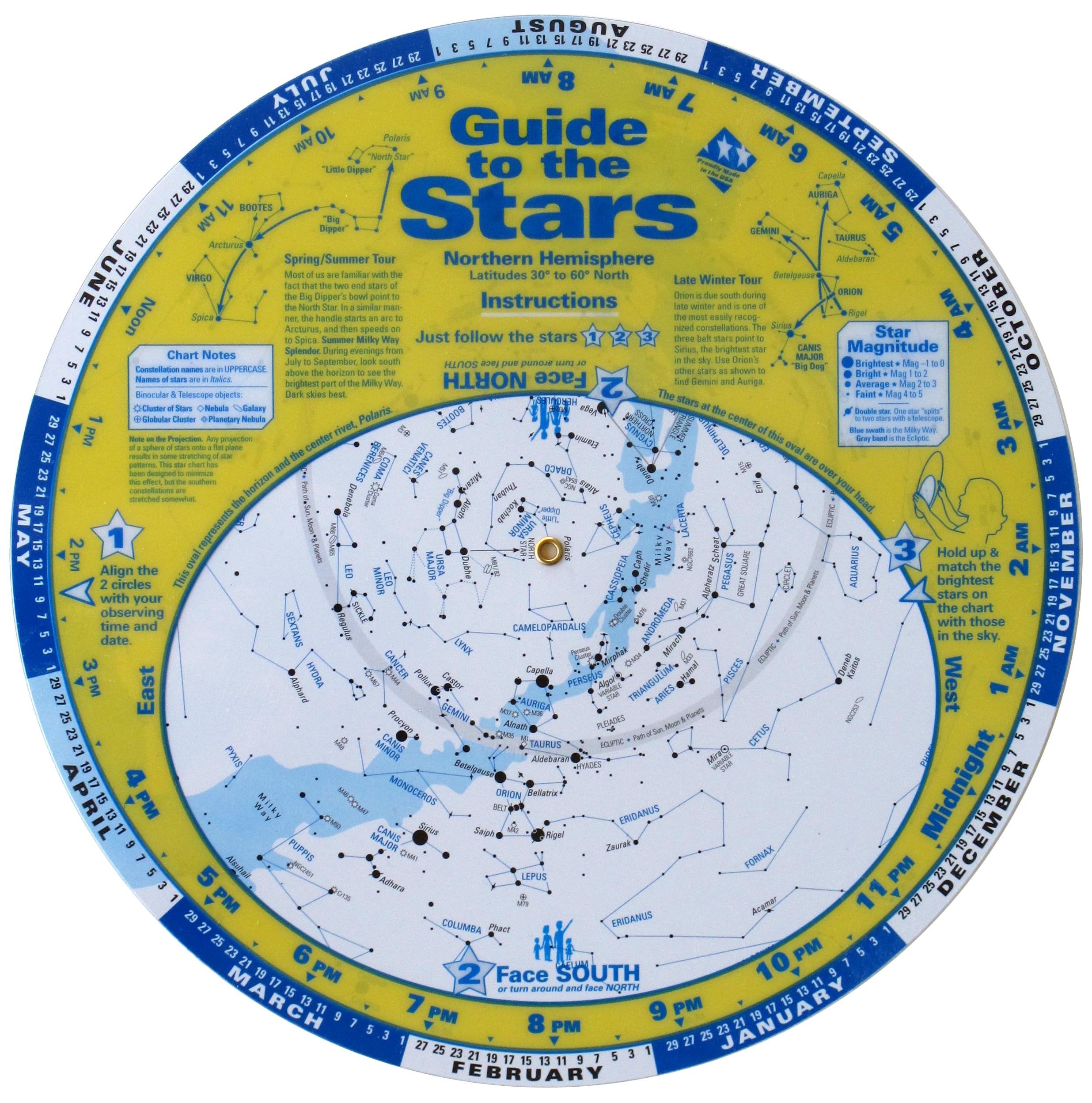
The 4Th Edition Of The 11Inch Diameter Plastic Guide To The Stars Chart Is A ''Map'' To Help You Identify The Constellations. You Simply Dialin Your Observing Time And Date To Find The Set Of Constellations Visible In Your Sky (This Is Accomplished By Rotating The Clear Top Piece). This Chart Can Be Used For Latitudes 30 Degrees To 60 Degrees North, Which Covers The Us And Canada. Although This Chart Is Designed For Beginners, It Finds Use With Seasoned Amateur Astronomers. This Type Of Round Star Chart Is Often Called A Planisphere Because It Takes A Set Of Stars On A Sphere And Plots Them On A Flat Surface.The 11Inch Diameter Is A Compact Size Ideal For Travel. This Chart Can Be Used Anywhere In The World Between Latitudes 30 And 60 Degrees North Including England, Europe, Northern China And Japan. The 4Th Edition Has Been Improved By Indicating Favorite Double Stars And Providing More Information On The Back, All Without Increasing Clutter.The Front Chart Indicates 70 Constellations, The Names Of 55 Stars, The Milky Way Band, The Ecliptic (Which Is The Path Of The Sun, Moon And Planets), 55 Favorite Double Stars, The Summer Triangle, Winter/Summer Tours And 50 Galaxies, Star Clusters And Nebulae That Can Be Observed With Binoculars Or A Small Telescope. Additionally, Favorite Star Patterns Are Noted, Like The Great Square Of Pegasus, The Circlet Of Pisces, The Northern Cross Of Cygnus And Others.On The Back Side, There Are Useful Tables And Other Astronomical Information, Including: Yearly Meteor Showers, Phases Of The Moon, Facts About The Planets, A Short History Of Astronomy, The 10 Brightest Stars, Information About The Binocular & Telescope Objects (Indicated On The Chart), Why Stars Twinkle, Additional Instructions For Using The Chart To Identify The Stars And Constellations, And More.Planet Note. Most Star Charts, Like This One, Do Not Indicate, On The Chart, The Position Of The Planets Or Moon Because These Objects Move Through The Constellations Of The Zodiac, Along A Path In The Sky Called The Ecliptic (Indicated On The Chart). The Moon Moves At A Rate Of One Moon Diameter Per Hour Against The Background Stars. The Visible Planets Move Much Slower But Movement Can Normally Be Seen Over Several Days. Website Support Is Provided To Identify The Planets That Are Visible In The Sky.This Chart Is Also Available In A Larger, 16Inch Diameter Size That Is Easier To Read And Ideal For Families, Teachers And Seniors (Isbn 1928771017). The Larger Size Has More Astronomy Information On The Back. And, There Is A Very Low Price Kid'S Version ( Isbn Is 192877122X) Of This Chart That Is Printed In Color On Sturdy Cardlike Paper Stock. The Wheel Of Stars For The Kid'S Version Is 11Inches In Diameter. For Observing Around The Equator, There Is The Equatorial Guide To The Stars (Isbn 1928771777). Finally, There Is The Celestial Atlas Menor, 128 Pages Chockfull Of Star Charts And Tables For Use Anywhere In The World (Isbn 9781928771883).
⚠️ WARNING (California Proposition 65):
This product may contain chemicals known to the State of California to cause cancer, birth defects, or other reproductive harm.
For more information, please visit www.P65Warnings.ca.gov.
- Q: What are the dimensions of the Guide to the Stars chart? A: The chart has a diameter of eleven inches. It is compact and easy to carry, making it ideal for travel.
- Q: What material is the Guide to the Stars chart made of? A: The chart is made of plastic. This material ensures durability and flexibility for outdoor use.
- Q: How many pages does the Guide to the Stars chart contain? A: The chart contains three pages of information. It includes helpful details about stars, constellations, and astronomical events.
- Q: How do I use the Guide to the Stars chart? A: You simply dial in your observing time and date. This allows you to see which constellations are visible in your sky.
- Q: Is the Guide to the Stars chart suitable for beginners? A: Yes, it is designed for beginners. However, even seasoned amateur astronomers find it useful for quick reference.
- Q: Can I use the Guide to the Stars chart anywhere in the world? A: No, it is intended for latitudes between thirty and sixty degrees North. This includes regions in the US, Canada, and parts of Europe.
- Q: How should I store the Guide to the Stars chart? A: Store the chart flat or rolled to avoid creasing. Keeping it in a dry place will help maintain its condition.
- Q: Is the Guide to the Stars chart safe for children? A: Yes, it is safe for children. The chart is designed for educational purposes and can be used for family star-gazing activities.
- Q: How do I clean the Guide to the Stars chart? A: Wipe the chart gently with a damp cloth. Avoid using harsh chemicals that could damage the plastic material.
- Q: What additional information is included on the back of the chart? A: The back includes tables for yearly meteor showers, phases of the moon, and information about planets. It also provides tips for using the chart.
- Q: How does this chart compare to other star charts? A: This chart is compact and beginner-friendly, unlike larger atlases that may overwhelm new users. It effectively balances detail with usability.
- Q: What if my Guide to the Stars chart arrives damaged? A: You should contact customer support immediately. They will assist you with a return or replacement for damaged products.
- Q: Can I use this chart for educational purposes? A: Yes, it is excellent for educational use. Teachers and parents can use it to teach children about astronomy and star identification.
- Q: Is the Guide to the Stars chart waterproof? A: No, it is not waterproof. It is recommended to keep it dry and away from moisture to preserve its quality.
- Q: Can I buy a larger version of the Guide to the Stars chart? A: Yes, there is a larger sixteen-inch diameter version available. It is easier to read and ideal for families and classrooms.