
Title
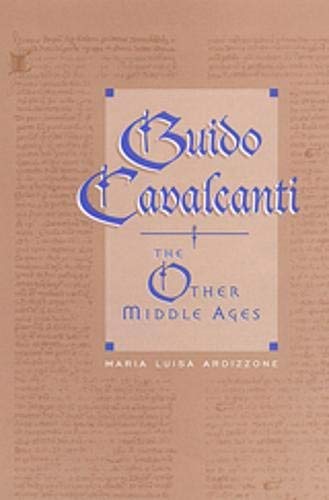
Guido Cavalcanti: The Other Middle Ages (Toronto Italian Studies),Used
Sold by Ergodebooks, an authorized reseller.
Returns accepted within 30 days | support@ergodebooks.com
Shipping Information
- Free Standard Shipping — United States only
- Processing Time: 3–5 business days
- Estimated Delivery: 6–10 business days after dispatch
- Double-boxed, fully insured & discreetly packaged
- Tracking number sent via email once dispatched
Returns & Refund
Returns accepted within 30 days of delivery.
Damaged or Defective Item
Free return shipping + replacement or full refund
Wrong Item Received
Free return shipping + replacement or full refund
Change of Mind
Return shipping at customer's expense · 25% restocking fee applies
Payment Option

About the AuthorMaria Luisa Ardizzone is a professor in the Department of Italian Studies at New York University.Product DescriptionGuido Cavalcanti (d. 1300) is one of the greatest Italian poets of all time. His legacy consists of some fifty poems, of which his canzone on the nature of love, Donna me prega (A lady asks me) is the most famously difficult and complex. The poem is important not only because it sheds light on fundamental intellectual debates during the time of Dante, but also because of its influence on generations of poets and philosophers. In this study, Maria Luisa Ardizzone sets Donna me prega in an entirely new light first, by examining its role in Cavalcanti's poetic practice, and second, by placing it in the context of ancient and medieval science and philosophy. The book deals with issues that are part of the intellectual history of Europe in the thirteenth century. Cavalcanti's work is interpreted by reconstructing the debate of ideas in which it partecipates, and the new model of poetry devised by Cavalcanti is one of the subjects of this book.For Cavalcanti, as for Dante, Aristotle was a master. But unlike Dante, who followed a more orthodox interpretation of Aristotle's text, Cavalcanti preferred the Aristotelianism which derived from the Arabic commentator Averroes, whose approach was responsible for introducing a radical rereading of Aristotle incompatible with basic tenets of the Christian faith. In this alternative view, human desires and difficulties were resolved not through theology but through biology, natural philosophy, and medicine. While other scholars have noted Cavalcanti's Averroism, Ardizzone is the first to analyse it in light of sciences such as optics or logic, focusing on new issues of intellectual debate of Cavalcanti's time, as, for instance, the medieval theory of matter.Review'Ardizzone has made a profound contribution to our understanding of medieval thought and poetry. She has written a book of great interest to any medievalist.' Otto A. Bird, Professor Emeritus of the Program of Liberal Studies, University of Notre Dame'Professor Ardizzone has brought off an innovative reading of Cavalcanti's highly controversial, difficult poem, Donna me prega, and she has done so by correlating this poem to other works by Cavalcanti and their specific intellectual context. Ardizzone's own text, which is written in an intense and yet clear analytical style, combines firsthand research and solid critical thinking. This reconstruction of the language of Cavalcanti its philosophical sources and its specialized, technical resonances yields insights into the historical and mental climate that spans the late Middle Ages Not the least of Ardizzone's exceptional merits is to have definitely shown that Cavalcanti, who is Dante's contemporary interlocutor, is a major poet I predict that the book will generate muchneeded critical discourse among medievalists.' Giuseppe Mazzotta, Charles C. and Dorathea S. Dilley Professor of Italian Language and Literature, Yale UniversityFrom the Back Cover'Professor Ardizzone has brought off an innovative reading of Cavalcanti's highly controversial, difficult poem, Donna me prega, and she has done so by correlating this poem to other works by Cavalcanti and their specific intellectual context. Ardizzone's own text, which is written in an intense and yet clear analytical style, combines firsthand research and solid critical thinking. This reconstruction of the language of Cavalcanti its philosophical sources and its specialized, technical resonances yields insights into the historical and mental climate that spans the late Middle Ages Not the least of Ardizzone's exceptional merits is to have definitely shown that Cavalcanti, who is Dante's contemporary interlocutor, is a major poet I predict that the book will generate muchneeded critical discourse among medievalists.''Ardizzone has made a profound contribution to our
⚠️ WARNING (California Proposition 65):
This product may contain chemicals known to the State of California to cause cancer, birth defects, or other reproductive harm.
For more information, please visit www.P65Warnings.ca.gov.
- Q: What is the main focus of 'Guido Cavalcanti: The Other Middle Ages'? A: The book primarily examines the works of Guido Cavalcanti, particularly his poem 'Donna me prega', and places it in the context of thirteenth-century intellectual history, exploring its philosophical and scientific influences.
- Q: Who is the author of this book? A: The author of 'Guido Cavalcanti: The Other Middle Ages' is Maria Luisa Ardizzone.
- Q: What is the significance of the poem 'Donna me prega'? A: 'Donna me prega' is significant because it reflects complex ideas about love and human experience, influencing poets and philosophers for generations.
- Q: In what format is the book available? A: The book is available in hardcover format.
- Q: How many pages does this book contain? A: The book contains 272 pages.
- Q: When was 'Guido Cavalcanti: The Other Middle Ages' published? A: The book was published on June 29, 2002.
- Q: What are the main themes discussed in the book? A: Main themes include the intellectual debates of Cavalcanti's time, the influence of Aristotle and Averroes on Cavalcanti's work, and the relationship between poetry and science.
- Q: Is the book suitable for readers unfamiliar with Italian literature? A: Yes, the book provides contextual analysis that can help readers unfamiliar with Italian literature understand Cavalcanti's significance.
- Q: What type of readers would benefit from this book? A: Scholars, students of literature, and anyone interested in medieval philosophy and poetry would benefit from this book.
- Q: Does the book include any illustrations or images? A: The book does not specifically mention illustrations or images; it focuses on textual analysis and scholarly commentary.