If you have any questions, you are always welcome to contact us. We'll get back to you as soon as possible, withing 24 hours on weekdays.
Customer service
All questions about your order, return and delivery must be sent to our customer service team by e-mail at yourstore@yourdomain.com
Sale & Press
If you are interested in selling our products, need more information about our brand or wish to make a collaboration, please contact us at press@yourdomain.com
Help
If you have any questions, you are always welcome to contact us. We'll get back to you as soon as possible, withing 24 hours on weekdays.
Customer service
All questions about your order, return and delivery must be sent to our customer service team by e-mail at yourstore@yourdomain.com
Sale & Press
If you are interested in selling our products, need more information about our brand or wish to make a collaboration, please contact us at press@yourdomain.com
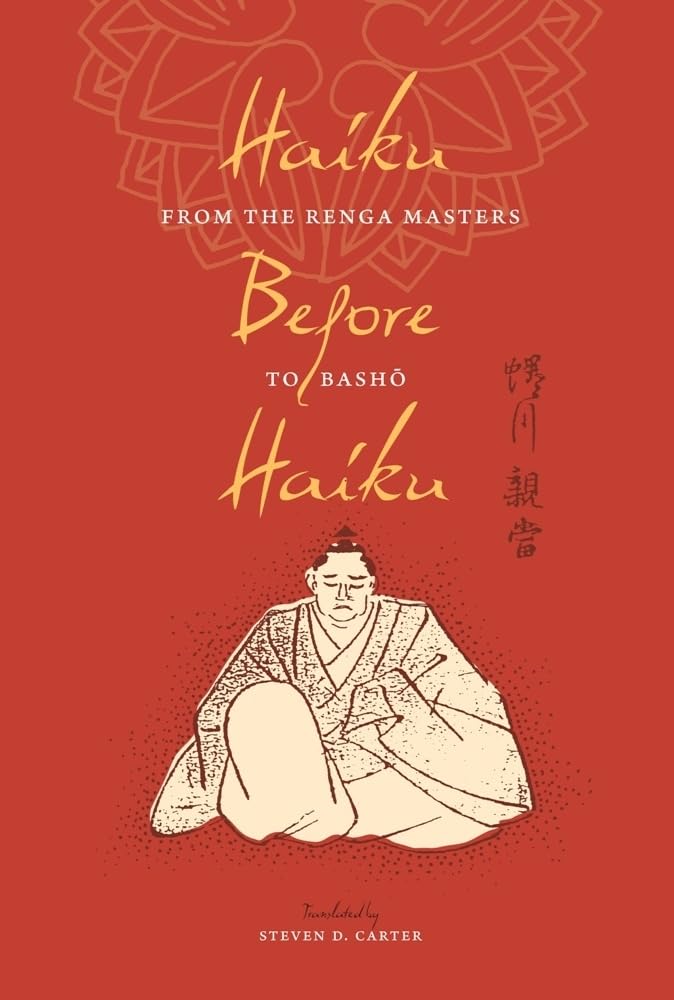
While the rise of the charmingly simple, brilliantly evocative haiku is often associated with the seventeenthcentury Japanese poet Matsuo Basho, the form had already flourished for more than four hundred years before Basho even began to write. These early poems, known as hokku, are identical to haiku in syllable count and structure but function differently as a genre. Whereas each haiku is its own constellation of image and meaning, a hokku opens a series of linked, collaborative stanzas in a sequence called renga.Under the mastery of Basho, hokku first gained its modern independence. His talents contributed to the evolution of the style into the haiku beloved by so many poets around the worldRichard Wright, Jack Kerouac, and Billy Collins being notable devotees. Haiku Before Haiku presents 320 hokku composed between the thirteenth and early eighteenth centuries, from the poems of the courtier Nijo Yoshimoto to those of the genre's first "professional" master, Sogi, and his disciples. It features 20 masterpieces by Basho himself. Steven D. Carter introduces the history of haiku and its aesthetics, classifying these poems according to style and context. His rich commentary and notes on composition and setting illuminate each work, and he provides brief biographies of the poets, the original Japanese text in romanized form, and earlier, classical poems to which some of the hokku allude.
⚠️ WARNING (California Proposition 65):
This product may contain chemicals known to the State of California to cause cancer,
birth defects, or other reproductive harm.
For MAP (Minimum Advertised Price) violations and Intellectual Property (IP) or Trademark concerns, please contact:
support@ergodebooks.com
⚠️ California Proposition 65 Warning: Some products sold on this website may expose you to chemicals known to the State of California to cause cancer, birth defects, or other reproductive harm. For more information, visit www.P65Warnings.ca.gov.