
Title
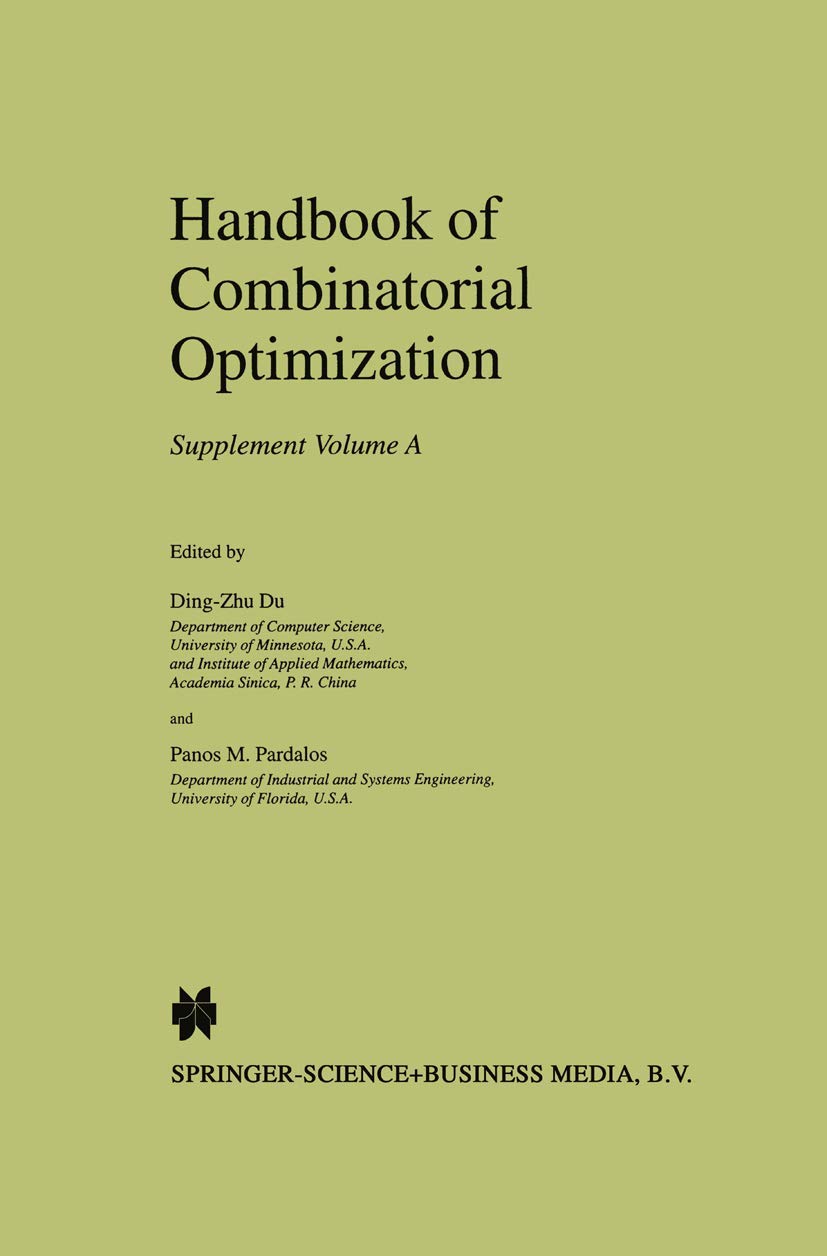
Handbook of Combinatorial Optimization: Supplement Volume A,Used
Sold by Ergodebooks, an authorized reseller.
Returns accepted within 30 days | support@ergodebooks.com
Shipping Information
- Free Standard Shipping — United States only
- Processing Time: 3–5 business days
- Estimated Delivery: 6–10 business days after dispatch
- Double-boxed, fully insured & discreetly packaged
- Tracking number sent via email once dispatched
Returns & Refund
Returns accepted within 30 days of delivery.
Damaged or Defective Item
Free return shipping + replacement or full refund
Wrong Item Received
Free return shipping + replacement or full refund
Change of Mind
Return shipping at customer's expense · 25% restocking fee applies
Payment Option

Combinatorial (or discrete) optimization is one of the most active fields in the interface of operations research, computer science, and applied math ematics. Combinatorial optimization problems arise in various applications, including communications network design, VLSI design, machine vision, air line crew scheduling, corporate planning, computeraided design and man ufacturing, database query design, cellular telephone frequency assignment, constraint directed reasoning, and computational biology. Furthermore, combinatorial optimization problems occur in many diverse areas such as linear and integer programming, graph theory, artificial intelligence, and number theory. All these problems, when formulated mathematically as the minimization or maximization of a certain function defined on some domain, have a commonality of discreteness. Historically, combinatorial optimization starts with linear programming. Linear programming has an entire range of important applications including production planning and distribution, personnel assignment, finance, alloca tion of economic resources, circuit simulation, and control systems. Leonid Kantorovich and Tjalling Koopmans received the Nobel Prize (1975) for their work on the optimal allocation of resources. Two important discover ies, the ellipsoid method (1979) and interior point approaches (1984) both provide polynomial time algorithms for linear programming. These algo rithms have had a profound effect in combinatorial optimization. Many polynomialtime solvable combinatorial optimization problems are special cases of linear programming (e.g. matching and maximum flow). In addi tion, linear programming relaxations are often the basis for many approxi mation algorithms for solving NPhard problems (e.g. dualheuristics).
⚠️ WARNING (California Proposition 65):
This product may contain chemicals known to the State of California to cause cancer, birth defects, or other reproductive harm.
For more information, please visit www.P65Warnings.ca.gov.