
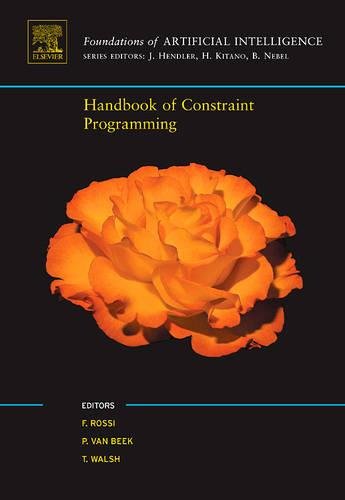
Title
Handbook of Constraint Programming (Foundations of Artificial Intelligence),Used
Sold by Ergodebooks, an authorized reseller.
Returns accepted within 30 days | support@ergodebooks.com
Shipping Information
- Free Standard Shipping — United States only
- Processing Time: 3–5 business days
- Estimated Delivery: 6–10 business days after dispatch
- Double-boxed, fully insured & discreetly packaged
- Tracking number sent via email once dispatched
Returns & Refund
Returns accepted within 30 days of delivery.
Damaged or Defective Item
Free return shipping + replacement or full refund
Wrong Item Received
Free return shipping + replacement or full refund
Change of Mind
Return shipping at customer's expense · 25% restocking fee applies
Payment Option

Constraint programming is a powerful paradigm for solving combinatorial search problems that draws on a wide range of techniques from artificial intelligence, computer science, databases, programming languages, and operations research. Constraint programming is currently applied with success to many domains, such as scheduling, planning, vehicle routing, configuration, networks, and bioinformatics.The aim of this handbook is to capture the full breadth and depth of the constraint programming field and to be encyclopedic in its scope and coverage. While there are several excellent books on constraint programming, such books necessarily focus on the main notions and techniques and cannot cover also extensions, applications, and languages. The handbook gives a reasonably complete coverage of all these lines of work, based on constraint programming, so that a reader can have a rather precise idea of the whole field and its potential. Of course each line of work is dealt with in a surveylike style, where some details may be neglected in favor of coverage. However, the extensive bibliography of each chapter will help the interested readers to find suitable sources for the missing details. Each chapter of the handbook is intended to be a selfcontained survey of a topic, and is written by one or more authors who are leading researchers in the area.The intended audience of the handbook is researchers, graduate students, higheryear undergraduates and practitioners who wish to learn about the stateoftheart in constraint programming. No prior knowledge about the field is necessary to be able to read the chapters and gather useful knowledge. Researchers from other fields should find in this handbook an effective way to learn about constraint programming and to possibly use some of the constraint programming concepts and techniques in their work, thus providing a means for a fruitful crossfertilization among different research areas.The handbook is organized in two parts. The first part covers the basic foundations of constraint programming, including the history, the notion of constraint propagation, basic search methods, global constraints, tractability and computational complexity, and important issues in modeling a problem as a constraint problem. The second part covers constraint languages and solver, several useful extensions to the basic framework (such as interval constraints, structured domains, and distributed CSPs), and successful application areas for constraint programming. Covers the whole field of constraint programming Surveystyle chapters Five chapters on applications
⚠️ WARNING (California Proposition 65):
This product may contain chemicals known to the State of California to cause cancer, birth defects, or other reproductive harm.
For more information, please visit www.P65Warnings.ca.gov.