
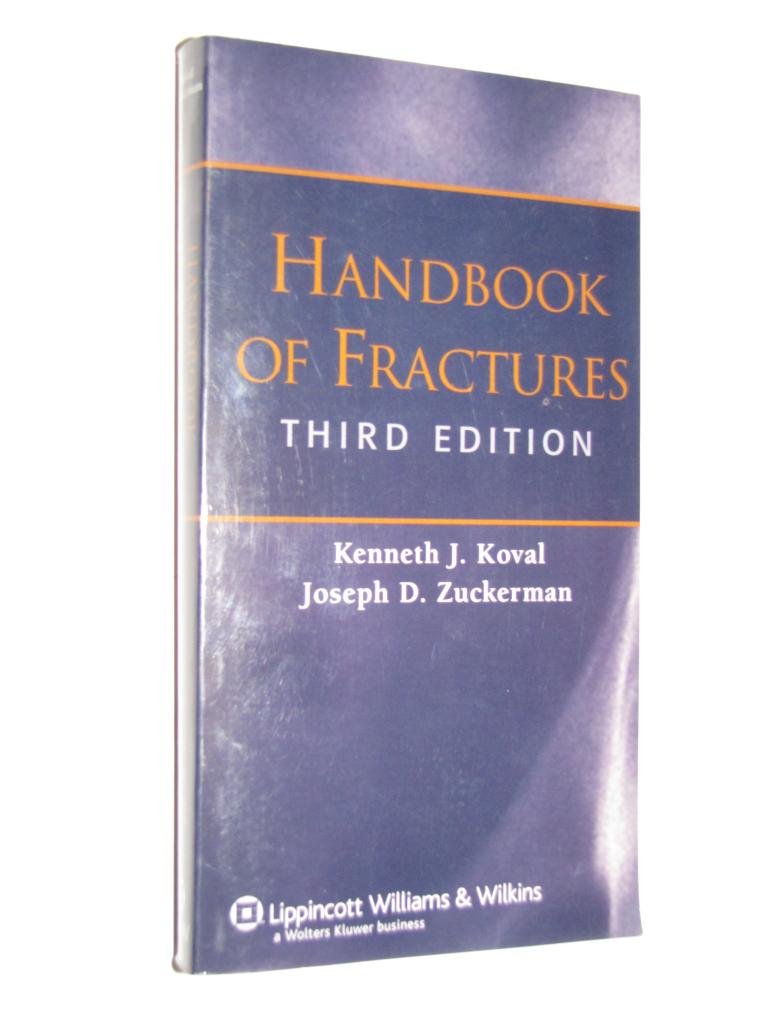
Title
Handbook of Fractures,New
Sold by Ergodebooks, an authorized reseller.
Returns accepted within 30 days | support@ergodebooks.com
Shipping Information
- Free Standard Shipping — United States only
- Processing Time: 3–5 business days
- Estimated Delivery: 6–10 business days after dispatch
- Double-boxed, fully insured & discreetly packaged
- Tracking number sent via email once dispatched
Returns & Refund
Returns accepted within 30 days of delivery.
Damaged or Defective Item
Free return shipping + replacement or full refund
Wrong Item Received
Free return shipping + replacement or full refund
Change of Mind
Return shipping at customer's expense · 25% restocking fee applies
Payment Option

Thoroughly updated for its Third Edition, this pocketsized goanywhere guide is the ideal onthespot reference for residents and practitioners seeking fast facts on fracture management and classification. Chapters organized by anatomic site provide key information on fractures in adults and in children, including epidemiology, anatomy, mechanism of injury, clinical evaluation, radiologic evaluation, classification, treatment, and management of complications. The book's easyaccess format features numerous charts, tables, diagrams, illustrations, and bulleted lists. Two new chapters in this edition cover closed reduction, casting, and traction, and orthopaedic analgesia.Handbook of Fractures, Third Edition will also be available for PDAs. See PDA listing for details.
⚠️ WARNING (California Proposition 65):
This product may contain chemicals known to the State of California to cause cancer, birth defects, or other reproductive harm.
For more information, please visit www.P65Warnings.ca.gov.
- Q: What is the page count of the Handbook of Fractures? A: The Handbook of Fractures has six hundred eighty-five pages. This extensive content provides a thorough reference for fracture management.
- Q: What is the binding type of the Handbook of Fractures? A: The binding type is paperback. This makes it lightweight and portable for easy reference during practical use.
- Q: What are the dimensions of the Handbook of Fractures? A: The dimensions are four and a half inches in length, one inch in width, and eight inches in height. This size is designed for convenience and portability.
- Q: How should I use the Handbook of Fractures? A: You can use this book as a quick reference guide for fracture management. It is organized by anatomic site, making it easy to find relevant information.
- Q: Is the Handbook of Fractures suitable for medical professionals? A: Yes, it is suitable for residents and practitioners. The book provides fast facts and practical information critical for healthcare providers.
- Q: Can students benefit from the Handbook of Fractures? A: Yes, students can benefit significantly from this book. It offers essential information that supports learning in orthopedics.
- Q: How should I care for the Handbook of Fractures? A: To keep it in good condition, store it in a dry place and avoid exposure to excessive moisture. Regularly handle it with clean hands to maintain its quality.
- Q: Is the Handbook of Fractures safe for all ages? A: Yes, the content is safe for all ages but is primarily intended for medical professionals and students. It provides clinical information rather than general reading material.
- Q: How do I store the Handbook of Fractures? A: Store it upright on a shelf or in a bookcase to prevent bending. Ensure it is placed in a location away from direct sunlight to avoid fading.
- Q: What if my Handbook of Fractures arrives damaged? A: If it arrives damaged, you should contact the seller for a return or exchange. Make sure to keep the original packaging for the return process.
- Q: Does the Handbook of Fractures include illustrations? A: Yes, it includes numerous illustrations, charts, and diagrams. These visual aids enhance understanding of complex topics related to fractures.
- Q: Is the Handbook of Fractures updated regularly? A: Yes, this is the third edition, thoroughly updated. It incorporates the latest information on fracture management and treatment.
- Q: Who is the author of the Handbook of Fractures? A: The author is Kenneth J. Koval, M.D. He is recognized for his expertise in orthopedics and fracture management.
- Q: Does the Handbook of Fractures cover pediatric fractures? A: Yes, it includes information on fractures in both adults and children. This makes it a comprehensive resource for all age groups.
- Q: What new topics are included in the third edition? A: The third edition includes new chapters on closed reduction, casting, traction, and orthopedic analgesia. These additions reflect current practices in the field.