
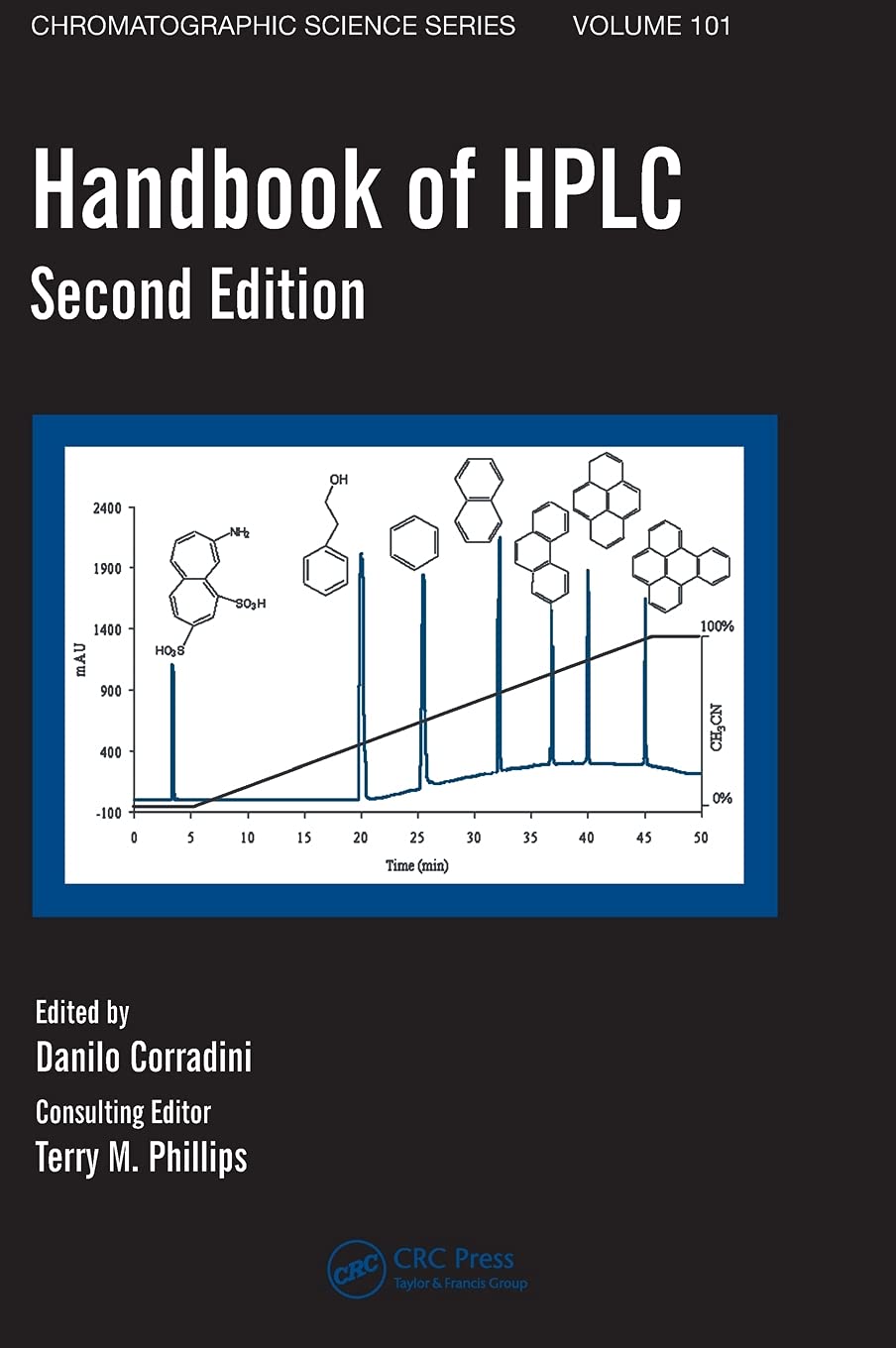
Title
Handbook Of Hplc (Chromatographic Science Series)
Sold by Ergodebooks, an authorized reseller.
Returns accepted within 30 days | support@ergodebooks.com
Shipping Information
- Free Standard Shipping — United States only
- Processing Time: 3–5 business days
- Estimated Delivery: 6–10 business days after dispatch
- Double-boxed, fully insured & discreetly packaged
- Tracking number sent via email once dispatched
Returns & Refund
Returns accepted within 30 days of delivery.
Damaged or Defective Item
Free return shipping + replacement or full refund
Wrong Item Received
Free return shipping + replacement or full refund
Change of Mind
Return shipping at customer's expense · 25% restocking fee applies
Payment Option

High Performance Liquid Chromatography (Hplc) Is One Of The Most Widespread Analytical And Preparative Scale Separation Techniques Used For Both Scientific Investigations And Industrial And Biomedical Analysis. Now In Its Second Edition, This Revised And Updated Version Of The Handbook Of Hplc Examines The New Advances Made In This Field Since The Publication Of The Benchmark First Edition Twelve Years Ago. It Reports Detailed Information On Fundamental And Practical Aspects Of Hplc Related To Conventional Format And Sophisticated Novel Approaches Which Have Been Developed To Address A Variety Of Separation Problems In Different Fields.The Latest Conceptsnew Concepts Presented In This Edition Include Monolithic Columns, Bonded Stationary Phases, Microhplc, Twodimensional Comprehensive Liquid Chromatography, Gradient Elution Mode, And Capillary Electromigration Techniques. The Book Also Discusses Lcms Interfaces, Nonlinear Chromatography, Displacement Chromatography Of Peptides And Proteins, Fieldflow Fractionation, Retention Models For Ions, And Polymer Hplc.Fundamentals And Applicationsthe First Section Of The Book Explores Emerging Novel Aspects Of Hplc And Related Separation Methods Based On The Differential Velocity Of Analytes In A Liquid Medium Under The Action Of Either An Electric Field (Capillary Electromigration Techniques) Or A Gravitational Field (Fieldflow Fractionation). The Section Focusing On Applications Highlights Four Significant Areas In Which Hplc Is Successfully Employed: Chiral Pharmaceutical, Environmental Analysis, Food Analysis, And Forensic Science.Ideal For A Widespread Audienceexplanatory Figures And Tables Supplement The Text And Clarify Difficult Concepts. Extensive References Provide Gateways To More Focused Study. Suitable For Undergraduates Or New Practitioners Interested In Improving Their Knowledge On The Current Status And Future Trends Of Hplc, The Book Is Also A Critical Resource For Researchers Looking For Solutions To Complex Separation Problems Or Those Who Currently Use Hplc Either As An Analytical Or A Preparative Scale Tool.
⚠️ WARNING (California Proposition 65):
This product may contain chemicals known to the State of California to cause cancer, birth defects, or other reproductive harm.
For more information, please visit www.P65Warnings.ca.gov.
- Q: How many pages does the Handbook of HPLC have? A: This book has seven hundred sixteen pages. It provides comprehensive coverage of high performance liquid chromatography techniques.
- Q: What is the binding type of the Handbook of HPLC? A: The binding type is hardcover. This ensures durability for frequent use in both academic and professional settings.
- Q: What are the dimensions of the Handbook of HPLC? A: The dimensions are seven point zero one inches in length, one point five inches in width, and ten inches in height. These dimensions make it easy to handle and store.
- Q: Who is the author of the Handbook of HPLC? A: The author is Danilo Corradini. He provides expert insights into the latest advancements in high performance liquid chromatography.
- Q: What topics are covered in the Handbook of HPLC? A: The book covers topics such as monolithic columns, gradient elution mode, and capillary electromigration techniques. It addresses both fundamental and practical aspects of HPLC.
- Q: Is the Handbook of HPLC suitable for beginners? A: Yes, it is suitable for undergraduates or new practitioners. The book presents complex concepts in an accessible manner, making it beneficial for learners.
- Q: How can I apply the knowledge from the Handbook of HPLC? A: You can apply it in areas like environmental analysis, food analysis, and forensic science. The book illustrates practical applications of HPLC techniques in various fields.
- Q: Are there illustrations in the Handbook of HPLC? A: Yes, the book includes explanatory figures and tables. These visual aids help clarify difficult concepts related to HPLC.
- Q: What are the latest advancements discussed in the Handbook of HPLC? A: The book discusses advancements like two-dimensional comprehensive liquid chromatography and nonlinear chromatography. These innovations enhance separation techniques.
- Q: Can researchers benefit from the Handbook of HPLC? A: Yes, researchers can find critical resources for solving complex separation problems. The detailed information makes it a valuable reference.
- Q: How should I store the Handbook of HPLC? A: Store it in a cool, dry place away from direct sunlight. This will help maintain the integrity of the hardcover and the pages.
- Q: Is the Handbook of HPLC safe for use in laboratories? A: Yes, it is safe for use in laboratories. The book is designed to assist professionals in conducting HPLC analyses safely and effectively.
- Q: What kind of audience is the Handbook of HPLC intended for? A: It is intended for a widespread audience including students, practitioners, and researchers. The content is tailored to meet diverse educational needs.
- Q: Are there any references for further study in the Handbook of HPLC? A: Yes, extensive references are provided for further study. These references guide readers to more focused research on HPLC topics.
- Q: Can this book help with complex separation problems? A: Yes, it offers solutions to complex separation problems. The book's in-depth analysis supports researchers in their practical applications of HPLC.