
Title
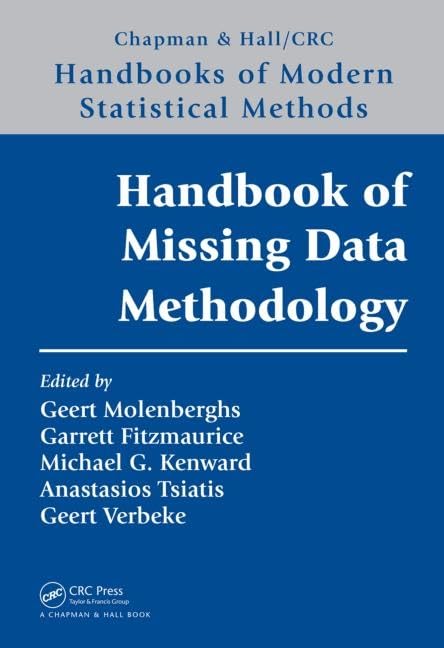
Handbook of Missing Data Methodology (Chapman & Hall/CRC Handbooks of Modern Statistical Methods),Used
Sold by Ergodebooks, an authorized reseller.
Returns accepted within 30 days | support@ergodebooks.com
Shipping Information
- Free Standard Shipping — United States only
- Processing Time: 3–5 business days
- Estimated Delivery: 6–10 business days after dispatch
- Double-boxed, fully insured & discreetly packaged
- Tracking number sent via email once dispatched
Returns & Refund
Returns accepted within 30 days of delivery.
Damaged or Defective Item
Free return shipping + replacement or full refund
Wrong Item Received
Free return shipping + replacement or full refund
Change of Mind
Return shipping at customer's expense · 25% restocking fee applies
Payment Option

Missing data affect nearly every discipline by complicating the statistical analysis of collected data. But since the 1990s, there have been important developments in the statistical methodology for handling missing data. Written by renowned statisticians in this area, Handbook of Missing Data Methodology presents many methodological advances and the latest applications of missing data methods in empirical research.Divided into six parts, the handbook begins by establishing notation and terminology. It reviews the general taxonomy of missing data mechanisms and their implications for analysis and offers a historical perspective on early methods for handling missing data. The following three parts cover various inference paradigms when data are missing, including likelihood and Bayesian methods; semiparametric methods, with particular emphasis on inverse probability weighting; and multiple imputation methods.The next part of the book focuses on a range of approaches that assess the sensitivity of inferences to alternative, routinely nonverifiable assumptions about the missing data process. The final part discusses special topics, such as missing data in clinical trials and sample surveys as well as approaches to model diagnostics in the missing data setting. In each part, an introduction provides useful background material and an overview to set the stage for subsequent chapters.Covering both established and emerging methodologies for missing data, this book sets the scene for future research. It provides the framework for readers to delve into research and practical applications of missing data methods.
⚠️ WARNING (California Proposition 65):
This product may contain chemicals known to the State of California to cause cancer, birth defects, or other reproductive harm.
For more information, please visit www.P65Warnings.ca.gov.