
Title
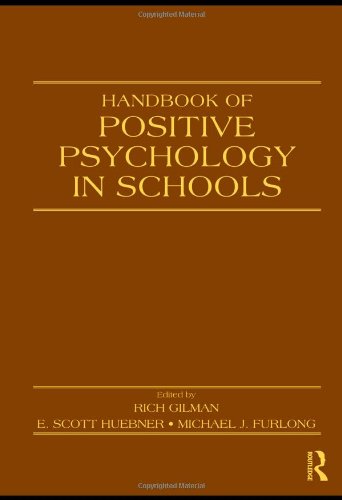
Handbook of Positive Psychology in Schools (Educational Psychology Handbook),Used
Sold by Ergodebooks, an authorized reseller.
Returns accepted within 30 days | support@ergodebooks.com
Shipping Information
- Free Standard Shipping — United States only
- Processing Time: 3–5 business days
- Estimated Delivery: 6–10 business days after dispatch
- Double-boxed, fully insured & discreetly packaged
- Tracking number sent via email once dispatched
Returns & Refund
Returns accepted within 30 days of delivery.
Damaged or Defective Item
Free return shipping + replacement or full refund
Wrong Item Received
Free return shipping + replacement or full refund
Change of Mind
Return shipping at customer's expense · 25% restocking fee applies
Payment Option

National surveys consistently reveal that an inordinate number of students report high levels of boredom, anger, and stress in school, which often leads to their disengagement from critical learning and social development. If the ultimate goal of schools is to educate young people to become responsible and critically thinking citizens who can succeed in life, understanding factors that stimulate them to become active agents in their own leaning is critical. A new field labeled 'positive psychology' is one lens that can be used to investigate factors that facilitate a students sense of agency and active school engagement.The purposes of this groundbreaking Handbook are to 1) describe ways that positive emotions, traits, and institutions promote school achievement and healthy social/emotional development 2) describe how specific positivepsychological constructs relate to students and schools and support the delivery of schoolbased services and 3) describe the application of positive psychology to educational policy making. By doing so, the book provides a longneeded centerpiece around which the field can continue to grow in an organized and interdisciplinary manner.Key features include:Comprehensive this book is the first to provide a comprehensive review of what is known about positive psychological constructs and the school experiences of children and youth. Topical coverage ranges from conceptual foundations to assessment and intervention issues to service delivery models. Intrapersonal factors (e.g., hope, life satisfaction) and interpersonal factors (e.g., positive peer and family relationships) are examined as is classroomandschoollevel influences (e.g., studentteacher and schoolcommunity relations).Interdisciplinary Focus this volume brings together the divergent perspectives, methods, and findings of a broad, interdisciplinary community of scholars whose work often fails to reach those working in contiguous fields.Chapter Structure to insure continuity, flow, and readability chapters are organized as follows: overview, research summary, relationship to student development, examples of realworld applications, and a summarizing table showing implications for future research and practice.Methodologies chapters feature longitudinal studies, personcentered approaches, experimental and quasiexperimental designs and mixed methods.
⚠️ WARNING (California Proposition 65):
This product may contain chemicals known to the State of California to cause cancer, birth defects, or other reproductive harm.
For more information, please visit www.P65Warnings.ca.gov.
- Q: What is the page count of the book? A: The book has five hundred twenty pages. It provides a comprehensive overview of positive psychology in educational settings.
- Q: What are the dimensions of the book? A: The book measures six point seventy-five inches in length, one inch in width, and nine point seventy-six inches in height. These dimensions make it a standard-sized paperback.
- Q: Who is the author of the book? A: The author is Rich Gilman. He brings expertise in educational psychology, focusing on positive psychological constructs.
- Q: How can I use this book in an educational setting? A: You can use this book as a resource for understanding positive psychology principles in schools. It offers practical applications for educators and policymakers.
- Q: Is this book suitable for high school students? A: Yes, the book is suitable for high school students. It discusses topics relevant to their engagement and emotional development.
- Q: Can this book be used for teacher training? A: Yes, it can be a valuable resource for teacher training. The content focuses on enhancing teacher-student relationships and promoting positive school environments.
- Q: How should I store the book to keep it in good condition? A: Store the book in a cool, dry place away from direct sunlight. Keeping it on a shelf upright will help maintain its condition.
- Q: Is the book durable for frequent handling? A: Yes, the paperback binding is designed for regular use. However, handle it carefully to prevent wear and tear.
- Q: What if the book arrives damaged? A: If the book arrives damaged, you can contact the seller for a return or exchange. Make sure to keep the original packaging for returns.
- Q: Does this book include research summaries? A: Yes, the book includes research summaries in each chapter. This provides a clear overview of findings related to positive psychology in education.
- Q: Are there applications for school policy in this book? A: Yes, the book discusses how positive psychology can influence educational policy making. This is essential for improving school environments.
- Q: Is there a focus on interdisciplinary approaches in the book? A: Yes, the book emphasizes interdisciplinary approaches, integrating various perspectives on positive psychology and education.
- Q: Can I find real-world applications in the book? A: Yes, the book provides examples of real-world applications of positive psychology in schools. This helps translate theory into practice.
- Q: What methodologies are discussed in the book? A: The book discusses various methodologies including longitudinal studies and mixed methods. This variety enriches the research presented.
- Q: Is there a glossary of terms in the book? A: Yes, the book includes a glossary of terms related to positive psychology. This aids in understanding key concepts.
- Q: Does the book cover emotional development in children? A: Yes, the book extensively covers emotional development in children. It highlights factors that promote positive social and emotional growth.