If you have any questions, you are always welcome to contact us. We'll get back to you as soon as possible, withing 24 hours on weekdays.
Customer service
All questions about your order, return and delivery must be sent to our customer service team by e-mail at yourstore@yourdomain.com
Sale & Press
If you are interested in selling our products, need more information about our brand or wish to make a collaboration, please contact us at press@yourdomain.com
Help
If you have any questions, you are always welcome to contact us. We'll get back to you as soon as possible, withing 24 hours on weekdays.
Customer service
All questions about your order, return and delivery must be sent to our customer service team by e-mail at yourstore@yourdomain.com
Sale & Press
If you are interested in selling our products, need more information about our brand or wish to make a collaboration, please contact us at press@yourdomain.com
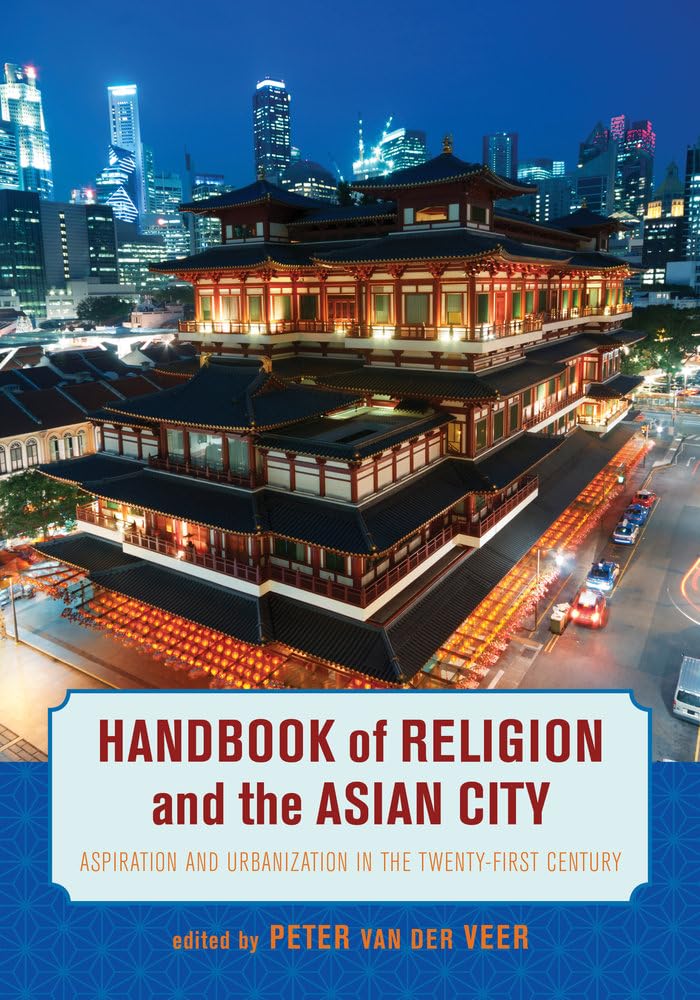
Handbook of Religion and the Asian City highlights the creative and innovative role of urban aspirations in Asian world cities. It does not assume that religion is of the past and that the urban is secular, but instead points out that urban politics and governance often manifest religious boundaries and sensibilitiesin short, that public religion is politics. The essays in this book show how projects of secularism come up against projects and ambitions of a religious nature, a particular form of contestation that takes the city as its public arena.Questioning the limits of cities like Mumbai, Singapore, Seoul, Beijing, Bangkok, and Shanghai, the authors assert that Asian cities have to be understood not as global models of futuristic city planning but as larger landscapes of spatial imagination that have specific cultural and political trajectories. Religion plays a central role in the politics of heritage that is emerging from the debris of modernist city planning.Megacities are arenas for the assertion of national and transnational aspirations as Asia confronts modernity. Cities are also sites of speculation, not only for those who invest in real estate but also for those who look for housing, employment, and salvation. In its potential and actual mobility, the sacred creates social space in which they all can meet. Handbook of Religion and the Asian City makes the comparative case that one cannot study the historical patterns of urbanization in Asia without paying attention to the role of religion in urban aspirations.
⚠️ WARNING (California Proposition 65):
This product may contain chemicals known to the State of California to cause cancer,
birth defects, or other reproductive harm.
For MAP (Minimum Advertised Price) violations and Intellectual Property (IP) or Trademark concerns, please contact:
support@ergodebooks.com
⚠️ California Proposition 65 Warning: Some products sold on this website may expose you to chemicals known to the State of California to cause cancer, birth defects, or other reproductive harm. For more information, visit www.P65Warnings.ca.gov.