
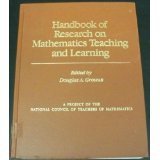
Title
Handbook Of Research On Mathematics Teaching And Learning: A Project Of The National Council Of Teachers Of Mathematics,Used
Sold by Ergodebooks, an authorized reseller.
Returns accepted within 30 days | support@ergodebooks.com
Shipping Information
- Free Standard Shipping — United States only
- Processing Time: 3–5 business days
- Estimated Delivery: 6–10 business days after dispatch
- Double-boxed, fully insured & discreetly packaged
- Tracking number sent via email once dispatched
Returns & Refund
Returns accepted within 30 days of delivery.
Damaged or Defective Item
Free return shipping + replacement or full refund
Wrong Item Received
Free return shipping + replacement or full refund
Change of Mind
Return shipping at customer's expense · 25% restocking fee applies
Payment Option

Research In The Area Of Mathematics Education Has Flourished Over The Past Two Decades. The Handbook Of Research On Mathematics Teaching And Learning Is The Most Comprehensive And Uptodate Survey Of The Best Research, New Developments, And Critical Conflicts And Controversies In Mathematics Education. Sponsored By The National Council Of Teachers Of Mathematics And Written By Leading Experts In The Field Of Mathematics Education, The Handbook Is Specifically Designed To Make Important, Vital Scholarship Accessible To Mathematics Education Professors, Graduate Students, Educational Researchers, Staff Development Directors, Curriculum Supervisors, And Teachers.The Handbook Provides A Framework For Understanding The Evolution Of The Mathematics Education Research Field Against The Backdrop Of Wellestablished Conceptual, Historical, Theoretical, And Methodological Perspectives. It Is An Indispensable Working Tool For Everyone Interested In Pursuing Research In Mathematics Education As The References For Each Of The Handbook'S Twentynine Chapters Are Complete Resources For Both Current And Past Work In That Particular Area.The Handbook'S Twentynine Chapters Are Organized Into Five Major Sections.Overview Presents A History Of Research In Mathematics Education, An Analysis Of How Mathematics As A Discipline Has Changed Over Time And How These Shifts Have Influenced Research, And A Theoretical Reconceptualization Of One Of The Most Crucial Issues In Mathematics Education The Nature Of Understanding Within The Context Of Learning And Teaching.Mathematics Teaching Includes Articles On The Culture Of The Classroom, Effective Teaching, Teacher Beliefs, Classroom Organization, And Teacher Education.Learning From Instruction Comprises Chapters Organized Around Mathematical Domains That Have Been The Focus Of Considerable Research: Additive Structures; Multiplicative Structures; National Numbers; Problem Solving; Estimation; Algebra, Geometry, And Spatial Reasoning; Probability And Statistics; And Proofs, Limits, Functions, And Infinity.Critical Issues Considers Such Important Issues In Mathematics Education As Affect, Evaluation, Gender, Ethnicity, And Technology, While Taking Into Account The Evolution Of These Issues From Teaching, Learning, And Research Perspectives.Perspectives Offers Viewpoints On International Studies Of Achievement, International Research, And Reflections On The Future Of Mathematics Education.
⚠️ WARNING (California Proposition 65):
This product may contain chemicals known to the State of California to cause cancer, birth defects, or other reproductive harm.
For more information, please visit www.P65Warnings.ca.gov.
- Q: What is the size of the Handbook of Research on Mathematics Teaching and Learning? A: The Handbook measures nine point zero two inches in length, one point five inches in width, and eleven point two six inches in height.
- Q: How many pages are in the Handbook of Research on Mathematics Teaching and Learning? A: The Handbook contains zero pages, as it may be a reference guide rather than a traditional book format.
- Q: What type of binding does the Handbook have? A: The Handbook is bound in hardcover, providing durability for frequent use.
- Q: Who is the author of the Handbook of Research on Mathematics Teaching and Learning? A: The Handbook is authored by Douglas A. Grouws, a leading expert in mathematics education.
- Q: What is the main focus of the Handbook? A: The Handbook focuses on comprehensive research, new developments, and key issues in mathematics education.
- Q: How should I use the Handbook of Research on Mathematics Teaching and Learning? A: You can use the Handbook as a resource for research in mathematics education, particularly for academic purposes.
- Q: Is this Handbook suitable for graduate students? A: Yes, the Handbook is specifically designed for graduate students, professors, and educational researchers in mathematics education.
- Q: What topics does the Handbook cover? A: The Handbook covers various topics including effective teaching, classroom organization, and critical issues in mathematics education.
- Q: Can teachers benefit from using this Handbook? A: Yes, teachers can benefit from the Handbook as it provides insights into effective teaching practices and critical educational issues.
- Q: How should I care for the Handbook of Research on Mathematics Teaching and Learning? A: Keep the Handbook in a dry place and handle it carefully to maintain its hardcover condition.
- Q: Is the Handbook safe for everyday use? A: Yes, the Handbook is safe for everyday use as it is a scholarly reference designed for academic audiences.
- Q: How do I store the Handbook properly? A: Store the Handbook upright on a shelf away from direct sunlight to prevent damage to the cover and pages.
- Q: What if the Handbook arrives damaged? A: If the Handbook arrives damaged, contact the seller for return options or a replacement.
- Q: Can I return the Handbook if I am not satisfied? A: Yes, most retailers offer a return policy if you are not satisfied with the Handbook.
- Q: Is there a warranty for the Handbook of Research on Mathematics Teaching and Learning? A: Typically, books do not come with warranties, but check with the seller for specific policies.
- Q: What should I do if I have questions about using the Handbook? A: If you have questions, refer to the Handbook's introduction or consult with your educational institution for guidance.