
Title
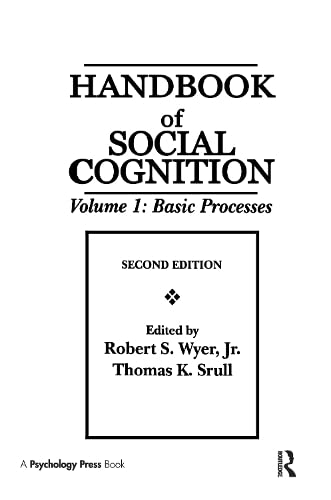
Handbook of Social Cognition, Vol. 1: Basic Processes, 2nd Edition,Used
Sold by Ergodebooks, an authorized reseller.
Returns accepted within 30 days | support@ergodebooks.com
Shipping Information
- Free Standard Shipping — United States only
- Processing Time: 3–5 business days
- Estimated Delivery: 6–10 business days after dispatch
- Double-boxed, fully insured & discreetly packaged
- Tracking number sent via email once dispatched
Returns & Refund
Returns accepted within 30 days of delivery.
Damaged or Defective Item
Free return shipping + replacement or full refund
Wrong Item Received
Free return shipping + replacement or full refund
Change of Mind
Return shipping at customer's expense · 25% restocking fee applies
Payment Option

This edition of the Handbook follows the first edition by 10 years. The earlier edition was a promissory note, presaging the directions in which the thenemerging field of social cognition was likely to move. The field was then in its infancy and the areas of research and theory that came to dominate the field during the next decade were only beginning to surface. The concepts and methods used had frequently been borrowed from cognitive psychology and had been applied to phenomena in a very limited number of areas. Nevertheless, social cognition promised to develop rapidly into an important area of psychological inquiry that would ultimately have an impact on not only several areas of psychology but other fields as well.The promises made by the earlier edition have generally been fulfilled. Since its publication, social cognition has become one of the most active areas of research in the entire field of psychology; its influence has extended to health and clinical psychology, and personality, as well as to political science, organizational behavior, and marketing and consumer behavior. The impact of social cognition theory and research within a very short period of time is incontrovertible. The present volumes provide a comprehensive and detailed review of the theoretical and empirical work that has been performed during these years, and of its implications for information processing in a wide variety of domains.The handbook is divided into two volumes. The first provides an overview of basic research and theory in social information processing, covering the automatic and controlled processing of information and its implications for how information is encoded and stored in memory, the mental representation of persons including oneself and events, the role of procedural knowledge in information processing, inference processes, and response processes. Special attention is given to the cognitive determinants and consequences of affect and emotion. The second book provides detailed discussions of the role of information processing in specific areas such as stereotyping; communication and persuasion; political judgment; close relationships; organizational, clinical and health psychology; and consumer behavior.The contributors are theorists and researchers who have themselves carried out important studies in the areas to which their chapters pertain. In combination, the contents of this twovolume set provide a sophisticated and indepth treatment of both theory and research in this major area of psychological inquiry and the directions in which it is likely to proceed in the future.
⚠️ WARNING (California Proposition 65):
This product may contain chemicals known to the State of California to cause cancer, birth defects, or other reproductive harm.
For more information, please visit www.P65Warnings.ca.gov.