If you have any questions, you are always welcome to contact us. We'll get back to you as soon as possible, withing 24 hours on weekdays.
Customer service
All questions about your order, return and delivery must be sent to our customer service team by e-mail at yourstore@yourdomain.com
Sale & Press
If you are interested in selling our products, need more information about our brand or wish to make a collaboration, please contact us at press@yourdomain.com
Help
If you have any questions, you are always welcome to contact us. We'll get back to you as soon as possible, withing 24 hours on weekdays.
Customer service
All questions about your order, return and delivery must be sent to our customer service team by e-mail at yourstore@yourdomain.com
Sale & Press
If you are interested in selling our products, need more information about our brand or wish to make a collaboration, please contact us at press@yourdomain.com
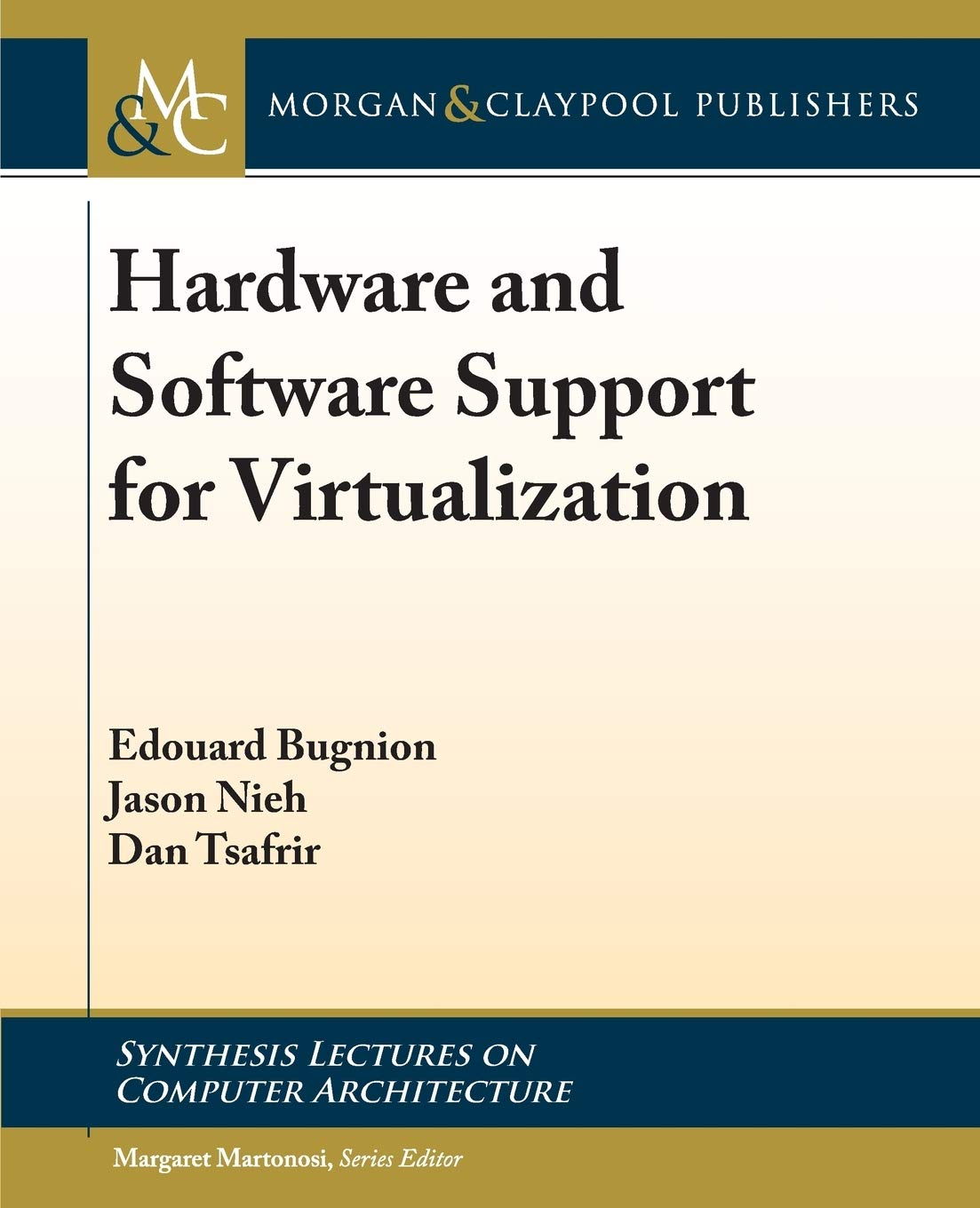
This book focuses on the core question of the necessary architectural support provided by hardware to efficiently run virtual machines, and of the corresponding design of the hypervisors that run them. Virtualization is still possible when the instruction set architecture lacks such support, but the hypervisor remains more complex and must rely on additional techniques.Despite the focus on architectural support in current architectures, some historical perspective is necessary to appropriately frame the problem. The first half of the book provides the historical perspective of the theoretical framework developed four decades ago by Popek and Goldberg. It also describes earlier systems that enabled virtualization despite the lack of architectural support in hardware.As is often the case, theory defines a necessarybut not sufficientset of features, and modern architectures are the result of the combination of the theoretical framework with insights derived from practical systems. The second half of the book describes stateoftheart support for virtualization in both x8664 and ARM processors. This book includes an indepth description of the CPU, memory, and I/O virtualization of these two processor architectures, as well as case studies on the Linux/KVM, VMware, and Xen hypervisors. It concludes with a performance comparison of virtualization on currentgeneration x86 and ARMbased systems across multiple hypervisors.
⚠️ WARNING (California Proposition 65):
This product may contain chemicals known to the State of California to cause cancer,
birth defects, or other reproductive harm.
For MAP (Minimum Advertised Price) violations and Intellectual Property (IP) or Trademark concerns, please contact:
support@ergodebooks.com
⚠️ California Proposition 65 Warning: Some products sold on this website may expose you to chemicals known to the State of California to cause cancer, birth defects, or other reproductive harm. For more information, visit www.P65Warnings.ca.gov.