
Title
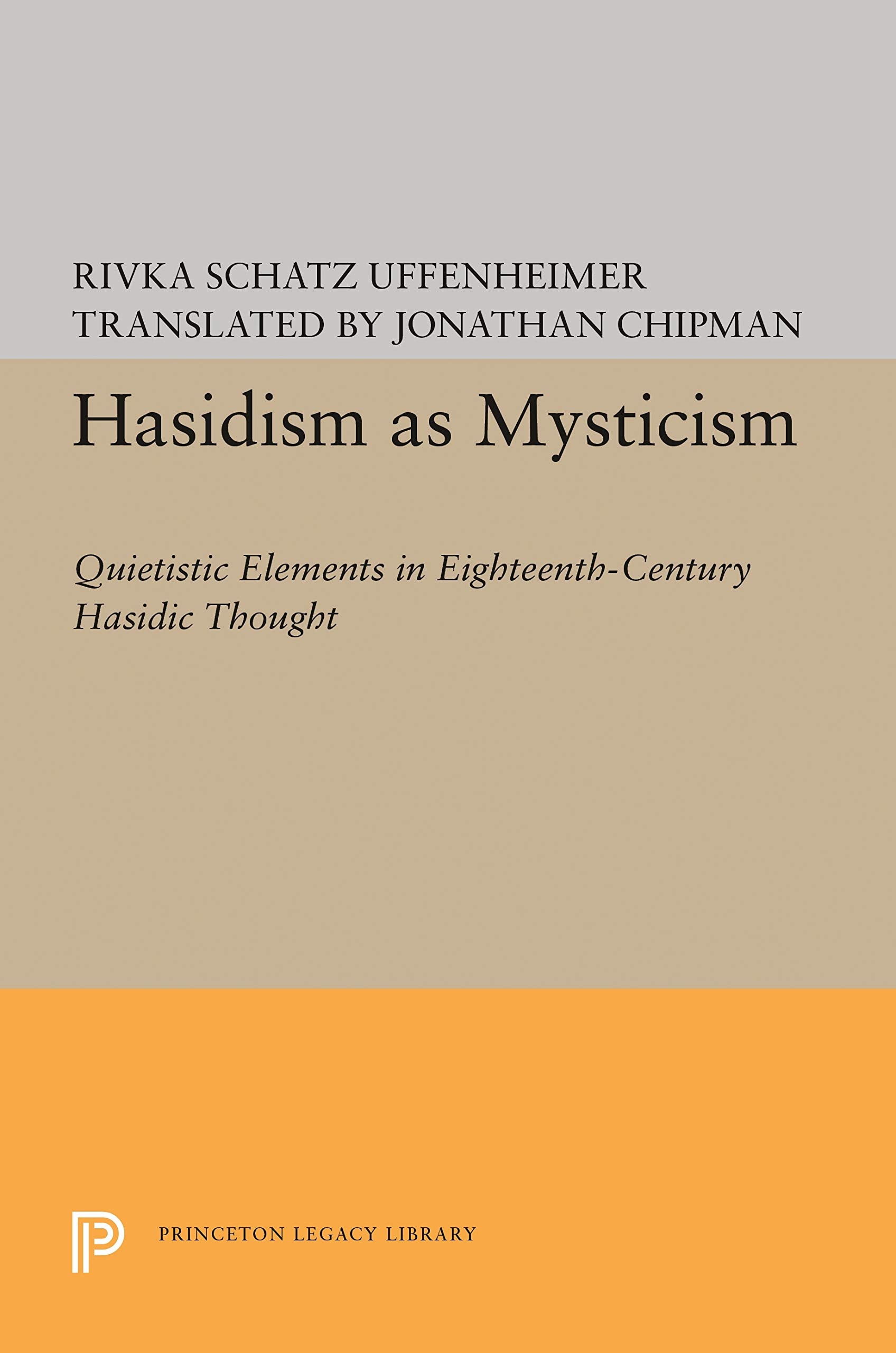
Hasidism as Mysticism: Quietistic Elements in EighteenthCentury Hasidic Thought (Princeton Legacy Library, 1748),Used
Sold by Ergodebooks, an authorized reseller.
Returns accepted within 30 days | support@ergodebooks.com
Shipping Information
- Free Standard Shipping — United States only
- Processing Time: 3–5 business days
- Estimated Delivery: 6–10 business days after dispatch
- Double-boxed, fully insured & discreetly packaged
- Tracking number sent via email once dispatched
Returns & Refund
Returns accepted within 30 days of delivery.
Damaged or Defective Item
Free return shipping + replacement or full refund
Wrong Item Received
Free return shipping + replacement or full refund
Change of Mind
Return shipping at customer's expense · 25% restocking fee applies
Payment Option

Offered here for the first time in English translation, Hasidism as Mysticism is a classic in its field. Using the tools of phenomenology, Rivka Schatz Uffenheimer places Hasidism squarely in the context of religious studies. Hasidism's theoretical texts have been largely ignored by historians of the movement, but Schatz Uffenheimer analyzes these materials fully, disclosing the mystical, quietistic tendencies that existed alongside Hasidism's more activist, popular elements. The author carefully reviewed this translation of her work; it includes a revised introduction with much new material, two new chapters, and an appendix containing a translation, history, and literary analysis of one of the few extant texts attributed to the Baal Shem Tov.Schatz Uffenheimer's inquiry covers the full gamut of Hasidic life and thought, embracing such topics as the emphasis on joy and the concomitant ban on sadness and regret in Hasidism, the focus on contemplative rather than petitionary prayer, the subordination of the mizvot (commandments) to the spiritualistic goal of devequt (attachment to God), and the anarchic elements of Hasidism's approach to life within society. Also discussed are the problematic role of Torah study resulting from this spiritualistic emphasis, the movement's neutralization or internalization of the traditional concept of a historical messiah, and the transformation within Hasidism of traditional concepts borrowed from Kabbalah. The author's illuminating hints as to the affinity between Hasidism and Christian Quietism should be of particular interest to scholars in the field.Rivka Schatz Uffenheimer (19271992) was the Edmonton Community Professor of Jewish Mysticism at the Hebrew University of Jerusalem. One of the outstanding students of Gershom Scholem, she forged her own path in the world of scholarship. Her research encompassed a wide range of areas: Zohar and Lurianic Kabbalah, Sabbatianism, Hasidism, and the typology of Jewish messianism. In addition, she was deeply involved in the ongoing discussion concerning the major spiritual and existential issues confronting contemporary Judaism and the State of Israel.Originally published in 1993.The Princeton Legacy Library uses the latest printondemand technology to again make available previously outofprint books from the distinguished backlist of Princeton University Press. These editions preserve the original texts of these important books while presenting them in durable paperback and hardcover editions. The goal of the Princeton Legacy Library is to vastly increase access to the rich scholarly heritage found in the thousands of books published by Princeton University Press since its founding in 1905.
⚠️ WARNING (California Proposition 65):
This product may contain chemicals known to the State of California to cause cancer, birth defects, or other reproductive harm.
For more information, please visit www.P65Warnings.ca.gov.
- Q: What is the binding type of this book? A: The binding type of this book is hardcover. This ensures durability and makes it suitable for long-term use.
- Q: How many pages does this book have? A: This book contains four hundred pages. This length provides an in-depth exploration of Hasidism as mysticism.
- Q: What are the dimensions of this book? A: The dimensions of this book are nine point seven six inches by seven point two five inches by one point two six inches. These measurements make it a manageable size for reading.
- Q: Who is the author of this book? A: The author of this book is Rivka Schatz Uffenheimer. She was a notable scholar in Jewish mysticism.
- Q: What genre does this book belong to? A: This book belongs to the genre of Monasticism and Asceticism. It focuses on religious studies and mysticism.
- Q: How do I read this book? A: You can read this book like any standard hardcover book. The content is rich and meant for those interested in religious studies.
- Q: Is this book suitable for beginners in religious studies? A: Yes, this book can be suitable for beginners, but some prior knowledge of Jewish mysticism may enhance understanding. It offers a comprehensive analysis of Hasidism.
- Q: What themes are covered in this book? A: This book covers themes such as joy in Hasidism, contemplative prayer, and the spiritualistic goals of the movement. It provides a deep dive into Hasidic thought.
- Q: How should I store this book to keep it in good condition? A: Store this book in a cool, dry place away from direct sunlight. Keeping it on a bookshelf will also help maintain its condition.
- Q: Is this book safe for all readers? A: Yes, this book is safe for all readers interested in religious studies. It has no adult content.
- Q: Can I return this book if I am not satisfied? A: Yes, you can typically return this book if you are not satisfied, depending on the retailer's return policy. Always check the specific terms before purchasing.
- Q: What if the book arrives damaged? A: If the book arrives damaged, contact the retailer immediately for a replacement or refund. Most sellers have policies in place for such issues.
- Q: Are there any special care instructions for this book? A: No special care instructions are needed for this book besides standard handling. Avoid bending the cover or pages to maintain its integrity.
- Q: Is this book well-reviewed by scholars? A: Yes, this book is well-reviewed by scholars in the field of religious studies. It is recognized as an important contribution to the understanding of Hasidism.
- Q: What makes this book a valuable addition to scholarly collections? A: This book is a valuable addition due to its in-depth analysis and translation of previously untranslated texts. It expands access to important scholarly heritage.
- Q: Does this book include any additional materials? A: Yes, this book includes a revised introduction, two new chapters, and an appendix with translations and analyses. These additions enhance its scholarly value.