
Title
Haskalah and Hasidism in the Kingdom of Poland: A History of Conflict (The Littman Library of Jewish Civilization),Used
Sold by Ergodebooks, an authorized reseller.
Returns accepted within 30 days | support@ergodebooks.com
Shipping Information
- Free Standard Shipping — United States only
- Processing Time: 3–5 business days
- Estimated Delivery: 6–10 business days after dispatch
- Double-boxed, fully insured & discreetly packaged
- Tracking number sent via email once dispatched
Returns & Refund
Returns accepted within 30 days of delivery.
Damaged or Defective Item
Free return shipping + replacement or full refund
Wrong Item Received
Free return shipping + replacement or full refund
Change of Mind
Return shipping at customer's expense · 25% restocking fee applies
Payment Option

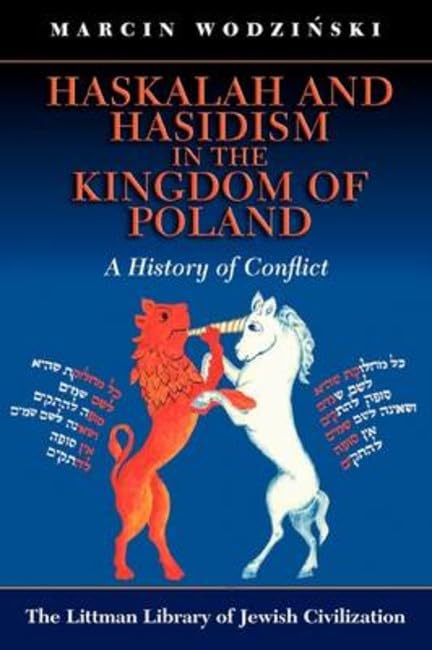
The conflict between Haskalah and hasidism was one of the most important forces in shaping the world of Polish Jewry for almost two centuries, but our understanding of it has long been dominated by theories based on stereotypes rather than detailed analysis of the available sources. In this awardwinning study, Marcin Wodzinski challenges the longestablished theories about the conflict by contextualizing it, principally in the Kingdom of Poland but also with regard to other parts of eastern Europe. Covering the period from the earliest antihasidic polemics in the late eighteenth century through to the postHaskalah movements of the twentieth century, it follows the development of this important conflict in its central arena.Using source materials (including many hitherto unknown documents) in Polish and five other languages, Wodzinski has succeeded in reconstructing the way the conflict expressed itself. Identifying the motives, the methods, and the consequences of the conflict as it was played out in five Polish towns (Ldz, Opoczno, Piotrkw, Warsaw, and Warta), he shows that it was primarily informed by nonideological clashes at the level of local communities rather than by highlevel ideological debates.Much attention is also devoted to the general characteristics of hasidism and the Haskalah, as well as to the postHaskalah movements. Here too Wodzinski challenges the ideologically charged assumptions of a generation of historians who refused to see the advocates of Jewish modernity in nineteenthcentury Poland as an integral part of the Haskalah movement. Extensive consideration is given to the professional, social, institutional, and ideological characteristics of the Polish Haskalah as well as to its geographic extent, and to the changes the movement underwent in the course of the nineteenth century. Similar attention is given to the influence of the specific characteristics of Polish hasidism on the shape of the conflict, especially as regard the size of the movement and the evolution of hasidic communal involvement. In consequence the book presents a synthesis that offers both breadth and depth, contextualizing its subject matter within the broader domains of the European Enlightenment and Polish culture, hasidism and rabbinic culture, tsarist policy and Polish history, not to mention the ins and outs of the Haskalah itself across Europe.An extensive appendix presents translations of nineteen important and hitherto unknown sources of relevance to a nuanced understanding of many aspects of nineteenthcentury Jewish history in Poland and eastern Europe more generally.
⚠️ WARNING (California Proposition 65):
This product may contain chemicals known to the State of California to cause cancer, birth defects, or other reproductive harm.
For more information, please visit www.P65Warnings.ca.gov.