
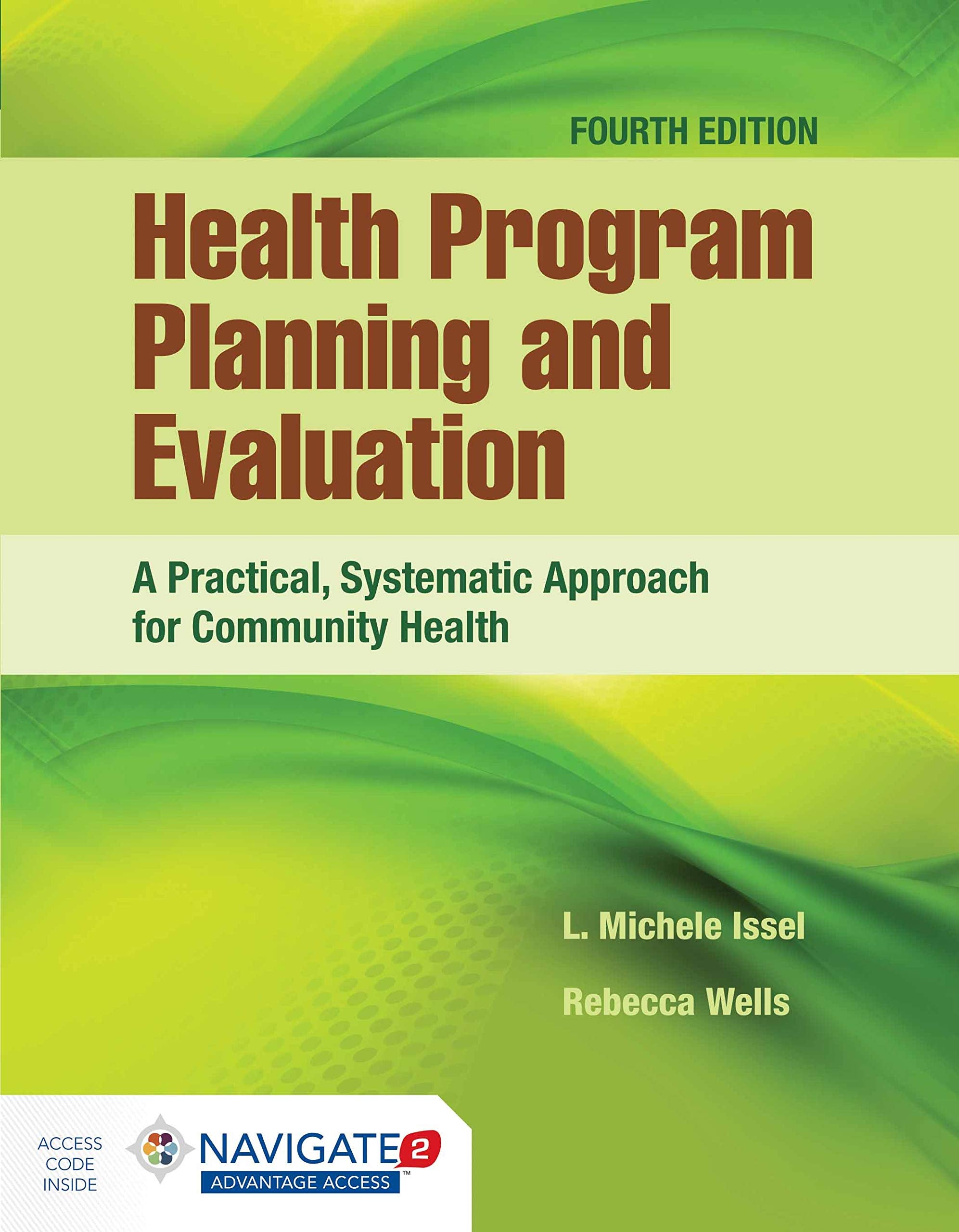
Title
Health Program Planning and Evaluation: A Practical, Systematic Approach for Community Health: A Practical, Systematic Approach ,Used
Sold by Ergodebooks, an authorized reseller.
Returns accepted within 30 days | support@ergodebooks.com
Shipping Information
- Free Standard Shipping — United States only
- Processing Time: 3–5 business days
- Estimated Delivery: 6–10 business days after dispatch
- Double-boxed, fully insured & discreetly packaged
- Tracking number sent via email once dispatched
Returns & Refund
Returns accepted within 30 days of delivery.
Damaged or Defective Item
Free return shipping + replacement or full refund
Wrong Item Received
Free return shipping + replacement or full refund
Change of Mind
Return shipping at customer's expense · 25% restocking fee applies
Payment Option

Selected by Doody's Review Services as one of Doody's Core Titles in Public Health, Health Program Planning and Evaluation, Fourth Edition carefully walks the reader through the process for developing, implementing, and evaluating successful community health promotion programs. Featuring readerfriendly, accessible language and practical tools and concepts, this outstanding resource prepares students and professionals to become savvy consumers of evaluation reports and prudent users of evaluation consultants. The Fourth Edition reflects the major changes in the field of community health with updated examples and references throughout. New to this Edition: Introduction of the concept of root causes as social determinants. A comprehensive description of how each target setting option relates to the corresponding level of the health impact pyramid. More information on informatics and big data as related to program planning and monitoring A discussion of photos and video as modes of data collection. A reinforcement of informatics, photos and big data as useful in program evaluation Current terminology of first and second order coding of qualitative data. The following is a list of chapter specific major, substantive revisions evident in the 4th edition, beyond general updating of references: Combined Chapters 3 and 4 in order to tighten and shorten the content. Only currently used planning tools will be presented, and greater content on workforce planning will be added. We will increase the emphasis assetbased and strengths based approaches to assessment and planning. We will also discuss the relevance of the ACA to community assessment. Chapter 4: Introduce the concept of root causes as social determinants. Chapter 8: Provide a strong description of how each target setting option relates to the corresponding level of the health impact pyramid. Move Chapter 9 into Section III Health Program Development, and revise wording to reflect that the information is part of the development phase. Chapter 10: increase the content on informatics and big data as related to program planning and monitoring. Revise the exhibit to show the budge on an excel sheet. Chapter 11: include discussion of photos and video as modes of data collection. Chapter 15: reinforce informatics, photos and big data as useful in program evaluation Chapter 16: revise to reflect current terminology of first and second order coding of qualitative data. We will also frame case study as a mixed method rather than a strictly qualitative method
⚠️ WARNING (California Proposition 65):
This product may contain chemicals known to the State of California to cause cancer, birth defects, or other reproductive harm.
For more information, please visit www.P65Warnings.ca.gov.
- Q: How many pages does this book have? A: This book has four hundred twenty-eight pages. It's a comprehensive resource for planning and evaluating health programs.
- Q: What is the binding type of this book? A: The binding type is paperback. This makes it lightweight and easy to handle for reading or carrying.
- Q: What are the dimensions of the book? A: The dimensions are seven point zero one inches in length, one inch in width, and nine point zero two inches in height. These dimensions make it a convenient size for both reading and storage.
- Q: Who is the author of this book? A: The author is L. Michele Issel. She provides valuable insights into community health planning and evaluation.
- Q: What is the main topic covered in this book? A: The main topic is health program planning and evaluation. It focuses on a systematic approach tailored for community health.
- Q: Is this book suitable for beginners? A: Yes, this book is suitable for beginners. It provides practical guidance that is easy to understand for those new to community health.
- Q: What age group is this book intended for? A: This book is intended for adults, particularly those involved in health program planning. It is not specifically aimed at children.
- Q: How can I apply the concepts from this book? A: You can apply the concepts by following the systematic approach outlined in the text. It guides you through planning and evaluating health programs effectively.
- Q: Is there a specific reading level recommended for this book? A: This book is recommended for a college-level reading audience. It contains terminology and concepts suitable for health professionals.
- Q: How do I care for this paperback book? A: To care for this book, keep it in a dry place and avoid exposure to direct sunlight. This will help maintain its condition over time.
- Q: Can I store this book with other books? A: Yes, you can store this book with other books. Ensure it is placed upright on a shelf to prevent bending or damage.
- Q: Is this book safe for children to read? A: No, this book is not specifically designed for children. It discusses advanced topics in health that may not be suitable for younger audiences.
- Q: What if I receive a damaged book? A: If you receive a damaged book, you should contact the seller for return instructions. Most sellers offer a return policy for damaged items.
- Q: Can I return this book if I change my mind? A: Yes, you can usually return this book if you change your mind, depending on the seller's return policy. Check their terms for details.
- Q: Are there any online resources that complement this book? A: Yes, there are various online resources that complement this book. Look for websites related to community health for additional materials and support.