
Title
Heat Transfer (Oxford Chemistry Primers),Used
Sold by Ergodebooks, an authorized reseller.
Returns accepted within 30 days | support@ergodebooks.com
Shipping Information
- Free Standard Shipping — United States only
- Processing Time: 3–5 business days
- Estimated Delivery: 6–10 business days after dispatch
- Double-boxed, fully insured & discreetly packaged
- Tracking number sent via email once dispatched
Returns & Refund
Returns accepted within 30 days of delivery.
Damaged or Defective Item
Free return shipping + replacement or full refund
Wrong Item Received
Free return shipping + replacement or full refund
Change of Mind
Return shipping at customer's expense · 25% restocking fee applies
Payment Option

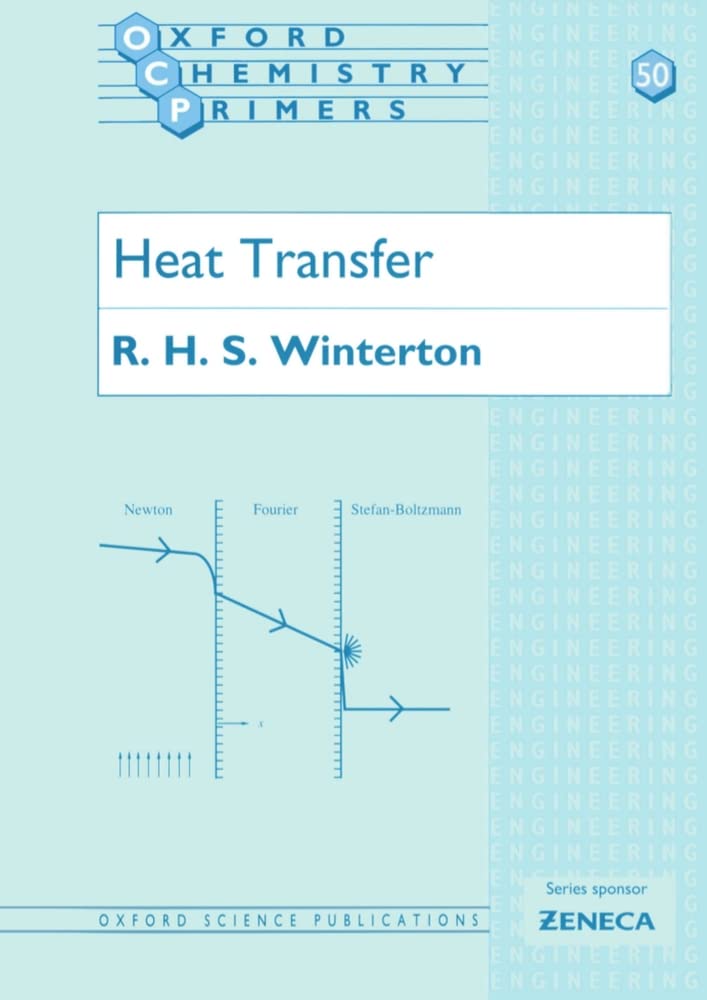
This primer follows a classical approach to the study of heat transfer with main chapters on conduction, forced convection, natural convection and radiation. Practical problems, however, do not normally divide neatly into purely conduction problems, purely forced convection and so on, although texts often assume this. To overcome this barrier, the author demonstrates in examples and problems that more than one aspect of heat transfer may be needed to solve a single practical problem. The book covers the essential material of a text twice its length, making it easier for the reader to find and understand key principles. It will be of particular interest to undergraduate students in engineering, especially in mechanical and chemical engineering, and to professional engineers working on heat transfer.
⚠️ WARNING (California Proposition 65):
This product may contain chemicals known to the State of California to cause cancer, birth defects, or other reproductive harm.
For more information, please visit www.P65Warnings.ca.gov.
- Q: What is the main focus of 'Heat Transfer (Oxford Chemistry Primers)'? A: The book primarily focuses on the classical study of heat transfer, covering key topics such as conduction, forced convection, natural convection, and radiation.
- Q: Who is the author of this book? A: The author of 'Heat Transfer (Oxford Chemistry Primers)' is R. H. S. Winterton.
- Q: What is the condition of the book? A: The book is listed as 'New', indicating it has not been previously owned or used.
- Q: How many pages does the book contain? A: The book contains a total of 92 pages.
- Q: Is this book suitable for undergraduate students? A: Yes, this book is particularly suitable for undergraduate students in engineering, especially those studying mechanical and chemical engineering.
- Q: What type of binding does this book have? A: This book is available in paperback binding.
- Q: When was 'Heat Transfer (Oxford Chemistry Primers)' published? A: The book was published on October 2, 1997.
- Q: What makes this book different from other heat transfer texts? A: This book addresses the integration of multiple aspects of heat transfer to solve practical problems, rather than treating topics in isolation, which is often the case in other texts.
- Q: Can this book be useful for professional engineers? A: Yes, it is also beneficial for professional engineers working in the field of heat transfer.
- Q: What is the primary benefit of this primer? A: The primary benefit of this primer is that it covers essential material in a concise format, making it easier for readers to grasp key principles of heat transfer.