
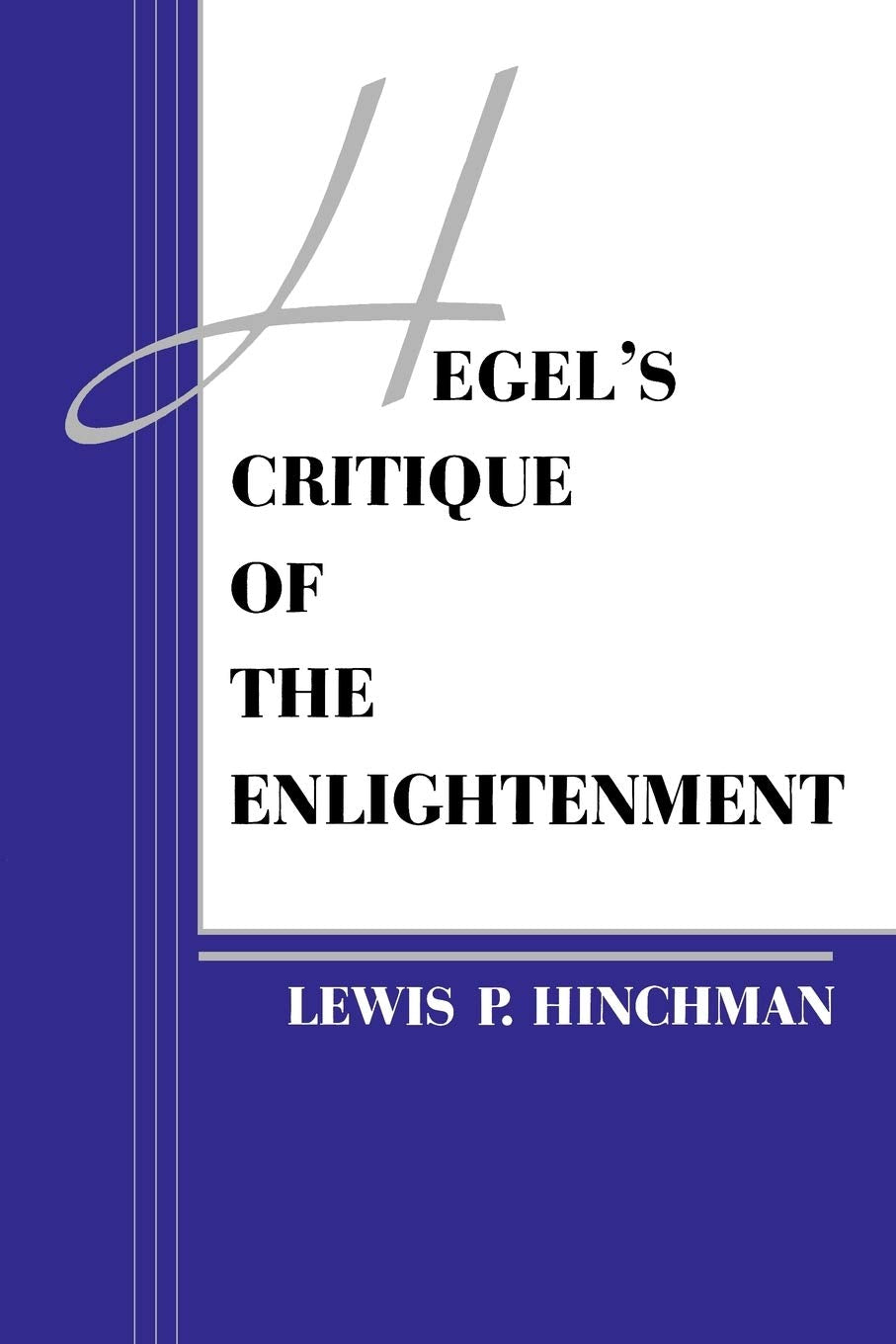
Title
Hegel'S Critique Of The Enlightenment,Used
Sold by Ergodebooks, an authorized reseller.
Returns accepted within 30 days | support@ergodebooks.com
Shipping Information
- Free Standard Shipping — United States only
- Processing Time: 3–5 business days
- Estimated Delivery: 6–10 business days after dispatch
- Double-boxed, fully insured & discreetly packaged
- Tracking number sent via email once dispatched
Returns & Refund
Returns accepted within 30 days of delivery.
Damaged or Defective Item
Free return shipping + replacement or full refund
Wrong Item Received
Free return shipping + replacement or full refund
Change of Mind
Return shipping at customer's expense · 25% restocking fee applies
Payment Option

The Enlightenment has turned different faces to those who have sought to demonstrate its significance for contemporary politics and philosophy. Some would call it the seedbed of all that is best in modern Western civilization: human rights, toleration, popular sovereignty, and the idea of progress. Others have glimpsed a darker side, stressing its celebration of instrumental reason, mechanistic determinism, hostility to religion, and political atomism.Lewis Hinchman discerns in Hegel the first major philosopher to have appreciated the ambiguous nature of the Enlightenment and to have undertaken a systematic inquiry into its origins and sociopolitical implications. Hinchman is sympathetic toward Hegels philosophical approach, seeing in it anticipations of (even improvements on) influential nineteenth and twentiethcentury critiques on empiricism and liberalism. On the other hand, he does take Hegel to task in cases where Hegel appears to stray from his own program and principles (most notably in the philosophy of right).Hinchmans approach to Hegel will appeal to a wide range of readers, including political scientists, intellectual historians, and students of comparative and nineteenthcentury German literature, as well as philosophers interested in the history of their own discipline. He brings together for comparison texts and passages that are frequently studied in isolation from each other by scholars in diverse fields.The burden of Hinchmans argument falls upon his reconstruction of Hegels concept of the self. He shows how Hegel partly adopts ideas of the self that were longstanding among Enlightenment philosophers such as Descartes, Kant, and Fichte, and partly develops a novel conception in response to inadequacies in his predecessors theories. Hinchman contends that Hegel is the first philosopher to work out a truly nonsubstantialist idea of the self, one that does not reify this most elusive of human activities. He then demonstrates that implications of this conception of the self when one applies it as Hegel did to a critique of the Enlightenments epistemology and sociopolitical practice.
⚠️ WARNING (California Proposition 65):
This product may contain chemicals known to the State of California to cause cancer, birth defects, or other reproductive harm.
For more information, please visit www.P65Warnings.ca.gov.