
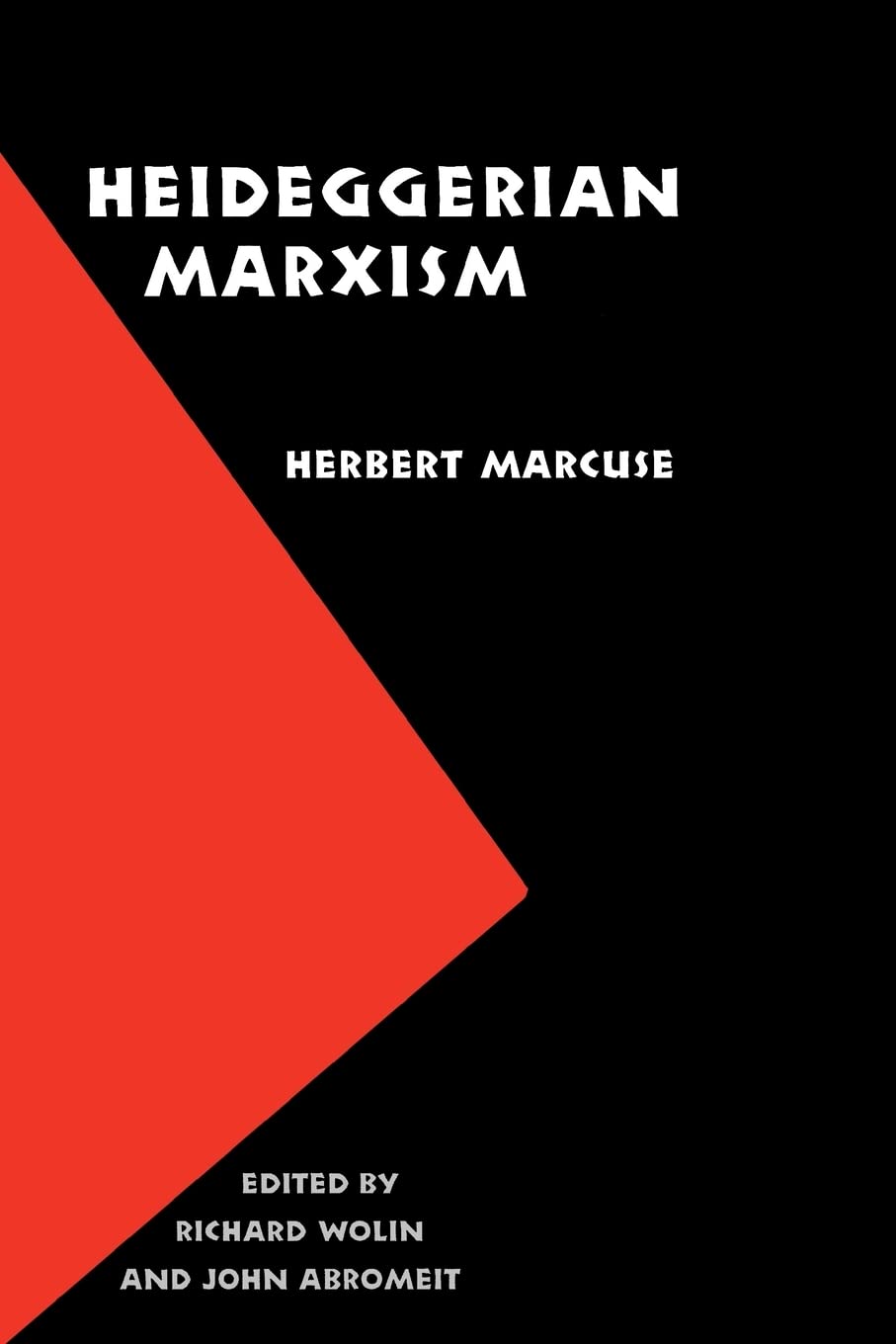
Title
Heideggerian Marxism (European Horizons),Used
Sold by Ergodebooks, an authorized reseller.
Returns accepted within 30 days | support@ergodebooks.com
Shipping Information
- Free Standard Shipping — United States only
- Processing Time: 3–5 business days
- Estimated Delivery: 6–10 business days after dispatch
- Double-boxed, fully insured & discreetly packaged
- Tracking number sent via email once dispatched
Returns & Refund
Returns accepted within 30 days of delivery.
Damaged or Defective Item
Free return shipping + replacement or full refund
Wrong Item Received
Free return shipping + replacement or full refund
Change of Mind
Return shipping at customer's expense · 25% restocking fee applies
Payment Option

The Frankfurt School philosopher Herbert Marcuse (18981979) studied with Martin Heidegger at Freiburg University from 1928 to 1932 and completed a dissertation on Hegels theory of historicity under Heideggers supervision. During these years, Marcuse wrote a number of provocative philosophical essays experimenting with the possibilities of Heideggerian Marxism. For a time he believed that Heideggers ideas could revitalize Marxism, providing a dimension of experiential concreteness that was sorely lacking in the German Idealist tradition. Ultimately, two events deterred Marcuse from completing this program: the 1932 publication of Marxs early economic and philosophical manuscripts, and Heideggers conversion to Nazism a year later. Heideggerian Marxism offers rich and fascinating testimony concerning the first attempt to fuse Marxism and existentialism.These essays offer invaluable insight concerning Marcuses early philosophical evolution. They document one of the centurys most important Marxist philosophers attempting to respond to the crisis of Marxism: the failure of the European revolution coupled with the growing repression in the USSR. In response, Marcuse contrived an imaginative and original theoretical synthesis: existential Marxism.
⚠️ WARNING (California Proposition 65):
This product may contain chemicals known to the State of California to cause cancer, birth defects, or other reproductive harm.
For more information, please visit www.P65Warnings.ca.gov.
- Q: What is the page count of 'Heideggerian Marxism'? A: The book has two hundred sixty-four pages. This length allows for an in-depth exploration of Herbert Marcuse's philosophical essays.
- Q: What is the binding type of this book? A: The book is paperback. This makes it lightweight and easy to handle, ideal for reading on the go.
- Q: What are the dimensions of 'Heideggerian Marxism'? A: The dimensions of the book are six point two six inches in length, zero point seven five inches in width, and nine point two five inches in height.
- Q: Who is the author of this book? A: The author is Herbert Marcuse. He is known for his influential work in philosophy and critical theory.
- Q: What is the main theme of 'Heideggerian Marxism'? A: The main theme explores the fusion of Marxism and existentialism. It documents Marcuse's philosophical evolution during a critical time in Europe.
- Q: What category does this book fall under? A: This book falls under the category of Existentialism. It delves into philosophical ideas that challenge traditional Marxist thought.
- Q: How should I care for 'Heideggerian Marxism'? A: To keep the book in good condition, store it in a cool, dry place and avoid exposure to direct sunlight. Handle it gently to prevent creasing.
- Q: Is this book suitable for beginners in philosophy? A: Yes, it can be suitable for beginners. However, readers should have some basic understanding of Marxism and existentialism for better comprehension.
- Q: What should I do if my book arrives damaged? A: If your book arrives damaged, you should contact the seller's customer support for assistance with returns or exchanges.
- Q: Is 'Heideggerian Marxism' a good choice for academic study? A: Yes, it is an excellent choice for academic study. The book provides valuable insights into critical theories that are essential for philosophy courses.
- Q: What is the condition of the book being sold? A: The book is classified as a used book in good condition. This means it may show some signs of wear but is still readable.
- Q: Can I find similar themes in other books? A: Yes, you can find similar themes in other existential and Marxist literature. Works by authors like Jean-Paul Sartre and Theodor Adorno may be of interest.
- Q: How do I read 'Heideggerian Marxism' effectively? A: To read the book effectively, take notes on key concepts and themes. Engaging with the text critically can enhance understanding.
- Q: Is there a warranty on this book? A: Typically, used books do not come with a warranty. Check the seller's policies for return or exchange options.
- Q: What topics does Marcuse address in his essays? A: Marcuse addresses topics such as the crisis of Marxism and the integration of existentialist thought. His essays reflect on the socio-political climate of his time.